
A simple circuit contains a 12 V battery and a bulb having 24-ohm resistance. When you turn on the switch, the ammeter connected to the circuit would read
0.5 A
Understanding Simple Circuits and Current
A simple circuit typically consists of a voltage source (like a battery), a load (like a bulb or resistor), and connecting wires. When the circuit is complete and the switch is turned on, electric current flows through it. The question describes such a circuit with a 12 V battery and a bulb acting as a resistor with 24 ohms of resistance. We need to find out the amount of current flowing through this circuit, which is what an ammeter connected in series would measure.
Applying Ohm's Law to Find Current
The relationship between voltage, current, and resistance in a simple DC circuit is described by Ohm's Law. This fundamental law states that the current flowing through a conductor between two points is directly proportional to the voltage across the two points and inversely proportional to the resistance between them.
Mathematically, Ohm's Law is expressed as:
Where:
- \(V\) is the voltage across the circuit element (measured in volts, V).
- \(I\) is the current flowing through the circuit element (measured in amperes, A).
- \(R\) is the resistance of the circuit element (measured in ohms, \(\Omega\)).
To find the current (\(I\)) when the voltage (\(V\)) and resistance (\(R\)) are known, we can rearrange the formula:
Calculating the Circuit Current
In this specific problem, we are given the following values:
- Voltage of the battery, \(V = 12 \text{ V}\).
- Resistance of the bulb, \(R = 24 \ \Omega\).
Now, we can plug these values into the rearranged Ohm's Law formula to calculate the current (\(I\)):
Therefore, the ammeter connected in the circuit would read 0.5 amperes.
Comparing with Options
Let's look at the given options and compare them with our calculated value:
| Option | Value | Comparison |
|---|---|---|
| 1 | 0.5 A | Matches our calculated current. |
| 2 | 2 A | Does not match. |
| 3 | 4 A | Does not match. |
| 4 | 5 A | Does not match. |
Our calculation shows that the current is 0.5 A, which corresponds to Option 1.
Revision Table: Ohm's Law Summary
| Quantity | Symbol | Unit | Formula (from V=IR) |
|---|---|---|---|
| Voltage | V | Volts (V) | \(V = I \times R\) |
| Current | I | Amperes (A) | \(I = \frac{V}{R}\) |
| Resistance | R | Ohms (\(\Omega\)) | \(R = \frac{V}{I}\) |
Additional Information on Circuit Components
- Battery (Voltage Source): Provides the potential difference or voltage that pushes the electric charge (current) through the circuit. In this case, it's a 12 V battery.
- Bulb (Resistor): A component that opposes the flow of current, converting electrical energy into light and heat. This opposition is called resistance, measured in ohms. The bulb here has a resistance of 24 \(\Omega\).
- Ammeter: An instrument used to measure the electric current flowing through a point in a circuit. Ammeters are always connected in series with the component through which the current is to be measured. A series connection means the current flows through the ammeter just as it flows through the other components.
- Switch: A device used to make or break the circuit connection, controlling the flow of current. Turning the switch on completes the circuit, allowing current to flow.
- Simple Circuit: A basic electrical circuit containing a voltage source, a load, and connecting wires, usually with a switch.
Understanding how these components interact and applying fundamental laws like Ohm's Law is crucial for analyzing simple circuits.
Similar Questions
The graphs between current (I) and voltage (V) for three linear resistors 1, 2 and 3 are given below:
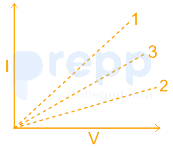
If R 1, R 2and R 3are the resistances of these resistors, then which one of the following is correct?
An electric circuit is given below. V1 = 1V and Resistance R=1000 Ω.
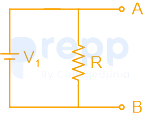
The current through the resistance R is very close to 1 mA and the voltage across point A and B, VAB = 1V. Now the circuit is changed to:
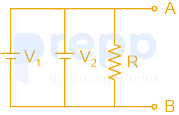
where value of V2 = 5V. The internal resistances of both the batteries are 0.1Ω . The current through the resistance R is about:
Which one of the following statements regarding Ohm's law is not correct?
Which one of the following devices is non-ohmic?
Important Questions from Ohm’s Law
Three resistors having resistances in the ratio 1 : 2 : 3 are in parallel. The current through the resistors are in the ratio
Which of the law states that in any closed circuit the current is directly proportional to the voltage, provided the physical conditions of the circuit are kept constant?
According to Ohm’s law, if current (I) increases and potential difference (V) remains constant, then:
Fill in the blank with the most appropriate option.
18 volts = _________ × 3 ohms.
- ______ states that the electric current flowing through a metallic wire is directly proportional to the potential difference ‘V’ across its ends provided its temperature remains the same.



