
The graphs between current (I) and voltage (V) for three linear resistors 1, 2 and 3 are given below: If R 1, R 2and R 3are the resistances of these resistors, then which one of the following is correct?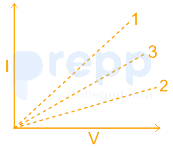
R 1< R 3< R 2
CONCEPT:
- Ohm’s law: At constant temperature , the potential difference across a current carrying wire is directly proportional to current flowing through it .
- V = IR
Where V is the potential difference , R is resistance and I is current .
EXPLANATION:
We have graph between Current (I) and potential difference (V):
As V = IR
So I = V/R
The above relation of I and R is a straight line equation in which 1/R gives the slope of the line .
Slope of graph = 1/R
From the given graph in the question, as slope of graph 1 is maximum and then it is of graph 3 and slope of graph 2 is minimum .
∴ Slope of graph 1 > slope of graph 3 > slope of graph 2
So 1/R 1> 1/R 3> 1/R 2
Hence R2 > R 3> R 1Similar Questions
An electric circuit is given below. V1 = 1V and Resistance R=1000 Ω.
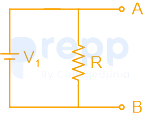
The current through the resistance R is very close to 1 mA and the voltage across point A and B, VAB = 1V. Now the circuit is changed to:
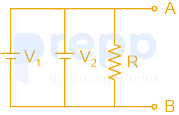
where value of V2 = 5V. The internal resistances of both the batteries are 0.1Ω . The current through the resistance R is about:
A simple circuit contains a 12 V battery and a bulb having 24-ohm resistance. When you turn on the switch, the ammeter connected to the circuit would read
Which one of the following statements regarding Ohm's law is not correct?
Which one of the following devices is non-ohmic?
Important Questions from Ohm’s Law
Three resistors having resistances in the ratio 1 : 2 : 3 are in parallel. The current through the resistors are in the ratio
Which of the law states that in any closed circuit the current is directly proportional to the voltage, provided the physical conditions of the circuit are kept constant?
According to Ohm’s law, if current (I) increases and potential difference (V) remains constant, then:
Fill in the blank with the most appropriate option.
18 volts = _________ × 3 ohms.
- ______ states that the electric current flowing through a metallic wire is directly proportional to the potential difference ‘V’ across its ends provided its temperature remains the same.



