
Read the following passage and answer the items that follow the passage. Your answers to these items should be based on the passage only. In our country, regrettably, teaching and learning for the examination have been our forte but the new demands of society and the future of work require critical and independent thinking, learning through doing, asking questions from multiple disciplinary perspectives on the same issue, using evidence for building arguments, and reflecting and articulation. Higher education should not “either be a mere servant of the government policy or a passive respondent to public mood.” Higher learning is all about how to think rather than what to think. Teaching has to be re-invented.
Which one of the following statements best reflects the central idea conveyed by the passage?
Classroom needs to be reimagined and teaching needs to be re-invented.
Analyzing the Passage on Higher Education
The passage discusses the current state of education in the country, highlighting that the focus has historically been on teaching and learning primarily for examinations. However, it emphasizes that modern society and the future job market require different skills. These include:
- Critical and independent thinking
- Learning through doing
- Asking questions from multiple disciplines
- Using evidence to build arguments
- Reflecting and articulating ideas
The passage also states that higher education should not merely serve government policy or react passively to public mood. Its true purpose, according to the text, is to teach students how to think, not just what to think. Based on this, the passage concludes that teaching has to be re-invented.
Understanding the Central Idea Question
The question asks for the single statement that best captures the main point or core message conveyed by the entire passage. This requires evaluating each option against the overall theme and specific arguments presented in the text.
Evaluating the Options
Let's examine each option in the context of the passage:
- India does not have enough resources for promoting quality education in its universities.
The passage does not mention a lack of resources. It focuses entirely on the pedagogical approach and the required skills for the future workforce. Therefore, this statement is not supported by the passage and does not reflect its central idea.
- The institutions of higher learning in the country should not be under the control of the Government.
The passage does state that higher education should not be a "mere servant of the government policy or a passive respondent to public mood." This suggests a need for independence in pursuing its true purpose. However, the core argument isn't about administrative control but about the fundamental shift needed in teaching and learning methods and goals. Independence from government/public mood is presented as a condition that enables higher learning to focus on how to think, which is part of the broader call for re-invention.
- Classroom approach to higher education should be done away with.
The passage argues for re-inventing teaching and changing the focus of learning. It does not suggest eliminating classrooms or the classroom approach entirely. Re-invention implies a transformation of the existing structure and methods, not their abolition.
- Classroom needs to be reimagined and teaching needs to be re-invented.
This option directly aligns with the passage's main arguments. The passage calls for teaching to be "re-invented" to move away from exam-focused learning towards developing critical thinking, learning by doing, etc. This necessary re-invention of teaching naturally implies a need to reimagine the environment and methods used in the classroom setting to facilitate these new approaches and skill developments.
Identifying the Central Idea of the Passage
The central idea is the urgent need to transform the teaching and learning approach in higher education. The traditional method, focused on exams, is outdated. The new approach must cultivate critical thinking and practical skills, focusing on how to think. This fundamental change requires teaching methods to be re-invented, which directly impacts how learning happens, particularly in the classroom.
Concluding the Best Option
Based on the analysis, the statement that best reflects the central idea conveyed by the passage is that the classroom needs to be reimagined and teaching needs to be re-invented. This encompasses the shift in focus from rote learning for exams to developing critical thinking and practical skills, which necessitates a fundamental change in educational methods and environments as explicitly called for in the passage.
Revision Table: Key Concepts
| Current Approach | Required Approach (Future Ready) |
|---|---|
| Teaching/Learning for examination | Critical and independent thinking |
| What to think (rote learning) | How to think (analytical skills) |
| Passive learning | Learning through doing |
| Single perspective | Multiple disciplinary perspectives |
| Arguments without basis | Using evidence for arguments |
| — | Reflecting and articulation |
Additional Information: Transforming Higher Education
The passage highlights key aspects of transforming higher education to meet future demands. This transformation goes beyond just updating syllabi; it involves a fundamental shift in pedagogy and institutional philosophy. Here are some related concepts:
- Critical Thinking: This involves analyzing information objectively and making reasoned judgments. It's crucial for solving complex problems in the modern world.
- Pedagogical Innovation: This refers to introducing new methods of teaching and learning that are more engaging, effective, and relevant than traditional methods. Project-based learning, inquiry-based learning, and flipped classrooms are examples.
- Interdisciplinary Learning: Approaching issues from multiple subject perspectives helps students see connections and understand complexity, moving away from siloed knowledge.
- Evidence-Based Reasoning: Teaching students to base their arguments and conclusions on reliable evidence is fundamental to academic integrity and effective problem-solving.
- Role of Higher Education: Beyond job preparation, higher education is ideally about fostering intellectual growth, civic responsibility, and the capacity for lifelong learning, empowering individuals to think independently and contribute meaningfully to society.
Similar Questions
Which one of the following statements best reflects the most logical and rational message conveyed by the author of the passage?
With reference to the above passage, the following assumptions have been made:
I. There is no need for the State to be involved in any manner in the handloom sector.
II. Handloom products are no longer appealing and attractive in the rapidly changing modern world.
Which of the above assumptions is/are valid?Which one of the following statements best reflects the central idea conveyed by the passage?
Which one of the following statements best reflects the central idea conveyed by the passage?
Which one of the following statements best reflects the critical message conveyed by the author of the passage?
With reference to the above passage, the following assumptions have been made:
I. Path-dependent green investments will eventually most likely benefit growth as well as public finances in a country like India.
II. If other green technologies follow the same pattern as that of solar energy, there will most likely be an easy green transition.
Which of the above assumptions is/are valid?A natural number N is such that it can be expressed as N = p + q + r, where p, q and r are distinct factors of N. How many numbers below 50 have this property?
Team X scored a total of N runs in 20 overs. Team Y tied the score in 10% less overs. Had Team Y’s average run rate (runs per over) been 50% higher, the scores would have been tied in 12 overs. How many runs were scored by Team X?
Consider the following statements:
I. If A ≤ B > C < D > E > F ≥ G = H; then B is always greater than E.
II. If P > Q = R ≥ S = T ≤ U = V > W; then S is always less than V.
Which of the statements given above is/are correct?Consider the first 100 natural numbers. How many of them are not divisible by any one of 2, 3, 5, 7 and 9?
Important Questions from Miscellaneous Topics
- In communication the word 'Haptics' signifies :
- Which of the following statements best defines the scope of semiotics?
The compound interest on Rs. 75,000 for three years, at successive interest rates of 4%, 6% and 9% for each year respectively is:
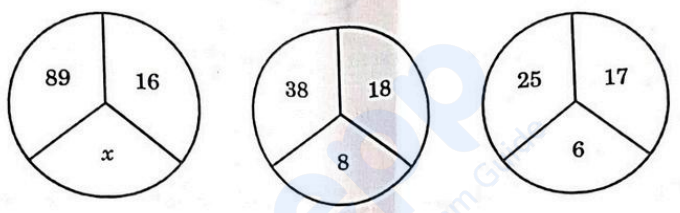
The value of x in the following figures is :
When a child reaches adolescence, there is apt to be a conflict between the parents and the child, since
the latter considers himself to be by now quite capable of managing his own affairs, while the former
are filled with parental solicitude, which is often a disguise for love of power. Parents consider, usually,
that the various moral problems which arise in adolescence are peculiarly their province. The options
they express, however, are so dogmatic that the young seldom confide in them, and usually go their
own way in secret.



