
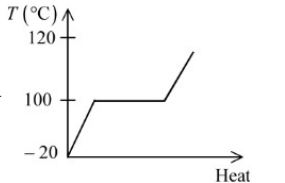
Water Temperature vs. Heat Supplied Graph Analysis
This question asks for the correct representation of the temperature change of water as heat is supplied, covering the range from $-20^\circ\text{C}$ to $120^\circ\text{C}$. This range includes solid (ice), liquid (water), and gaseous (steam) states, along with the phase transitions of melting and boiling.
Phase Analysis
The heating process can be divided into five distinct stages:
- Stage 1: Ice (Solid Phase): From $-20^\circ\text{C}$ up to $0^\circ\text{C}$. Adding heat increases the temperature of the ice. This is represented by a sloped line on the graph, indicating temperature increases with heat.
- Stage 2: Melting (Phase Transition): At $0^\circ\text{C}$. As heat is supplied, the ice melts into water at a constant temperature ($0^\circ\text{C}$). This is represented by a horizontal line on the graph.
- Stage 3: Water (Liquid Phase): From $0^\circ\text{C}$ up to $100^\circ\text{C}$. Adding heat increases the temperature of the liquid water. This is represented by another sloped line.
- Stage 4: Boiling (Phase Transition): At $100^\circ\text{C}$. As heat is supplied, the water boils and turns into steam at a constant temperature ($100^\circ\text{C}$). This is represented by another horizontal line.
- Stage 5: Steam (Gaseous Phase): From $100^\circ\text{C}$ up to $120^\circ\text{C}$. Adding heat increases the temperature of the steam. This is represented by a final sloped line.
Graph Characteristics
The correct graph must show these five stages sequentially: a rise, a plateau (at $0^\circ\text{C}$), another rise, another plateau (at $100^\circ\text{C}$), and a final rise.
The slope of the temperature vs. heat graph during the phase changes (ice, water, steam) depends on the specific heat capacity ($c$) of the substance. The relationship is $Q = mc\Delta T$, so $\frac{\Delta T}{\Delta Q} = \frac{1}{mc}$.
- Specific heat of ice ($c_{ice}$) is approx. $2.1 \, \text{J/g}^\circ\text{C}$.
- Specific heat of water ($c_{water}$) is approx. $4.2 \, \text{J/g}^\circ\text{C}$.
- Specific heat of steam ($c_{steam}$) is approx. $2.0 \, \text{J/g}^\circ\text{C}$.
Since $mc_{ice}$ and $mc_{steam}$ are less than $mc_{water}$, the slopes for the solid (ice) and gaseous (steam) phases should be steeper than the slope for the liquid (water) phase.
Option 1 correctly depicts all five stages in the correct order and with appropriate temperature points ($0^\circ\text{C}$ and $100^\circ\text{C}$) for phase transitions. It also shows steeper slopes for ice and steam compared to water.
The correct graph is shown in Option 1:
Similar Questions
- $10 \text{ kg}$ of ice at $-10^\circ\text{C}$ is added to $100 \text{ kg}$ of water to lower its temperature from $25^\circ\text{C}$. Consider no heat exchange to surroundings. The decrement to the temperature of water is ________$^\circ\text{C}$.
(specific heat of ice = $2100 \text{ J/Kg.}^\circ\text{C}$, specific heat of water = $4200 \text{ J/Kg.}^\circ\text{C}$, latent heat of fusion of ice = $3.36 \times 10^5 \text{ J/Kg}$) - The volume of an ideal gas increases 8 times and temperature becomes $(1/4)^{\text{th}}$ of initial temperature during a reversible change. If there is no exchange of heat in this process ($\Delta Q = 0$) then identify the gas from the following options (Assuming the gases given in the options are ideal gases):
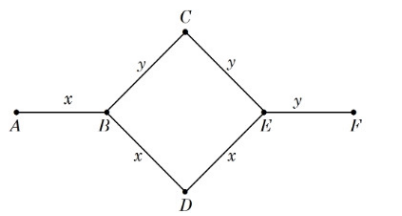
Rods x and y of equal dimensions but of different materials are joined as shown in figure. Temperatures of end points $A$ and $F$ are maintained at $100^\circ\text{C}$ and $40^\circ\text{C}$ respectively. Given the thermal conductivity of rod x is three times of that of rod y, the temperature at junction points $B$ and $E$ are (close to):
- Consider two boxes containing ideal gases A and B such that their temperatures, pressures and number densities are same. The molecular size of A is half of that of B and mass of molecule A is four times that of B. If the collision frequency in gas B is $32 \times 10^{18}$ /s then collision frequency in gas A is _________ /s.
- An insulated cylinder of volume $60 \text{ cm}^3$ is filled with a gas at $27^\circ\text{C}$ and 2 atmospheric pressure. Then the gas is compressed making the final volume as $20 \text{ cm}^3$ while allowing the temperature to rise to $77^\circ\text{C}$. The final pressure is _________ atmospheric pressure.
- A brass wire of length 2 m and radius 1 mm at $27^\circ\text{C}$ is held taut between two rigid supports. Initially it was cooled to a temperature of $-43^\circ\text{C}$ creating a tension $T$ in the wire. The temperature to which the wire has to be cooled in order to increase the tension in it to $1.4T$, is ______ $^\circ\text{C}$.
- A gas of certain mass filled in a closed cylinder at a pressure of 3.23 kPa has temperature $50^\circ\text{C}$. The gas is now heated to double its temperature. The modified pressure is ______ Pa.
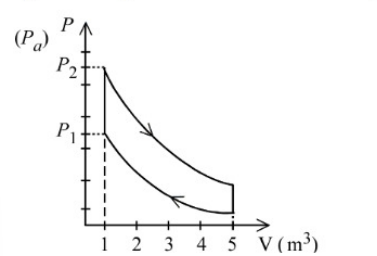
10 mole of an ideal gas is undergoing the process shown in the figure. The heat involved in the process from $P_1$ to $P_2$ is $\alpha \text{ Joule}$ ($P_1 = 21.7 \text{ Pa}$ and $P_2 = 30 \text{ Pa}, C_v = 21 \text{ J/K.mol}, R = 8.3 \text{ J/mol.K}$). The value of $\alpha$ is _______.
- When $300 \text{ J}$ of heat given to an ideal gas with $C_p = \frac{7}{2} R$ its temperature raises from $20^\circ\text{C}$ to $50^\circ\text{C}$ keeping its volume constant. The mass of the gas is (approximately) _______ g. ($R = 8.314 \text{ J/mol.K}$)
- An aluminium and steel rods having same lengths and cross-sections are joined to make total length of $120 \text{ cm}$ at $30^\circ\text{C}$. The coefficient of linear expansion of aluminium and steel are $24 \times 10^{-6} /^\circ\text{C}$ and $1.2 \times 10^{-5} /^\circ\text{C}$, respectively. The length of this composite rod when its temperature is raised to $100^\circ\text{C}$, is ____________ $\text{cm}$.
Important Questions from Heat and Thermodynamics
- $10 \text{ kg}$ of ice at $-10^\circ\text{C}$ is added to $100 \text{ kg}$ of water to lower its temperature from $25^\circ\text{C}$. Consider no heat exchange to surroundings. The decrement to the temperature of water is ________$^\circ\text{C}$.
(specific heat of ice = $2100 \text{ J/Kg.}^\circ\text{C}$, specific heat of water = $4200 \text{ J/Kg.}^\circ\text{C}$, latent heat of fusion of ice = $3.36 \times 10^5 \text{ J/Kg}$) - The volume of an ideal gas increases 8 times and temperature becomes $(1/4)^{\text{th}}$ of initial temperature during a reversible change. If there is no exchange of heat in this process ($\Delta Q = 0$) then identify the gas from the following options (Assuming the gases given in the options are ideal gases):
Rods x and y of equal dimensions but of different materials are joined as shown in figure. Temperatures of end points $A$ and $F$ are maintained at $100^\circ\text{C}$ and $40^\circ\text{C}$ respectively. Given the thermal conductivity of rod x is three times of that of rod y, the temperature at junction points $B$ and $E$ are (close to):
- Consider two boxes containing ideal gases A and B such that their temperatures, pressures and number densities are same. The molecular size of A is half of that of B and mass of molecule A is four times that of B. If the collision frequency in gas B is $32 \times 10^{18}$ /s then collision frequency in gas A is _________ /s.
- An insulated cylinder of volume $60 \text{ cm}^3$ is filled with a gas at $27^\circ\text{C}$ and 2 atmospheric pressure. Then the gas is compressed making the final volume as $20 \text{ cm}^3$ while allowing the temperature to rise to $77^\circ\text{C}$. The final pressure is _________ atmospheric pressure.


