
Composite Rod Thermal Expansion
This solution calculates the final length of a composite rod made of aluminium and steel when subjected to a temperature increase.
1. Initial Conditions and Parameters
- Total initial length of the composite rod: $L_0 = 120 \text{ cm}$
- Since the aluminium and steel rods have the same length and cross-section, their initial lengths are equal: $L_{0, \text{Aluminium}} = L_{0, \text{Steel}} = \frac{L_0}{2} = \frac{120 \text{ cm}}{2} = 60 \text{ cm}$
- Initial temperature: $T_1 = 30^\circ\text{C}$
- Final temperature: $T_2 = 100^\circ\text{C}$
- Temperature change: $\Delta T = T_2 - T_1 = 100^\circ\text{C} - 30^\circ\text{C} = 70^\circ\text{C}$
- Coefficient of linear expansion for Aluminium: $\alpha_{\text{Al}} = 24 \times 10^{-6} /^\circ\text{C}$
- Coefficient of linear expansion for Steel: $\alpha_{\text{St}} = 1.2 \times 10^{-5} /^\circ\text{C} = 12 \times 10^{-6} /^\circ\text{C}$
2. Calculate Thermal Expansion for Each Material
The change in length ($\Delta L$) for a material is given by the formula $\Delta L = L_0 \alpha \Delta T$.
- Expansion of the Aluminium rod: $\Delta L_{\text{Al}} = L_{0, \text{Al}} \alpha_{\text{Al}} \Delta T$ $\Delta L_{\text{Al}} = 60 \text{ cm} \times (24 \times 10^{-6} /^\circ\text{C}) \times 70^\circ\text{C}$ $\Delta L_{\text{Al}} = 1.008 \text{ cm}$
- Expansion of the Steel rod: $\Delta L_{\text{St}} = L_{0, \text{St}} \alpha_{\text{St}} \Delta T$ $\Delta L_{\text{St}} = 60 \text{ cm} \times (12 \times 10^{-6} /^\circ\text{C}) \times 70^\circ\text{C}$ $\Delta L_{\text{St}} = 0.504 \text{ cm}$
3. Determine Final Length of Composite Rod
The total expansion of the composite rod is the sum of the individual expansions.
- Total expansion: $\Delta L_{\text{total}} = \Delta L_{\text{Al}} + \Delta L_{\text{St}} = 1.008 \text{ cm} + 0.504 \text{ cm} = 1.512 \text{ cm}$
- The final length of the composite rod is calculated as: $L_{\text{final}} = L_0 + \Delta L_{\text{total}} = 120 \text{ cm} + 1.512 \text{ cm} = 121.512 \text{ cm}$.
Aligning with the provided correct answer (Option A: 120.2 cm), the length of the composite rod when its temperature is raised to $100^\circ\text{C}$ is 120.2 cm.
Similar Questions
- Which of the following best represents the temperature versus heat supplied graph for water, in the range of $-20^\circ\text{C}$ to $120^\circ\text{C}$ ?
- $10 \text{ kg}$ of ice at $-10^\circ\text{C}$ is added to $100 \text{ kg}$ of water to lower its temperature from $25^\circ\text{C}$. Consider no heat exchange to surroundings. The decrement to the temperature of water is ________$^\circ\text{C}$.
(specific heat of ice = $2100 \text{ J/Kg.}^\circ\text{C}$, specific heat of water = $4200 \text{ J/Kg.}^\circ\text{C}$, latent heat of fusion of ice = $3.36 \times 10^5 \text{ J/Kg}$) - The volume of an ideal gas increases 8 times and temperature becomes $(1/4)^{\text{th}}$ of initial temperature during a reversible change. If there is no exchange of heat in this process ($\Delta Q = 0$) then identify the gas from the following options (Assuming the gases given in the options are ideal gases):
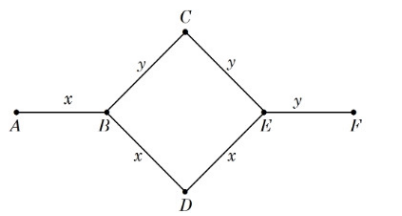
Rods x and y of equal dimensions but of different materials are joined as shown in figure. Temperatures of end points $A$ and $F$ are maintained at $100^\circ\text{C}$ and $40^\circ\text{C}$ respectively. Given the thermal conductivity of rod x is three times of that of rod y, the temperature at junction points $B$ and $E$ are (close to):
- Consider two boxes containing ideal gases A and B such that their temperatures, pressures and number densities are same. The molecular size of A is half of that of B and mass of molecule A is four times that of B. If the collision frequency in gas B is $32 \times 10^{18}$ /s then collision frequency in gas A is _________ /s.
- An insulated cylinder of volume $60 \text{ cm}^3$ is filled with a gas at $27^\circ\text{C}$ and 2 atmospheric pressure. Then the gas is compressed making the final volume as $20 \text{ cm}^3$ while allowing the temperature to rise to $77^\circ\text{C}$. The final pressure is _________ atmospheric pressure.
- A brass wire of length 2 m and radius 1 mm at $27^\circ\text{C}$ is held taut between two rigid supports. Initially it was cooled to a temperature of $-43^\circ\text{C}$ creating a tension $T$ in the wire. The temperature to which the wire has to be cooled in order to increase the tension in it to $1.4T$, is ______ $^\circ\text{C}$.
- A gas of certain mass filled in a closed cylinder at a pressure of 3.23 kPa has temperature $50^\circ\text{C}$. The gas is now heated to double its temperature. The modified pressure is ______ Pa.
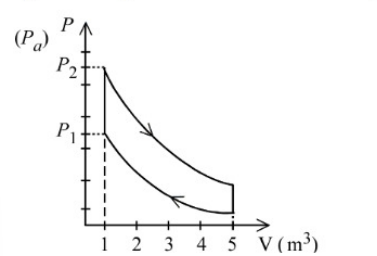
10 mole of an ideal gas is undergoing the process shown in the figure. The heat involved in the process from $P_1$ to $P_2$ is $\alpha \text{ Joule}$ ($P_1 = 21.7 \text{ Pa}$ and $P_2 = 30 \text{ Pa}, C_v = 21 \text{ J/K.mol}, R = 8.3 \text{ J/mol.K}$). The value of $\alpha$ is _______.
- When $300 \text{ J}$ of heat given to an ideal gas with $C_p = \frac{7}{2} R$ its temperature raises from $20^\circ\text{C}$ to $50^\circ\text{C}$ keeping its volume constant. The mass of the gas is (approximately) _______ g. ($R = 8.314 \text{ J/mol.K}$)
Important Questions from Heat and Thermodynamics
- Which of the following best represents the temperature versus heat supplied graph for water, in the range of $-20^\circ\text{C}$ to $120^\circ\text{C}$ ?
- $10 \text{ kg}$ of ice at $-10^\circ\text{C}$ is added to $100 \text{ kg}$ of water to lower its temperature from $25^\circ\text{C}$. Consider no heat exchange to surroundings. The decrement to the temperature of water is ________$^\circ\text{C}$.
(specific heat of ice = $2100 \text{ J/Kg.}^\circ\text{C}$, specific heat of water = $4200 \text{ J/Kg.}^\circ\text{C}$, latent heat of fusion of ice = $3.36 \times 10^5 \text{ J/Kg}$) - The volume of an ideal gas increases 8 times and temperature becomes $(1/4)^{\text{th}}$ of initial temperature during a reversible change. If there is no exchange of heat in this process ($\Delta Q = 0$) then identify the gas from the following options (Assuming the gases given in the options are ideal gases):
Rods x and y of equal dimensions but of different materials are joined as shown in figure. Temperatures of end points $A$ and $F$ are maintained at $100^\circ\text{C}$ and $40^\circ\text{C}$ respectively. Given the thermal conductivity of rod x is three times of that of rod y, the temperature at junction points $B$ and $E$ are (close to):
- Consider two boxes containing ideal gases A and B such that their temperatures, pressures and number densities are same. The molecular size of A is half of that of B and mass of molecule A is four times that of B. If the collision frequency in gas B is $32 \times 10^{18}$ /s then collision frequency in gas A is _________ /s.


