
Which of the following algorithms are based on the Breadth First Search (BFS) ? A. Prim's algorithms B. Kruskal algorithms C. Dijkstra algorithms D. Greedy algorithms E. Dynamic Programming Choose the correct answer from the options given below:
A & C only
Breadth First Search grows a search tree outward from a source vertex, keeping a frontier of discovered vertices in a queue and repeatedly expanding the next frontier vertex. Cormen et al. note that Prim's minimum-spanning-tree algorithm and Dijkstra's single-source shortest-path algorithm both use ideas similar to BFS: they also grow a tree from a single source by repeatedly taking the best vertex from a frontier, using a priority queue instead of a FIFO queue.
A. Prim's algorithm: grows one tree from a start vertex, each time adding the minimum-weight edge leaving the tree; this is a weighted generalisation of the BFS frontier expansion.
C. Dijkstra's algorithm: expands vertices from the source in order of distance; with all edge weights equal it reduces exactly to BFS.
B. Kruskal's algorithm sorts all edges and merges a forest with a disjoint-set structure; it does not grow from a source or explore neighbours level by level, so it is not BFS-based.
D. Greedy algorithms and E. dynamic programming are general design paradigms, not algorithms built on BFS, so any choice containing them is wrong.
A & C only option is correct.
Similar Questions
In the following graph, discovery time stamps and finishing time stamps of Depth First Search (DFS) are shown as \(x/y\), where \(x\) is discovery time stamp and \(y\) is finishing time stamp.
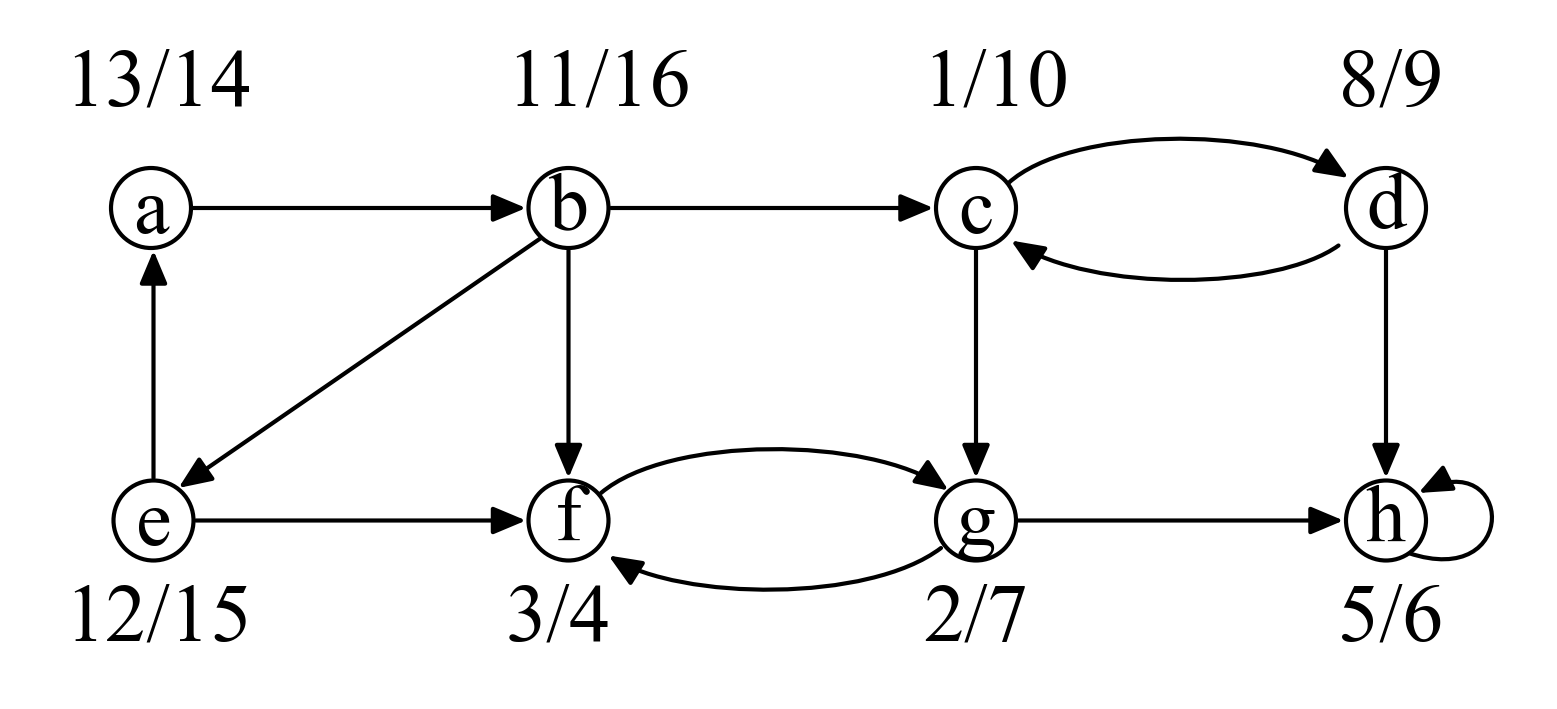
It shows which of the following depth first forest ?
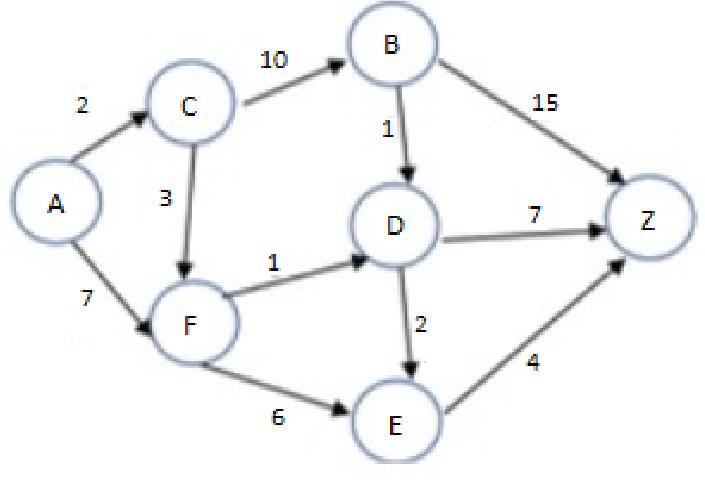
Consider the graph given below. What is the order in which the nodes mentioned in the options are to be traversed to find the shortest path from A to Z using best first search?
A. Node-A
B. Node-B
C. Node-C
D. Node-D
E. Node-E
F. Node-F
Choose the correct answer from the options given below:
Important Questions from Graph Search
- The depth first search will use ________ as a structure to held nodes for further processing.
Consider the following pseudocode for depth-first search (DFS) algorithm which takes a directed graph $G(V, E)$ as input, where $d[v]$ and $f[v]$ are the discovery time and finishing time, respectively, of the vertex $v \in V$.
DFS(G):
unmark all v ∈ V
t ← 0
for each v ∈ V
if v is unmarked
t ← Explore(G, v, t)
end if
end forExplore(G, v, t):
mark v
t ← t + 1
d[v] ← t
for each (v, w) ∈ E
if w is unmarked
t ← Explore(G, w, t)
end if
end for
t ← t + 1
f[v] ← t
return tSuppose that the input directed graph $G(V, E)$ is a directed acyclic graph (DAG).
For an edge $(u, v) \in E$, which of the following options will NEVER be correct?Consider the following algorithm someAlgo that takes an undirected graph G as input.
someAlgo (G)
1. Let $v$ be any vertex in G. Run BFS on G starting at $v$. Let $u$ be a vertex in G at maximum distance from $v$ as given by the BFS.
2. Run BFS on G again with $u$ as the starting vertex. Let $z$ be the vertex at maximum distance from $u$ as given by the BFS.
3. Output the distance between $u$ and $z$ in G.
The output of someAlgo (T) for the tree shown in the given figure is ____________ (Answer in integer)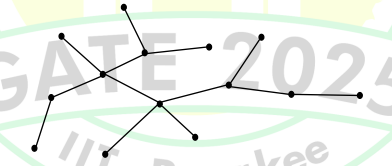
In the following graph, discovery time stamps and finishing time stamps of Depth First Search (DFS) are shown as \(x/y\), where \(x\) is discovery time stamp and \(y\) is finishing time stamp.
It shows which of the following depth first forest ?
Consider the graph given below. What is the order in which the nodes mentioned in the options are to be traversed to find the shortest path from A to Z using best first search?
A. Node-A
B. Node-B
C. Node-C
D. Node-D
E. Node-E
F. Node-F
Choose the correct answer from the options given below:



