
In the following graph, discovery time stamps and finishing time stamps of Depth First Search (DFS) are shown as \(x/y\), where \(x\) is discovery time stamp and \(y\) is finishing time stamp. It shows which of the following depth first forest ?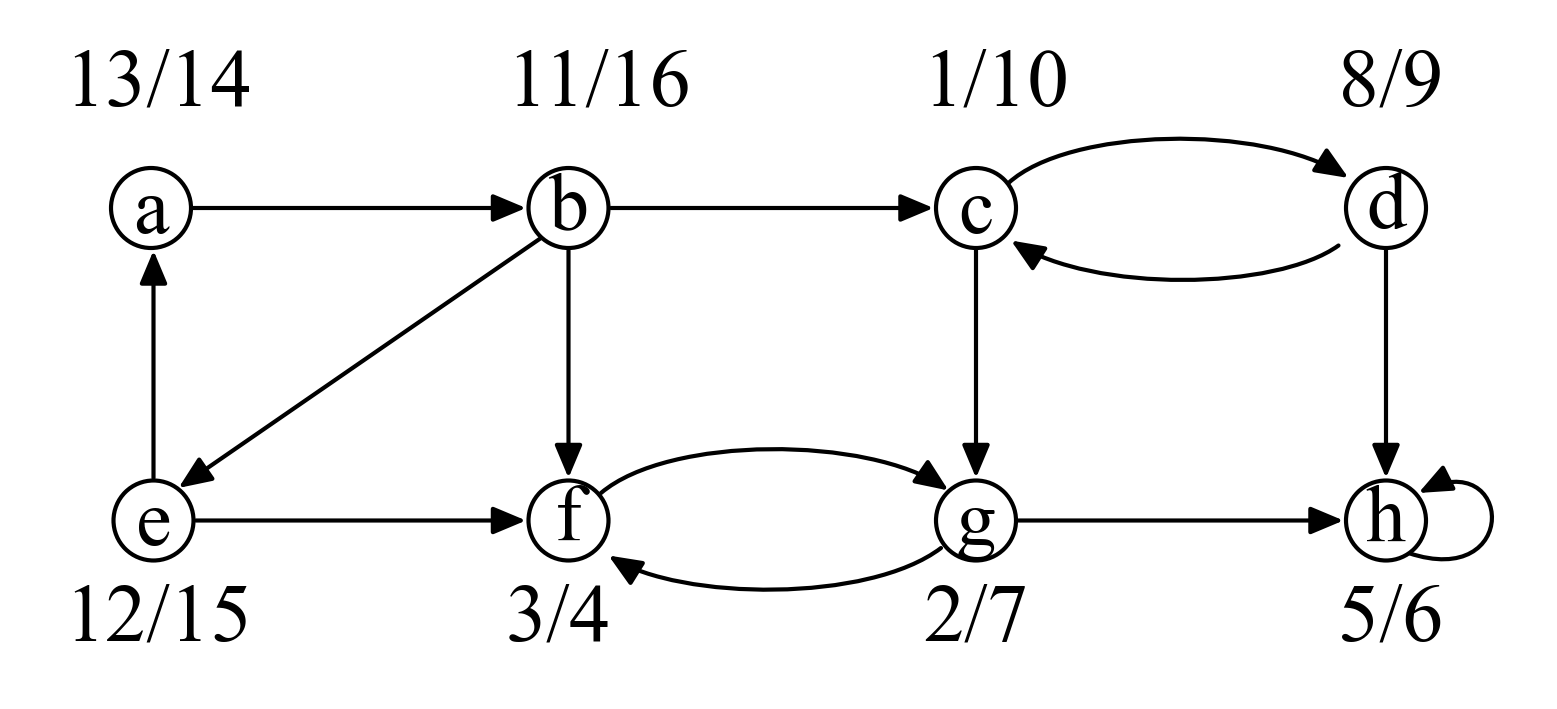
{a, b, e} {c, d, f, g, h}
In a DFS forest, v is a descendant of u exactly when v's interval lies inside u's interval (parenthesis theorem); each outermost interval is a tree root.
c has interval 1/10, which contains g 2/7, f 3/4, h 5/6 and d 8/9, so the first tree is {c, d, f, g, h}.
b has interval 11/16, which contains e 12/15 and a 13/14, so the second tree is {a, b, e}.
Check: no other vertex has an interval outside these two, so the forest has exactly two trees.
Hence, {a, b, e} {c, d, f, g, h}.
Similar Questions
Which of the following algorithms are based on the Breadth First Search (BFS) ?
A. Prim's algorithms
B. Kruskal algorithms
C. Dijkstra algorithms
D. Greedy algorithms
E. Dynamic Programming
Choose the correct answer from the options given below:
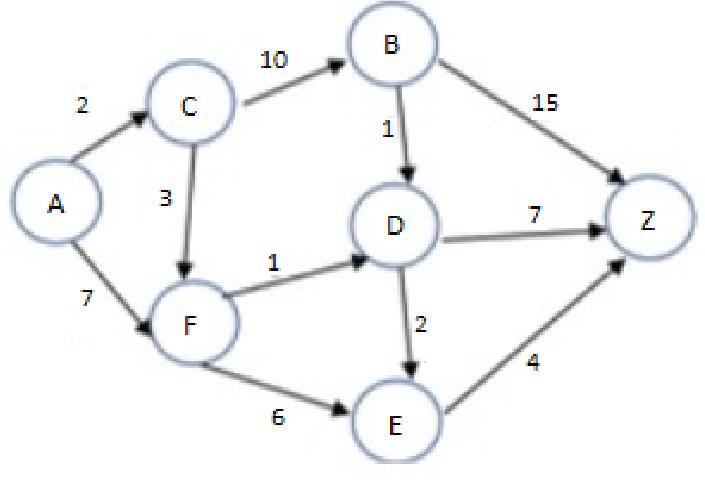
Consider the graph given below. What is the order in which the nodes mentioned in the options are to be traversed to find the shortest path from A to Z using best first search?
A. Node-A
B. Node-B
C. Node-C
D. Node-D
E. Node-E
F. Node-F
Choose the correct answer from the options given below:
Important Questions from Graph Search
- The depth first search will use ________ as a structure to held nodes for further processing.
Consider the following pseudocode for depth-first search (DFS) algorithm which takes a directed graph $G(V, E)$ as input, where $d[v]$ and $f[v]$ are the discovery time and finishing time, respectively, of the vertex $v \in V$.
DFS(G):
unmark all v ∈ V
t ← 0
for each v ∈ V
if v is unmarked
t ← Explore(G, v, t)
end if
end forExplore(G, v, t):
mark v
t ← t + 1
d[v] ← t
for each (v, w) ∈ E
if w is unmarked
t ← Explore(G, w, t)
end if
end for
t ← t + 1
f[v] ← t
return tSuppose that the input directed graph $G(V, E)$ is a directed acyclic graph (DAG).
For an edge $(u, v) \in E$, which of the following options will NEVER be correct?Consider the following algorithm someAlgo that takes an undirected graph G as input.
someAlgo (G)
1. Let $v$ be any vertex in G. Run BFS on G starting at $v$. Let $u$ be a vertex in G at maximum distance from $v$ as given by the BFS.
2. Run BFS on G again with $u$ as the starting vertex. Let $z$ be the vertex at maximum distance from $u$ as given by the BFS.
3. Output the distance between $u$ and $z$ in G.
The output of someAlgo (T) for the tree shown in the given figure is ____________ (Answer in integer)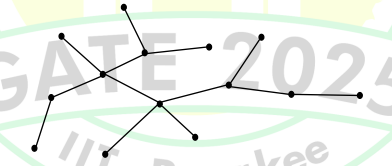
Which of the following algorithms are based on the Breadth First Search (BFS) ?
A. Prim's algorithms
B. Kruskal algorithms
C. Dijkstra algorithms
D. Greedy algorithms
E. Dynamic Programming
Choose the correct answer from the options given below:
Consider the graph given below. What is the order in which the nodes mentioned in the options are to be traversed to find the shortest path from A to Z using best first search?
A. Node-A
B. Node-B
C. Node-C
D. Node-D
E. Node-E
F. Node-F
Choose the correct answer from the options given below:



