
Depth First Search and its Supporting Structure
Depth First Search (DFS) is a fundamental algorithm used for traversing or searching through a graph or tree data structure. The core idea behind DFS is to explore as far as possible along each branch before backtracking.
To manage the process of exploring nodes and keeping track of where to go next, DFS requires a specific data structure. This structure must allow the algorithm to remember the path it has taken and return to previous points when a dead end is reached.
Choosing the Right Data Structure for DFS
DFS operates on a principle known as Last-In, First-Out (LIFO). When DFS visits a node, it explores one of its unvisited neighbors. If that neighbor has further unvisited neighbors, it explores them first. Only when it reaches a node with no unvisited neighbors does it backtrack to the most recently visited node that still has unexplored paths.
This LIFO behavior directly maps to the functionality of a Stack data structure.
- Stack: A stack follows the LIFO principle. You can $push$ elements onto the top and $pop$ elements from the top. When DFS explores a path, it pushes the nodes onto the stack. When it needs to backtrack, it pops the most recently added node from the stack to explore its alternative paths.
- Queue: A queue follows the First-In, First-Out (FIFO) principle. This structure is used by Breadth First Search (BFS), which explores nodes level by level, not depth-first.
- List/Array: While lists and arrays can be used to implement stacks, they are not the abstract data structure concept inherently used by DFS's traversal logic. The defining characteristic is the LIFO access pattern, which is the abstract definition of a stack.
Therefore, the Stack is the most appropriate abstract data structure that Depth First Search uses to hold nodes for further processing.
Why Stack is Used in DFS
Consider a graph represented as follows:
Node A connects to B and C.
Node B connects to D.
Node C connects to E.
If DFS starts at A:
- Visit A. Push A onto the stack. Stack: [A]
- Explore a neighbor of A, say B. Visit B. Push B onto the stack. Stack: [A, B]
- Explore a neighbor of B, say D. Visit D. Push D onto the stack. Stack: [A, B, D]
- D has no unvisited neighbors. Backtrack. Pop D. Stack: [A, B]
- Are there other neighbors of B? No. Backtrack. Pop B. Stack: [A]
- Explore the next neighbor of A, which is C. Visit C. Push C onto the stack. Stack: [A, C]
- Explore a neighbor of C, say E. Visit E. Push E onto the stack. Stack: [A, C, E]
- E has no unvisited neighbors. Backtrack. Pop E. Stack: [A, C]
- Are there other neighbors of C? No. Backtrack. Pop C. Stack: [A]
- Are there other neighbors of A? No. Backtrack. Pop A. Stack: []
This step-by-step process clearly demonstrates the LIFO behavior provided by the stack, enabling the depth-first exploration.
Conclusion
The essential characteristic of Depth First Search is its strategy of going deep into a branch before exploring other possibilities. This strategy is perfectly implemented using a Stack, which keeps track of the nodes to visit in a LIFO order.
Important Questions from Graph Search
Consider the following algorithm someAlgo that takes an undirected graph G as input.
someAlgo (G)
1. Let $v$ be any vertex in G. Run BFS on G starting at $v$. Let $u$ be a vertex in G at maximum distance from $v$ as given by the BFS.
2. Run BFS on G again with $u$ as the starting vertex. Let $z$ be the vertex at maximum distance from $u$ as given by the BFS.
3. Output the distance between $u$ and $z$ in G.
The output of someAlgo (T) for the tree shown in the given figure is ____________ (Answer in integer)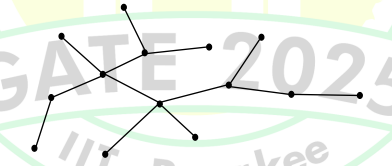
Given below are two statements: one is labelled as Assertion A and the other is labelled as Reason R
Assertion A: Depth first search can be used to perform a topological sort of a directed acyclic graph.
Reason R: A topological sort a directed acyclic graph G =(V, E) is a linear ordering of its vertices such that if G contain an edge (u, v) then u appears before v in the ordering.
In the light of the above statements, choose the most appropriate answer from the options given below
Which of the following statements about DFS are correct?
A. It can detect cycles in a graph
B. It can be used to find connected components.
C. It works for both directed and undirected graph.
D. Guarantees shortest path in unweighted graphs.
Choose the correct answer from the options given below:
Consider the following pseudocode for depth-first search (DFS) algorithm which takes a directed graph $G(V, E)$ as input, where $d[v]$ and $f[v]$ are the discovery time and finishing time, respectively, of the vertex $v \in V$.
DFS(G):
unmark all v ∈ V
t ← 0
for each v ∈ V
if v is unmarked
t ← Explore(G, v, t)
end if
end forExplore(G, v, t):
mark v
t ← t + 1
d[v] ← t
for each (v, w) ∈ E
if w is unmarked
t ← Explore(G, w, t)
end if
end for
t ← t + 1
f[v] ← t
return tSuppose that the input directed graph $G(V, E)$ is a directed acyclic graph (DAG).
For an edge $(u, v) \in E$, which of the following options will NEVER be correct?Which traversal algorithm is typically implemented using a stack data structure?


