All Exams Test series for 1 year @ ₹349 only
Question

What is the sum of the roots of the equation \(\left|\begin{array}{ccc} 0 & x-a & x-b \\ 0 & 0 & x-c \\ x+b & x+c & 1 \end{array}\right|=0\) ?

This question was previously asked in
NDA I 2023 GAT Previous Year Paper (16-Apr-2023)
The correct answer is

a - b + c

Finding the Sum of Roots for a Determinant Equation

The problem asks for the sum of the roots of the given determinant equation:

\(\left|\begin{array}{ccc} 0 & x-a & x-b \\ 0 & 0 & x-c \\ x+b & x+c & 1 \end{array}\right|=0\)

To find the roots of this equation, we first need to expand the determinant. We can expand the determinant along any row or column. Expanding along the first column is easiest because it contains two zero elements.

The expansion along the first column is given by:

\(\text{Determinant} = a_{11}C_{11} + a_{21}C_{21} + a_{31}C_{31}\)

where \(a_{ij}\) is the element in the i-th row and j-th column, and \(C_{ij}\) is the cofactor of \(a_{ij}\). In this case, \(a_{11}=0\), \(a_{21}=0\), and \(a_{31}=x+b\).

So, the determinant expands to:

\(0 \cdot C_{11} + 0 \cdot C_{21} + (x+b) \cdot C_{31}\)

This simplifies to:

\((x+b) \cdot C_{31}\)

Now we need to calculate the cofactor \(C_{31}\). The cofactor \(C_{ij} = (-1)^{i+j} M_{ij}\), where \(M_{ij}\) is the minor determinant obtained by removing the i-th row and j-th column.

For \(C_{31}\), we remove the 3rd row and 1st column:

\(M_{31} = \left|\begin{array}{cc} x-a & x-b \\ 0 & x-c \end{array}\right|\)

The 2x2 determinant is calculated as \((x-a)(x-c) - (x-b)(0)\):

\(M_{31} = (x-a)(x-c) - 0 = (x-a)(x-c)\)

Since \(i+j = 3+1 = 4\) is even, \(C_{31} = (-1)^4 M_{31} = 1 \cdot (x-a)(x-c) = (x-a)(x-c)\).

Substituting \(C_{31}\) back into the determinant expansion, the equation becomes:

\((x+b) \cdot (x-a)(x-c) = 0\)

This equation is already in factored form. The roots of this equation are the values of \(x\) that make each factor equal to zero.

  • Setting the first factor to zero: \(x+b = 0 \implies x_1 = -b\)
  • Setting the second factor to zero: \(x-a = 0 \implies x_2 = a\)
  • Setting the third factor to zero: \(x-c = 0 \implies x_3 = c\)

The roots of the equation are \(-b, a,\) and \(c\).

The question asks for the sum of the roots. The sum is \(x_1 + x_2 + x_3\).

Sum of roots \(= -b + a + c\)

Rearranging the terms, the sum of the roots is \(a - b + c\).

Revision Table: Key Steps

Step Description Calculation
1 Expand the determinant (using column 1) \((x+b) \cdot \left|\begin{array}{cc} x-a & x-b \\ 0 & x-c \end{array}\right|\)
2 Evaluate the 2x2 minor determinant \((x-a)(x-c)\)
3 Form the polynomial equation \((x+b)(x-a)(x-c) = 0\)
4 Find the roots by setting factors to zero \(x_1=-b, x_2=a, x_3=c\)
5 Calculate the sum of the roots \(-b + a + c\)

Additional Information: Roots and Determinants

In general, a determinant equation involving a variable \(x\) can result in a polynomial equation in \(x\). The degree of the polynomial is related to how \(x\) appears in the matrix elements. The roots of the determinant equation are the roots of the resulting polynomial.

For a polynomial equation of degree \(n\), say \(P(x) = c_n x^n + c_{n-1} x^{n-1} + \dots + c_1 x + c_0 = 0\) (where \(c_n \neq 0\)), the sum of the roots (\(\alpha_1, \alpha_2, \dots, \alpha_n\)) is given by Vieta's formulas:

Sum of roots \(= \alpha_1 + \alpha_2 + \dots + \alpha_n = -\frac{c_{n-1}}{c_n}\)

In our specific case, the expanded form of \((x+b)(x-a)(x-c)\) is a cubic polynomial:

\((x+b)(x^2 - ax - cx + ac) = (x+b)(x^2 - (a+c)x + ac)\)

\(= x(x^2 - (a+c)x + ac) + b(x^2 - (a+c)x + ac)\)

\(= x^3 - (a+c)x^2 + acx + bx^2 - b(a+c)x + abc\)

\(= x^3 + (b-(a+c))x^2 + (ac - b(a+c))x + abc\)

\(= x^3 + (b-a-c)x^2 + (ac - ab - bc)x + abc\)

This is a polynomial of degree 3. Comparing this to \(c_3 x^3 + c_2 x^2 + c_1 x + c_0\), we have:

  • \(c_3 = 1\)
  • \(c_2 = b-a-c\)
  • \(c_1 = ac - ab - bc\)
  • \(c_0 = abc\)

According to Vieta's formulas, the sum of the roots is \(-\frac{c_2}{c_3}\).

Sum of roots \(= -\frac{b-a-c}{1} = -(b-a-c) = -b+a+c = a-b+c\)

This confirms the sum of roots obtained by directly finding the roots from the factored form. Both methods yield the same result, \(a - b + c\).

Was this answer helpful?

Similar Questions

  1. The value of the determinant \(\left| {\begin{array}{*{20}{c}} {1 - {\rm{\alpha }}}&{{\rm{\alpha }} - {{\rm{\alpha }}^2}}&{{{\rm{\alpha }}^2}}\\ {1 - {\rm{\beta }}}&{{\rm{\beta }} - {{\rm{\beta }}^2}}&{{{\rm{\beta }}^2}}\\ {1 - {\rm{\gamma }}}&{{\rm{\gamma }} - {{\rm{\gamma }}^2}}&{{{\rm{\gamma }}^2}} \end{array}} \right|\) is equal to

  2. The element in the i th row and the j th column of a determinant of third order is equal to 2(i + j). What is the value of the determinant?

  3. Let p, q and r be three distinct positive real numbers. If \(\rm D = \left| {\begin{array}{*{20}{c}} \rm p&\rm q&\rm r\\ \rm q&\rm r&\rm p\\ \rm r&\rm p&\rm q \end{array}} \right|,\)  then which one of the following is correct?

  4. If a 1, a 2, a 3, _ _ _ _ _, a 9are in GP, then what is the value of the following determinant?

    \(\left| {\begin{array}{*{20}{c}} {{ln\:a_1}}&{{ln\:a_2}}&{{ln\:a_3}}\\ {{ln\:a_4}}&{{ln\:a_5}}&{{ln\:a_6}}\\ {{ln\:a_7}}&{{ln\:a_8}}&{{ln\:a_9}} \end{array}} \right|\)

  5. What is the value of the determinant \(\left| {\begin{array}{*{20}{c}} {\rm{i}}&{{{\rm{i}}^2}}&{{{\rm{i}}^3}}\\ {{{\rm{i}}^4}}&{{{\rm{i}}^6}}&{{{\rm{i}}^8}}\\ {{{\rm{i}}^9}}&{{{\rm{i}}^{12}}}&{{{\rm{i}}^{15}}} \end{array}} \right|\)  where \(\rm i = \sqrt {-1}\) ?

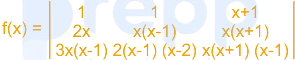
  6. If
     then what is f(-1) + f(0) + f(1) equal to?
  7. If a + b + c = 4 and ab + bc + ca = 0, then what is the value of the following determinant?

    \(\left| {\begin{array}{*{20}{c}} {{a}}&{{b}}&{{c}}\\ {{b}}&{{c}}&{{a}}\\ {{c}}&{{a}}&{{b}} \end{array}} \right|\)

  8. Let \(A = \left| {\begin{array}{*{20}{c}} p&q\\ r&s \end{array}} \right|\)

    where p, q, r and s are any four different prime numbers less than 20. What is the maximum value of the determinant?

  9. If \(\left| {\begin{array}{*{20}{c}} x&-3i&1\\ y&1&{i}\\ 0&2i&-i \end{array}} \right|=6+11i\)  , then what are the values of x and y respectively?

  10. If \(\left| {\begin{array}{*{20}{c}} {\rm{x}}&{\rm{y}}&0\\ 0&{\rm{x}}&{\rm{y}}\\ {\rm{y}}&0&{\rm{x}} \end{array}} \right| = 0\) , then which one of the following is correct?


Important Questions from Evaluation of Determinants

  1. The value of the determinant \(\left| {\begin{array}{*{20}{c}} {1 - {\rm{\alpha }}}&{{\rm{\alpha }} - {{\rm{\alpha }}^2}}&{{{\rm{\alpha }}^2}}\\ {1 - {\rm{\beta }}}&{{\rm{\beta }} - {{\rm{\beta }}^2}}&{{{\rm{\beta }}^2}}\\ {1 - {\rm{\gamma }}}&{{\rm{\gamma }} - {{\rm{\gamma }}^2}}&{{{\rm{\gamma }}^2}} \end{array}} \right|\) is equal to

  2. The element in the i th row and the j th column of a determinant of third order is equal to 2(i + j). What is the value of the determinant?

  3. If x, y, z are distinct real numbers and \(\left| {\begin{array}{*{20}{c}} x&{{x^2}}&{2 + {x^3}}\\ y&{{y^2}}&{2 + {y^3}}\\ z&{{z^2}}&{2 + {z^3}} \end{array}} \right| = 0\), then xyz =

  4. If A + B + C = \(\pi \), then, the value of \(\left| {\begin{array}{*{20}{c}} {\sin \left( {A + B + C} \right)}&{\sin B}&{\cos C}\\ { - \sin B}&0&{\tan A}\\ {\cos \left( {A + B} \right)}&{ - \tan A}&0 \end{array}} \right|\) is

  5. Let p, q and r be three distinct positive real numbers. If \(\rm D = \left| {\begin{array}{*{20}{c}} \rm p&\rm q&\rm r\\ \rm q&\rm r&\rm p\\ \rm r&\rm p&\rm q \end{array}} \right|,\)  then which one of the following is correct?
Need Expert Advice?
Test Series
NDA img
Defence
NDA 2026 Mock Test Series (Latest Pattern)
503 Tests 1 Tests Free
1066 Attempts
4.6(137)
English, Hindi

Start Your Preparation with Prepp Mobile App

Download the app from Google Play & App Store
Prepp Mobile App
