All Exams Test series for 1 year @ ₹349 only
Question

If a + b + c = 4 and ab + bc + ca = 0, then what is the value of the following determinant?

\(\left| {\begin{array}{*{20}{c}} {{a}}&{{b}}&{{c}}\\ {{b}}&{{c}}&{{a}}\\ {{c}}&{{a}}&{{b}} \end{array}} \right|\)

This question was previously asked in
NDA I 2021 GAT Previous Year Paper (18-Apr-2021)
The correct answer is

-64

Evaluating Determinant with Given Conditions

The problem asks us to find the value of a specific determinant given two conditions involving the variables a, b, and c.

The given conditions are:

  • \(a + b + c = 4\)
  • \(ab + bc + ca = 0\)

The determinant we need to evaluate is:

\(\left| {\begin{array}{*{20}{c}} {{a}}&{{b}}&{{c}}\\ {{b}}&{{c}}&{{a}}\\ {{c}}&{{a}}&{{b}} \end{array}} \right|\)

Expanding the Determinant

Let's expand the determinant. The general formula for a 3x3 determinant \(\left| {\begin{array}{*{20}{c}} p&q&r\\ s&t&u\\ v&w&x \end{array}} \right|\) is \(p(tx - uw) - q(sx - uv) + r(sw - tv)\).

Applying this to our determinant:

\(\left| {\begin{array}{*{20}{c}} {{a}}&{{b}}&{{c}}\\ {{b}}&{{c}}&{{a}}\\ {{c}}&{{a}}&{{b}} \end{array}} \right| = a(c \cdot b - a \cdot a) - b(b \cdot b - c \cdot a) + c(b \cdot a - c \cdot c)\)

\(= a(bc - a^2) - b(b^2 - ac) + c(ab - c^2)\)

\(= abc - a^3 - b^3 + abc + abc - c^3\)

\(= 3abc - (a^3 + b^3 + c^3)\)

Using Algebraic Identities

We need to find the value of \(3abc - (a^3 + b^3 + c^3)\). We can use a standard algebraic identity that relates \(a+b+c\), \(ab+bc+ca\), \(a^2+b^2+c^2\), \(a^3+b^3+c^3\), and \(abc\).

The identity is:

\(a^3 + b^3 + c^3 - 3abc = (a+b+c)(a^2+b^2+c^2 - ab - bc - ca)\)

From the given conditions, we know \(a+b+c = 4\) and \(ab+bc+ca = 0\).

We need to find the value of \(a^2+b^2+c^2\). We can get this from the identity:

\((a+b+c)^2 = a^2 + b^2 + c^2 + 2(ab+bc+ca)\)

Substitute the given values:

\((4)^2 = a^2 + b^2 + c^2 + 2(0)\)

\(16 = a^2 + b^2 + c^2 + 0\)

So, \(a^2 + b^2 + c^2 = 16\).

Now, substitute the known values into the main algebraic identity:

\(a^3 + b^3 + c^3 - 3abc = (a+b+c)(a^2+b^2+c^2 - (ab+bc+ca))\)

\(a^3 + b^3 + c^3 - 3abc = (4)(16 - 0)\)

\(a^3 + b^3 + c^3 - 3abc = (4)(16)\)

\(a^3 + b^3 + c^3 - 3abc = 64\)

Calculating the Determinant Value

The value of the determinant is \(3abc - (a^3 + b^3 + c^3)\). This is the negative of the expression we just found.

Determinant value = \(-(a^3 + b^3 + c^3 - 3abc)\)

Determinant value = \(-(64)\)

Determinant value = \(-64\)

Thus, the value of the given determinant is -64.

Given Derived Determinant Value
\(a+b+c=4\) \(a^2+b^2+c^2=16\) \(3abc - (a^3+b^3+c^3)\)
\(ab+bc+ca=0\) \(a^3+b^3+c^3-3abc=64\)

Revision Table: Determinants and Algebraic Identities

Let's quickly summarize the key formulas used in this problem.

Concept Formula/Identity
3x3 Determinant (General) \(\left| {\begin{array}{*{20}{c}} p&q&r\\ s&t&u\\ v&w&x \end{array}} \right| = p(tx - uw) - q(sx - uv) + r(sw - tv)\)
Cyclic Determinant (Specific) \(\left| {\begin{array}{*{20}{c}} {{a}}&{{b}}&{{c}}\\ {{b}}&{{c}}&{{a}}\\ {{c}}&{{a}}&{{b}} \end{array}} \right| = 3abc - a^3 - b^3 - c^3\)
Square of Sum \((a+b+c)^2 = a^2+b^2+c^2 + 2(ab+bc+ca)\)
Sum of Cubes Identity \(a^3+b^3+c^3-3abc = (a+b+c)(a^2+b^2+c^2 - ab - bc - ca)\)

Additional Information: Properties of Determinants and Algebraic Expressions

Determinants are scalar values associated with square matrices. They have many applications in linear algebra, such as solving systems of linear equations, finding matrix inverses, and calculating areas/volumes.

The specific determinant in this problem is a type of cyclic determinant. These often have symmetric or patterned expansions that can be simplified using algebraic identities.

The algebraic identity \(a^3 + b^3 + c^3 - 3abc = (a+b+c)(a^2+b^2+c^2 - ab - bc - ca)\) is very useful. A special case arises when \(a+b+c = 0\). In this case, the identity becomes \(a^3 + b^3 + c^3 - 3abc = (0)(a^2+b^2+c^2 - ab - bc - ca) = 0\), which simplifies to \(a^3 + b^3 + c^3 = 3abc\). This special case was not directly applicable here as \(a+b+c = 4 \neq 0\).

Was this answer helpful?

Similar Questions

  1. The value of the determinant \(\left| {\begin{array}{*{20}{c}} {1 - {\rm{\alpha }}}&{{\rm{\alpha }} - {{\rm{\alpha }}^2}}&{{{\rm{\alpha }}^2}}\\ {1 - {\rm{\beta }}}&{{\rm{\beta }} - {{\rm{\beta }}^2}}&{{{\rm{\beta }}^2}}\\ {1 - {\rm{\gamma }}}&{{\rm{\gamma }} - {{\rm{\gamma }}^2}}&{{{\rm{\gamma }}^2}} \end{array}} \right|\) is equal to

  2. The element in the i th row and the j th column of a determinant of third order is equal to 2(i + j). What is the value of the determinant?

  3. Let p, q and r be three distinct positive real numbers. If \(\rm D = \left| {\begin{array}{*{20}{c}} \rm p&\rm q&\rm r\\ \rm q&\rm r&\rm p\\ \rm r&\rm p&\rm q \end{array}} \right|,\)  then which one of the following is correct?

  4. If a 1, a 2, a 3, _ _ _ _ _, a 9are in GP, then what is the value of the following determinant?

    \(\left| {\begin{array}{*{20}{c}} {{ln\:a_1}}&{{ln\:a_2}}&{{ln\:a_3}}\\ {{ln\:a_4}}&{{ln\:a_5}}&{{ln\:a_6}}\\ {{ln\:a_7}}&{{ln\:a_8}}&{{ln\:a_9}} \end{array}} \right|\)

  5. What is the value of the determinant \(\left| {\begin{array}{*{20}{c}} {\rm{i}}&{{{\rm{i}}^2}}&{{{\rm{i}}^3}}\\ {{{\rm{i}}^4}}&{{{\rm{i}}^6}}&{{{\rm{i}}^8}}\\ {{{\rm{i}}^9}}&{{{\rm{i}}^{12}}}&{{{\rm{i}}^{15}}} \end{array}} \right|\)  where \(\rm i = \sqrt {-1}\) ?

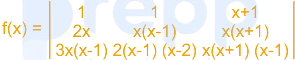
  6. If
     then what is f(-1) + f(0) + f(1) equal to?
  7. Let \(A = \left| {\begin{array}{*{20}{c}} p&q\\ r&s \end{array}} \right|\)

    where p, q, r and s are any four different prime numbers less than 20. What is the maximum value of the determinant?

  8. If \(\left| {\begin{array}{*{20}{c}} x&-3i&1\\ y&1&{i}\\ 0&2i&-i \end{array}} \right|=6+11i\)  , then what are the values of x and y respectively?

  9. If \(\left| {\begin{array}{*{20}{c}} {\rm{x}}&{\rm{y}}&0\\ 0&{\rm{x}}&{\rm{y}}\\ {\rm{y}}&0&{\rm{x}} \end{array}} \right| = 0\) , then which one of the following is correct?

  10. If \({\rm{A}} = \left[ {\begin{array}{*{20}{c}} {\rm{\alpha }}&2\\ 2&{\rm{\alpha }} \end{array}} \right]\) and det (A 3) = 125, then α is equal to


Important Questions from Evaluation of Determinants

  1. The value of the determinant \(\left| {\begin{array}{*{20}{c}} {1 - {\rm{\alpha }}}&{{\rm{\alpha }} - {{\rm{\alpha }}^2}}&{{{\rm{\alpha }}^2}}\\ {1 - {\rm{\beta }}}&{{\rm{\beta }} - {{\rm{\beta }}^2}}&{{{\rm{\beta }}^2}}\\ {1 - {\rm{\gamma }}}&{{\rm{\gamma }} - {{\rm{\gamma }}^2}}&{{{\rm{\gamma }}^2}} \end{array}} \right|\) is equal to

  2. The element in the i th row and the j th column of a determinant of third order is equal to 2(i + j). What is the value of the determinant?

  3. If x, y, z are distinct real numbers and \(\left| {\begin{array}{*{20}{c}} x&{{x^2}}&{2 + {x^3}}\\ y&{{y^2}}&{2 + {y^3}}\\ z&{{z^2}}&{2 + {z^3}} \end{array}} \right| = 0\), then xyz =

  4. If A + B + C = \(\pi \), then, the value of \(\left| {\begin{array}{*{20}{c}} {\sin \left( {A + B + C} \right)}&{\sin B}&{\cos C}\\ { - \sin B}&0&{\tan A}\\ {\cos \left( {A + B} \right)}&{ - \tan A}&0 \end{array}} \right|\) is

  5. Let p, q and r be three distinct positive real numbers. If \(\rm D = \left| {\begin{array}{*{20}{c}} \rm p&\rm q&\rm r\\ \rm q&\rm r&\rm p\\ \rm r&\rm p&\rm q \end{array}} \right|,\)  then which one of the following is correct?
Need Expert Advice?
Test Series
NDA img
Defence
NDA 2026 Mock Test Series (Latest Pattern)
503 Tests 1 Tests Free
1066 Attempts
4.6(137)
English, Hindi

Start Your Preparation with Prepp Mobile App

Download the app from Google Play & App Store
Prepp Mobile App
