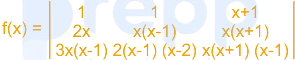
Understanding the Problem: Finding the Coefficient 'c'
The problem asks us to find the value of the coefficient 'c' in a cubic polynomial \({\rm{a}}{{\rm{x}}^3} + {\rm{b}}{{\rm{x}}^2} + {\rm{cx}} + {\rm{d}}\). This polynomial is defined as the determinant of a given \(3 \times 3\) matrix. The coefficient 'c' is the coefficient of the \(x\) term in the polynomial resulting from the determinant expansion.
To find the value of 'c', we need to calculate the determinant of the matrix and then identify the coefficient of the term containing \(x\).
Expanding the Determinant of the 3x3 Matrix
We will expand the determinant along the first row. The determinant of a \(3 \times 3\) matrix \(\begin{pmatrix} a_{11} & a_{12} & a_{13} \\ a_{21} & a_{22} & a_{23} \\ a_{31} & a_{32} & a_{33} \end{pmatrix}\) is given by:
This expression is equal to \({\rm{a}}{{\rm{x}}^3} + {\rm{b}}{{\rm{x}}^2} + {\rm{cx}} + {\rm{d}}\).
We are interested in the coefficient of the \(x\) term, which is 'c'. We collect the coefficients of \(x\) from each expanded term:
From Term 1: \(-1\)
From Term 2: \(+6\)
From Term 3: \(+30\)
The total coefficient of \(x\) is the sum of these values:
\( c = (-1) + (+6) + (+30) \)
\( c = -1 + 6 + 30 \)
\( c = 5 + 30 \)
\( c = 35 \)
Therefore, the value of c is 35.
Final Answer
The value of c is 35.
Revision Table: Determinant Expansion and Coefficient Finding
Step
Description
Result for \(x\) Coefficient
1
Expand the determinant using the first row cofactors.
Formula setup for each term.
2
Calculate the first term: \((x+1) \times \det(\text{minor})\)
\(2x^3 + 2x^2 - x - 1\). Coefficient of \(x\) is \(-1\).
3
Calculate the second term: \(-2x \times \det(\text{minor})\)
\(-22x^3 - 22x^2 + 6x\). Coefficient of \(x\) is \(+6\).
4
Calculate the third term: \(3x \times \det(\text{minor})\)
\(21x^3 + 48x^2 + 30x\). Coefficient of \(x\) is \(+30\).
5
Sum the coefficients of \(x\) from all terms.
\(-1 + 6 + 30 = 35\).
Additional Information: Determinants and Polynomials
When the entries of a matrix are polynomials in \(x\), the determinant of the matrix will also be a polynomial in \(x\). The degree of the resulting polynomial is at most the sum of the degrees of the entries along any diagonal path through the matrix that picks one element from each row and column (related to the Leibniz formula for determinants). In this specific case, the entries are linear or constant in \(x\), and the highest power of \(x\) comes from terms like \((x)(x)(x)\) or \((x)(x)(x)\) in the expansion, suggesting a cubic polynomial is possible, which matches the form \({\rm{a}}{{\rm{x}}^3} + {\rm{b}}{{\rm{x}}^2} + {\rm{cx}} + {\rm{d}}\).
Finding a specific coefficient like 'c' (the coefficient of \(x\)) often requires expanding the determinant and collecting terms. Alternatively, one could consider techniques involving differentiation, but direct expansion is straightforward for a \(3 \times 3\) matrix with linear entries.
Was this answer helpful?
Similar Questions
The value of the determinant \(\left| {\begin{array}{*{20}{c}} {1 - {\rm{\alpha }}}&{{\rm{\alpha }} - {{\rm{\alpha }}^2}}&{{{\rm{\alpha }}^2}}\\ {1 - {\rm{\beta }}}&{{\rm{\beta }} - {{\rm{\beta }}^2}}&{{{\rm{\beta }}^2}}\\ {1 - {\rm{\gamma }}}&{{\rm{\gamma }} - {{\rm{\gamma }}^2}}&{{{\rm{\gamma }}^2}} \end{array}} \right|\) is equal to
Let p, q and r be three distinct positive real numbers. If \(\rm D = \left| {\begin{array}{*{20}{c}} \rm p&\rm q&\rm r\\ \rm q&\rm r&\rm p\\ \rm r&\rm p&\rm q \end{array}} \right|,\) then which one of the following is correct?
What is the value of the determinant \(\left| {\begin{array}{*{20}{c}} {\rm{i}}&{{{\rm{i}}^2}}&{{{\rm{i}}^3}}\\ {{{\rm{i}}^4}}&{{{\rm{i}}^6}}&{{{\rm{i}}^8}}\\ {{{\rm{i}}^9}}&{{{\rm{i}}^{12}}}&{{{\rm{i}}^{15}}} \end{array}} \right|\) where \(\rm i = \sqrt {-1}\) ?
If x, y, z are distinct real numbers and \(\left| {\begin{array}{*{20}{c}} x&{{x^2}}&{2 + {x^3}}\\ y&{{y^2}}&{2 + {y^3}}\\ z&{{z^2}}&{2 + {z^3}} \end{array}} \right| = 0\), then xyz =
If A + B + C = \(\pi \), then, the value of \(\left| {\begin{array}{*{20}{c}} {\sin \left( {A + B + C} \right)}&{\sin B}&{\cos C}\\ { - \sin B}&0&{\tan A}\\ {\cos \left( {A + B} \right)}&{ - \tan A}&0 \end{array}} \right|\) is
Let p, q and r be three distinct positive real numbers. If \(\rm D = \left| {\begin{array}{*{20}{c}} \rm p&\rm q&\rm r\\ \rm q&\rm r&\rm p\\ \rm r&\rm p&\rm q \end{array}} \right|,\) then which one of the following is correct?