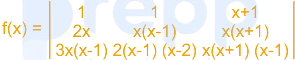
Let's simplify the determinant using elementary column operations. Recall that the value of a determinant does not change if we add a multiple of one column to another column.
First, observe the second column. We can factor out \(\alpha\), \(\beta\), and \(\gamma\) from the respective elements:
Let \(C_1\), \(C_2\), and \(C_3\) denote the first, second, and third columns, respectively.
Perform the operation \(C_2 \leftarrow C_2 + C_3\). This means we add the elements of the third column to the corresponding elements of the second column.
For the first row, the new second element is \(\alpha(1 - \alpha) + \alpha^2 = \alpha - \alpha^2 + \alpha^2 = \alpha\).
For the second row, the new second element is \(\beta(1 - \beta) + \beta^2 = \beta - \beta^2 + \beta^2 = \beta\).
For the third row, the new second element is \(\gamma(1 - \gamma) + \gamma^2 = \gamma - \gamma^2 + \gamma^2 = \gamma\).
The determinant becomes:
\(1 - {\rm{\alpha }}\)
\({\rm{\alpha }}\)
\({\rm{\alpha }}^2\)
\(1 - {\rm{\beta }}\)
\({\rm{\beta }}\)
\({\rm{\beta }}^2\)
\(1 - {\rm{\gamma }}\)
\({\rm{\gamma }}\)
\({\rm{\gamma }}^2\)
Now, perform the operation \(C_1 \leftarrow C_1 + C_2\). This means we add the elements of the second column to the corresponding elements of the first column.
For the first row, the new first element is \((1 - \alpha) + \alpha = 1\).
For the second row, the new first element is \((1 - \beta) + \beta = 1\).
For the third row, the new first element is \((1 - \gamma) + \gamma = 1\).
The determinant simplifies to:
\(1\)
\({\rm{\alpha }}\)
\({\rm{\alpha }}^2\)
\(1\)
\({\rm{\beta }}\)
\({\rm{\beta }}^2\)
\(1\)
\({\rm{\gamma }}\)
\({\rm{\gamma }}^2\)
Recognizing the Vandermonde Determinant
This simplified determinant is a standard form known as a Vandermonde determinant. A Vandermonde determinant of order 3 is given by:
Recognize the pattern in rows involving \(\alpha, \beta, \gamma\).
2
Apply \(C_2 \leftarrow C_2 + C_3\)
Simplify the second column elements from \(x(1-x)\) to \(x\).
3
Apply \(C_1 \leftarrow C_1 + C_2\)
Simplify the first column elements from \(1-x\) to \(1\).
4
Identify Vandermonde form
Recognize the resulting matrix structure \(\begin{pmatrix} 1 & x & x^2 \\ 1 & y & y^2 \\ 1 & z & z^2 \end{pmatrix}\).
5
Apply Vandermonde formula
Calculate the determinant value using the known formula.
6
Simplify and Match
Rearrange factors and signs to match the given options.
Additional Information: Vandermonde Determinants
A Vandermonde determinant is a determinant of a matrix where the entries of each row are powers of a sequence of elements, such as \(a^0, a^1, a^2, \ldots, a^{n-1}\). For an \(n \times n\) matrix, the Vandermonde determinant with elements \(a_1, a_2, \ldots, a_n\) is given by:
For a 3x3 matrix with elements \(a, b, c\), the product is \((a_2-a_1)(a_3-a_1)(a_3-a_2)\), which corresponds to \((b-a)(c-a)(c-b)\) when \(a_1=a, a_2=b, a_3=c\).
Vandermonde determinants are important in polynomial interpolation and other areas of linear algebra.
Was this answer helpful?
Similar Questions
The element in the i th row and the j th column of a determinant of third order is equal to 2(i + j). What is the value of the determinant?
Let p, q and r be three distinct positive real numbers. If \(\rm D = \left| {\begin{array}{*{20}{c}} \rm p&\rm q&\rm r\\ \rm q&\rm r&\rm p\\ \rm r&\rm p&\rm q \end{array}} \right|,\) then which one of the following is correct?
What is the value of the determinant \(\left| {\begin{array}{*{20}{c}} {\rm{i}}&{{{\rm{i}}^2}}&{{{\rm{i}}^3}}\\ {{{\rm{i}}^4}}&{{{\rm{i}}^6}}&{{{\rm{i}}^8}}\\ {{{\rm{i}}^9}}&{{{\rm{i}}^{12}}}&{{{\rm{i}}^{15}}} \end{array}} \right|\) where \(\rm i = \sqrt {-1}\) ?
If x, y, z are distinct real numbers and \(\left| {\begin{array}{*{20}{c}} x&{{x^2}}&{2 + {x^3}}\\ y&{{y^2}}&{2 + {y^3}}\\ z&{{z^2}}&{2 + {z^3}} \end{array}} \right| = 0\), then xyz =
If A + B + C = \(\pi \), then, the value of \(\left| {\begin{array}{*{20}{c}} {\sin \left( {A + B + C} \right)}&{\sin B}&{\cos C}\\ { - \sin B}&0&{\tan A}\\ {\cos \left( {A + B} \right)}&{ - \tan A}&0 \end{array}} \right|\) is
Let p, q and r be three distinct positive real numbers. If \(\rm D = \left| {\begin{array}{*{20}{c}} \rm p&\rm q&\rm r\\ \rm q&\rm r&\rm p\\ \rm r&\rm p&\rm q \end{array}} \right|,\) then which one of the following is correct?