
Three of the following four options are alike in a certain way and thus form a group. Which is the one that does NOT belong to that group? (NOTE: Operations should be performed on the whole numbers, without breaking down the numbers into its constituent digits. E.g. 13 – Operations on 13 such as adding/subtracting/multiplying etc. to 13 can be performed. Breaking down 13 into 1 and 3 and then performing mathematical operations on 1 and 3 is not allowed.)
86 - 41 - 38
To determine which option does not belong to the group, let's analyze each set of numbers based on the operations you can perform on them. We need to find a common pattern in three of the four options and identify which one deviates from this pattern.
- Option 1: \(118 - 93 - 161\)
- Sum of the numbers: \(118 + 93 + 161 = 372\)
- Option 2: \(86 - 41 - 38\)
- Sum of the numbers: \(86 + 41 + 38 = 165\)
- Option 3: \(52 - 36 - 56\)
- Sum of the numbers: \(52 + 36 + 56 = 144\)
- Option 4: \(33 - 15 - 12\)
- Sum of the numbers: \(33 + 15 + 12 = 60\)
To identify the commonality among three options, observe the nature of the sum:
- Options 1, 3, and 4 result in an even sum: \(372, 144,\) and \(60\) respectively.
- Option 2 results in an odd sum: \(165\).
Since Options 1, 3, and 4 all have an even sum, they belong to the same group. Option 2 has an odd sum, which does not fit the pattern.
Conclusion: The option that does not belong to the group is \(86 - 41 - 38\).
Similar Questions
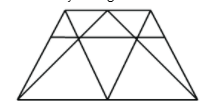
How many triangles are there in the given figure?
Find the odd word/letters/number pair from the given alternatives.
(A) Fire (B) Light (C) Gas (D) Water
Find the odd word/letters/number pair from the given alternatives.
Four letter-clusters have been given, out of which three are alike in some manner and one is different. Select the letter-cluster that is different.
Note: The odd one out is not based on the number of consonants/vowels or their position in the letter cluster.
In the following question, four number pairs are given. In each pair the number on left side of (-) is related to the number of the right side of (-) with some Logic/Rule/Relation. Three pairs are similar on basis of same Logic/Rule/Relation.
Select the odd one out from the given alternatives. (NOTE: Operations should be performed on the whole numbers, without breaking down the numbers into its constituent digits. E.g.13 - Operations on 13 such as adding /subtracting /multiplying etc. to 13 can be performed. Breaking down 13 into 1 and 3 and then performing mathematical operations on 1 and 3 is not allowed)Three of the following numbers are alike in a certain way and one is different. Pick the odd one out.
(NOTE: Operations should be performed on the whole numbers, without breaking down the numbers into their constituent digits. E.g. 13 – Operations on 13 such as adding/deleting/multiplying etc. to 13 can be performed. Breaking down 13 into 1 and 3 and then performing mathematical operations on 1 and 3 is not allowed.)
Three of the following numbers are alike in a certain way and one is different. Pick the odd one out. (NOTE: Operations should be performed on the whole numbers, without breaking down the numbers into its constituent digits. E.g. 13 – Operations on 13 such as adding/deleting/multiplying etc., to 13 can be performed. Breaking down 13 into 1 and 3 and then performing mathematical operations on 1 and 3 is not allowed.)
Four letter-clusters have been given, out of which three are alike in some manner and one is different. Select the letter-cluster that is different. Note: The odd one out is not based on the number of consonants/vowels or their position in the letter cluster.
- Find the ODD one out.
- Identify the odd city:
Important Questions from Classification
Directions for the following 3 (three) items : consider the given information and answer the three items that follow.
A, B, C, D, E, F and G are Lecturers from different cities—Hyderabad, Delhi, Shillong, Kanpur, Chennai, Mumbai and Srinagar (not necessarily in the same order) who participated in a conference. Each one of them is specialized in a different subject, viz., Economics, Commerce, History, Sociology, Geography, Mathematics and Statistics (not necessarily in the same order).
Further 1. Lecturer from Kanpur is specialized in Geography
2. Lecturer D is from Shillong
3. Lecturer C from Delhi is specialized in Sociology
4. Lecturer B is specialized in neither History nor Mathematics
5. Lecturer A who is specialized in Economics does not belong to Hyderabad
6. Lecturer F who is specialized in Commerce belongs to Srinagar
7. Lecturer G who is specialized in Statistics belongs to Chennai
Who is specialized in Geography?
A, B, C, D, E, F and G are Lecturers from different cities—Hyderabad, Delhi, Shillong, Kanpur, Chennai, Mumbai and Srinagar (not necessarily in the same order) who participated in a conference. Each one of them is specialized in a different subject, viz., Economics, Commerce, History, Sociology, Geography, Mathematics and Statistics (not necessarily in the same order).
Further 1. Lecturer from Kanpur is specialized in Geography
2. Lecturer D is from Shillong
3. Lecturer C from Delhi is specialized in Sociology
4. Lecturer B is specialized in neither History nor Mathematics
5. Lecturer A who is specialized in Economics does not belong to Hyderabad
6. Lecturer F who is specialized in Commerce belongs to Srinagar
7. Lecturer G who is specialized in Statistics belongs to Chennai
To which city does the Lecturer specialized in Economics belong?
A, B, C, D, E, F and G are Lecturers from different cities—Hyderabad, Delhi, Shillong, Kanpur, Chennai, Mumbai and Srinagar (not necessarily in the same order) who participated in a conference. Each one of them is specialized in a different subject, viz., Economics, Commerce, History, Sociology, Geography, Mathematics and Statistics (not necessarily in the same order).
Further 1. Lecturer from Kanpur is specialized in Geography
2. Lecturer D is from Shillong
3. Lecturer C from Delhi is specialized in Sociology
4. Lecturer B is specialized in neither History nor Mathematics
5. Lecturer A who is specialized in Economics does not belong to Hyderabad
6. Lecturer F who is specialized in Commerce belongs to Srinagar
7. Lecturer G who is specialized in Statistics belongs to Chennai
Who of the following belongs to Hyderabad?
In a school, there are five teachers A, B, C, D and E. A and B teach Hindi and English. C and B teach English and Geography. D and A teach Mathematics and Hindi. E and B teach History and French. Who teaches maximum numb, of subjects?
How many triangles are there in the given figure?



