
In the following question, four number pairs are given. In each pair the number on left side of (-) is related to the number of the right side of (-) with some Logic/Rule/Relation. Three pairs are similar on basis of same Logic/Rule/Relation.
Select the odd one out from the given alternatives. (NOTE: Operations should be performed on the whole numbers, without breaking down the numbers into its constituent digits. E.g.13 - Operations on 13 such as adding /subtracting /multiplying etc. to 13 can be performed. Breaking down 13 into 1 and 3 and then performing mathematical operations on 1 and 3 is not allowed)
Understanding the Number Pair Relationship
The question asks us to identify the number pair that does not follow the same rule or logic as the other three pairs. We are given four pairs of numbers, separated by a hyphen (left number - right number). The rule applies to the whole numbers, not their individual digits.
Analyzing Each Number Pair
Let's examine each number pair to find a possible mathematical relationship between the number on the left and the number on the right.
- Pair 1: 11 - 23
- Pair 2: 9 - 16
- Pair 3: 25 - 51
- Pair 4: 13 - 27
We need to look for a consistent operation (like addition, subtraction, multiplication, division, or a combination of these) that connects the first number to the second number in at least three of these pairs.
Discovering the Common Logic
Let's try a common type of relationship: multiplying the left number by a constant and then adding or subtracting a constant. Let the left number be $L$ and the right number be $R$. We are looking for a relationship like $R = aL + b$ or similar.
Consider the first pair: 11 - 23. If we multiply 11 by 2, we get 22. Adding 1 to 22 gives us 23. So, a possible rule is $R = 2L + 1$.
Let's test this rule on the other pairs:
| Pair | Left Number (L) | Applying Rule R = 2L + 1 | Calculated Right Number | Given Right Number (R) | Does it fit? |
|---|---|---|---|---|---|
| 1 | 11 | $2 \times 11 + 1$ | $22 + 1 = 23$ | 23 | Yes |
| 2 | 9 | $2 \times 9 + 1$ | $18 + 1 = 19$ | 16 | No |
| 3 | 25 | $2 \times 25 + 1$ | $50 + 1 = 51$ | 51 | Yes |
| 4 | 13 | $2 \times 13 + 1$ | $26 + 1 = 27$ | 27 | Yes |
As shown in the table, the rule $R = 2L + 1$ holds true for pairs 11 - 23, 25 - 51, and 13 - 27.
Identifying the Odd Pair
The pair 9 - 16 is the only one that does not follow the rule $R = 2L + 1$. According to this rule, if the left number is 9, the right number should be $2 \times 9 + 1 = 19$. However, the given pair is 9 - 16.
Conclusion: The Odd One Out
Based on the consistent logic found in three of the pairs, the pair 9 - 16 is the odd one out because it does not fit the rule $R = 2L + 1$.
Number Pair Analysis Revision Table
| Pair | Left Number (L) | Right Number (R) | Observed Relation | Fits Rule (R = 2L + 1)? | Odd One Out Status |
|---|---|---|---|---|---|
| 11 - 23 | 11 | 23 | $2 \times 11 + 1 = 23$ | Yes | Regular Pair |
| 9 - 16 | 9 | 16 | $2 \times 9 + 1 = 19 \neq 16$ | No | Odd Pair |
| 25 - 51 | 25 | 51 | $2 \times 25 + 1 = 51$ | Yes | Regular Pair |
| 13 - 27 | 13 | 27 | $2 \times 13 + 1 = 27$ | Yes | Regular Pair |
Additional Information on Number Patterns
Identifying patterns in number sequences or pairs is a common skill tested in various exams. These patterns can be based on arithmetic operations, algebraic expressions, squares, cubes, or other mathematical properties.
- Common Pattern Types: Look for arithmetic progressions (constant difference), geometric progressions (constant ratio), patterns involving squares or cubes, or linear relationships like $aL + b$.
- Tips for Finding Patterns:
- Calculate the difference or ratio between consecutive numbers (or numbers in a pair).
- Try simple operations: add, subtract, multiply, divide.
- Consider squaring or cubing the numbers.
- Test linear relationships like $aL + b$ by using two pairs to solve for $a$ and $b$.
- Once a potential rule is found, test it on all other items to confirm.
Similar Questions
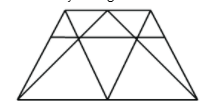
How many triangles are there in the given figure?
Find the odd word/letters/number pair from the given alternatives.
(A) Fire (B) Light (C) Gas (D) Water
Find the odd word/letters/number pair from the given alternatives.
Four letter-clusters have been given, out of which three are alike in some manner and one is different. Select the letter-cluster that is different.
Note: The odd one out is not based on the number of consonants/vowels or their position in the letter cluster.
Three of the following four options are alike in a certain way and thus form a group. Which is the one that does NOT belong to that group?
(NOTE: Operations should be performed on the whole numbers, without breaking down the numbers into its constituent digits. E.g. 13 – Operations on 13 such as adding/subtracting/multiplying etc. to 13 can be performed. Breaking down 13 into 1 and 3 and then performing mathematical operations on 1 and 3 is not allowed.)
Three of the following numbers are alike in a certain way and one is different. Pick the odd one out.
(NOTE: Operations should be performed on the whole numbers, without breaking down the numbers into their constituent digits. E.g. 13 – Operations on 13 such as adding/deleting/multiplying etc. to 13 can be performed. Breaking down 13 into 1 and 3 and then performing mathematical operations on 1 and 3 is not allowed.)
Three of the following numbers are alike in a certain way and one is different. Pick the odd one out. (NOTE: Operations should be performed on the whole numbers, without breaking down the numbers into its constituent digits. E.g. 13 – Operations on 13 such as adding/deleting/multiplying etc., to 13 can be performed. Breaking down 13 into 1 and 3 and then performing mathematical operations on 1 and 3 is not allowed.)
Four letter-clusters have been given, out of which three are alike in some manner and one is different. Select the letter-cluster that is different. Note: The odd one out is not based on the number of consonants/vowels or their position in the letter cluster.
Three of the following four options are alike in a certain way and thus form a group. Which is the option that does NOT belong to that group?
(NOTE : Operations should be performed on the whole numbers, without breaking down the numbers into its constituent digits. E.g. 13 – Operations on 13 such as adding /deleting /multiplying etc., to 13 can be performed. Breaking down 13 into 1 and 3 and then performing mathematical operations on 1 and 3 is not allowed).
In each of the following questions, a group of three numbers/symbols is given in each option. Identify the group that does NOT follow the same pattern as the others.
Important Questions from Classification
Directions for the following 3 (three) items : consider the given information and answer the three items that follow.
A, B, C, D, E, F and G are Lecturers from different cities—Hyderabad, Delhi, Shillong, Kanpur, Chennai, Mumbai and Srinagar (not necessarily in the same order) who participated in a conference. Each one of them is specialized in a different subject, viz., Economics, Commerce, History, Sociology, Geography, Mathematics and Statistics (not necessarily in the same order).
Further 1. Lecturer from Kanpur is specialized in Geography
2. Lecturer D is from Shillong
3. Lecturer C from Delhi is specialized in Sociology
4. Lecturer B is specialized in neither History nor Mathematics
5. Lecturer A who is specialized in Economics does not belong to Hyderabad
6. Lecturer F who is specialized in Commerce belongs to Srinagar
7. Lecturer G who is specialized in Statistics belongs to Chennai
Who is specialized in Geography?
A, B, C, D, E, F and G are Lecturers from different cities—Hyderabad, Delhi, Shillong, Kanpur, Chennai, Mumbai and Srinagar (not necessarily in the same order) who participated in a conference. Each one of them is specialized in a different subject, viz., Economics, Commerce, History, Sociology, Geography, Mathematics and Statistics (not necessarily in the same order).
Further 1. Lecturer from Kanpur is specialized in Geography
2. Lecturer D is from Shillong
3. Lecturer C from Delhi is specialized in Sociology
4. Lecturer B is specialized in neither History nor Mathematics
5. Lecturer A who is specialized in Economics does not belong to Hyderabad
6. Lecturer F who is specialized in Commerce belongs to Srinagar
7. Lecturer G who is specialized in Statistics belongs to Chennai
To which city does the Lecturer specialized in Economics belong?
A, B, C, D, E, F and G are Lecturers from different cities—Hyderabad, Delhi, Shillong, Kanpur, Chennai, Mumbai and Srinagar (not necessarily in the same order) who participated in a conference. Each one of them is specialized in a different subject, viz., Economics, Commerce, History, Sociology, Geography, Mathematics and Statistics (not necessarily in the same order).
Further 1. Lecturer from Kanpur is specialized in Geography
2. Lecturer D is from Shillong
3. Lecturer C from Delhi is specialized in Sociology
4. Lecturer B is specialized in neither History nor Mathematics
5. Lecturer A who is specialized in Economics does not belong to Hyderabad
6. Lecturer F who is specialized in Commerce belongs to Srinagar
7. Lecturer G who is specialized in Statistics belongs to Chennai
Who of the following belongs to Hyderabad?
In a school, there are five teachers A, B, C, D and E. A and B teach Hindi and English. C and B teach English and Geography. D and A teach Mathematics and Hindi. E and B teach History and French. Who teaches maximum numb, of subjects?
How many triangles are there in the given figure?



