
The properties of Dirac Delta are A. δ (t - to)=∞ if t = to B. δ (t - to)=0 if t = to C. δ (t - to)=0 if t ≠ to D. δ (t - to)=∞ if t ≠ to E. δ (t - to)=1 for all t = to Choose the correct answer from the options given below:
A and C only
The Dirac Delta function, denoted as \(\delta(t - t_o)\), is an important concept in signals and systems analysis. It has unique properties that are often tested in exams. Let's examine the properties listed in the question and determine which are correctly stated.
- Property A: \(\delta(t - t_o)=\infty\) if \(t = t_o\)
- This property is essentially true when considering the mathematical representation of the Dirac Delta, which can be thought of as having an infinite value at \(t = t_o\).
- The delta function is not a function in the traditional sense, but rather a distribution that integrates to one despite being 'infinitely high' exactly at \(t = t_o\).
- Property B: \(\delta(t - t_o)=0\) if \(t = t_o\)
- This statement is incorrect. At \(t = t_o\), the Dirac Delta function is not zero; as explained, it is conceptually 'infinite' at that point.
- Property C: \(\delta(t - t_o)=0\) if \(t \neq t_o\)
- This property is correct. The Dirac Delta function equals zero for all points except where \(t = t_o\).
- Property D: \(\delta(t - t_o)=\infty\) if \(t \neq t_o\)
- This statement is false. As established, \(\delta(t - t_o)\) is zero for all points except \(t = t_o\).
- Property E: \(\delta(t - t_o)=1\) for all \(t = t_o\)
- This property misunderstands the Dirac Delta function's nature. While the integral of the delta function over the entire real line is 1, its value at any specific point \(t = t_o\) is conceptually infinite, not 1.
Based on the above analysis, the correct answer is A and C only, as these reflect the true properties of the Dirac Delta function.
Similar Questions
From the options given below :
(A) x(t) δ(t) = x(0) δ(t) if x(t) is continuous at t = 0
(B) \(\int_{1}^{2}\left(3t^{2}+1\right)\delta(t)\,dt=4\) where δ(t) is Dirac Delta function
(C) x[n] = (–0.5)nu[n] is not an energy signal, where u[n] is a unit step sequence
(D) tδ'(t) = –δ(t) where δ(t) is Dirac Delta function
(E) x(t) = t u(t) is neither an energy signal nor a power signal, where u(t) is unit step functionChoose the most appropriate answer from the options given below :
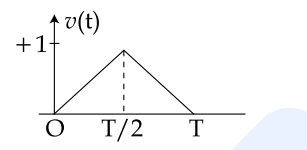
The correct expression of the following triangular wave is :
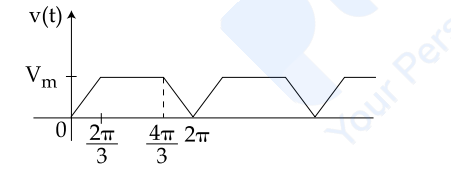
The average value of a periodic trapezoidal waveform is given by :
Important Questions from Standard Signals
Inverse Fourier Transform of δ(ω - ω 0) is ______.
The following statements relate to sampling distributions. Choose the correct code for the statements being correct or incorrect.
Statement I: Sampling distribution of mean is normally distributed irrespective of the type of population distribution and size of samples.
Statement II : The standard deviation of the sampling distribution of mean is less than the standard deviation of the population distribution.
The value of \(\mathop \smallint \limits_{ - \infty }^{ + \infty } {e^{ - t}}\delta \left( {2t - 2} \right)dt\), where \(\delta \left( t \right)\) is the Dirac delta function, is
Which of the following points CANNOT be observed about a unit impulse function if it is assumed in the form of a pulse?
Complete the sentence correctly:
An even signal is _______.



