
The average value of a periodic trapezoidal waveform is given by :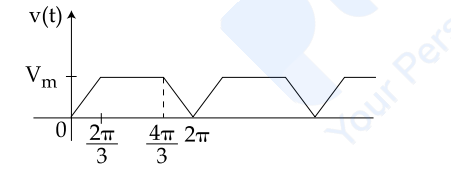
\(V_{av}(t)=\dfrac{2}{3}V_m\)
The average of a periodic waveform is its area divided by its period.
\(V_{av}=\dfrac{1}{T}\int_{0}^{T}v(t)\,dt=\dfrac{\text{area of one cycle}}{T}\)
Here \(T=2\pi\), and the shape is a trapezium, so the area can be read off geometrically without integrating.
Step 1 — split the cycle into its three pieces.
| Interval | Width | Shape | Area |
|---|---|---|---|
| 0 to 2π/3 | 2π/3 | Rising ramp | \(\tfrac{1}{2}\cdot\tfrac{2\pi}{3}\cdot V_m=\tfrac{\pi}{3}V_m\) |
| 2π/3 to 4π/3 | 2π/3 | Flat top | \(\tfrac{2\pi}{3}V_m\) |
| 4π/3 to 2π | 2π/3 | Falling ramp | \(\tfrac{1}{2}\cdot\tfrac{2\pi}{3}\cdot V_m=\tfrac{\pi}{3}V_m\) |
Step 2 — total the area.
\(A=\dfrac{\pi}{3}V_m+\dfrac{2\pi}{3}V_m+\dfrac{\pi}{3}V_m=\dfrac{4\pi}{3}V_m\)
Step 3 — divide by the period.
\(V_{av}=\dfrac{\left(4\pi/3\right)V_m}{2\pi}=\dfrac{4}{6}V_m=\dfrac{2}{3}V_m\)
which is option 1.
The trapezium shortcut. For any trapezium the area is the mean of the two parallel sides times the height. Here the "top" is 2π/3 long, the "base" is the full 2π, and the height is Vm:
\(A=\dfrac{1}{2}\left(\dfrac{2\pi}{3}+2\pi\right)V_m=\dfrac{4\pi}{3}V_m\ \checkmark\)
a single line instead of three.
The bounds that kill the wrong options instantly. The waveform never exceeds Vm and is zero over part of the cycle, so its average must lie strictly between 0 and Vm. Option 3 (Vm) would require a constant waveform and option 4 (1.5 Vm) exceeds the peak — impossible for any average. Only options 1 and 2 survive, and since the flat top alone already contributes \(\tfrac13V_m\) to the average, the total must exceed 1/3.
A useful comparison. Ramping the edges costs surprisingly little: a pure square wave with the same 2π/3 high time would average \(\tfrac13V_m\), and the two ramps add exactly as much again, because each contributes half of what a flat section of the same width would.
Hence, the average value is (2/3)Vm.
Similar Questions
From the options given below :
(A) x(t) δ(t) = x(0) δ(t) if x(t) is continuous at t = 0
(B) \(\int_{1}^{2}\left(3t^{2}+1\right)\delta(t)\,dt=4\) where δ(t) is Dirac Delta function
(C) x[n] = (–0.5)nu[n] is not an energy signal, where u[n] is a unit step sequence
(D) tδ'(t) = –δ(t) where δ(t) is Dirac Delta function
(E) x(t) = t u(t) is neither an energy signal nor a power signal, where u(t) is unit step functionChoose the most appropriate answer from the options given below :
The properties of Dirac Delta are
A. δ (t - to)=∞ if t = to
B. δ (t - to)=0 if t = to
C. δ (t - to)=0 if t ≠ to
D. δ (t - to)=∞ if t ≠ to
E. δ (t - to)=1 for all t = to
Choose the correct answer from the options given below:
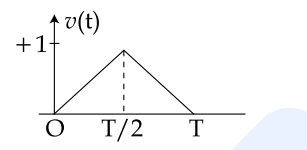
The correct expression of the following triangular wave is :
Important Questions from Standard Signals
Inverse Fourier Transform of δ(ω - ω 0) is ______.
The following statements relate to sampling distributions. Choose the correct code for the statements being correct or incorrect.
Statement I: Sampling distribution of mean is normally distributed irrespective of the type of population distribution and size of samples.
Statement II : The standard deviation of the sampling distribution of mean is less than the standard deviation of the population distribution.
The value of \(\mathop \smallint \limits_{ - \infty }^{ + \infty } {e^{ - t}}\delta \left( {2t - 2} \right)dt\), where \(\delta \left( t \right)\) is the Dirac delta function, is
Which of the following points CANNOT be observed about a unit impulse function if it is assumed in the form of a pulse?
Complete the sentence correctly:
An even signal is _______.



