
From the options given below : (A) x(t) δ(t) = x(0) δ(t) if x(t) is continuous at t = 0 Choose the most appropriate answer from the options given below :
(B) \(\int_{1}^{2}\left(3t^{2}+1\right)\delta(t)\,dt=4\) where δ(t) is Dirac Delta function
(C) x[n] = (–0.5)nu[n] is not an energy signal, where u[n] is a unit step sequence
(D) tδ'(t) = –δ(t) where δ(t) is Dirac Delta function
(E) x(t) = t u(t) is neither an energy signal nor a power signal, where u(t) is unit step function
(A), (D) and (E) Only
Statements (A), (D) and (E) are the true ones — option 3 — and each of the other two fails for a definite reason.
(A) — the sampling property. True. The impulse is zero everywhere except at the origin, so multiplying by any function that is continuous there can only pick out that function's value at t = 0:
\(x(t)\delta(t)=x(0)\delta(t)\)
The continuity condition matters: if x(t) jumped at t = 0 there would be no single value to select.
(B) — false, and the reason is the limits. The impulse sits at t = 0, which lies outside the interval from 1 to 2. An integral over a region where the integrand is identically zero must vanish:
\(\int_{1}^{2}\left(3t^{2}+1\right)\delta(t)\,dt=0\)
The value 4 is what would be obtained from \(3t^{2}+1\) at \(t=1\) — the trap is to evaluate the function at a limit instead of checking whether the impulse is enclosed at all.
(C) — false. The sequence \(x[n]=(-0.5)^{n}u[n]\) decays geometrically, and its energy is a convergent geometric series:
\(E=\sum_{n=0}^{\infty}\left|(-0.5)^{n}\right|^{2}=\sum_{n=0}^{\infty}(0.25)^{n}=\dfrac{1}{1-0.25}=\dfrac{4}{3}\)
A finite non-zero energy means it is an energy signal, so the statement asserts the opposite of the truth. Any decaying exponential with \(|a|\lt1\) qualifies.
(D) — true, and worth deriving. Apply the doublet to a test function and integrate by parts:
\(\int t\,\delta'(t)\phi(t)\,dt=-\int\delta(t)\dfrac{d}{dt}\left[t\phi(t)\right]dt=-\left[\phi(0)+0\right]=-\int\delta(t)\phi(t)\,dt\)
Since this holds for every test function, \(t\delta'(t)=-\delta(t)\).
(E) — true. The ramp grows without bound, so its energy diverges; and its average power
\(P=\lim_{T\to\infty}\dfrac{1}{2T}\int_{0}^{T}t^{2}dt=\lim_{T\to\infty}\dfrac{T^{2}}{6}\)
diverges too. Being neither finite-energy nor finite-power, it belongs to neither class — a reminder that the two categories are not exhaustive.
Hence, the true statements are (A), (D) and (E).
Similar Questions
The properties of Dirac Delta are
A. δ (t - to)=∞ if t = to
B. δ (t - to)=0 if t = to
C. δ (t - to)=0 if t ≠ to
D. δ (t - to)=∞ if t ≠ to
E. δ (t - to)=1 for all t = to
Choose the correct answer from the options given below:
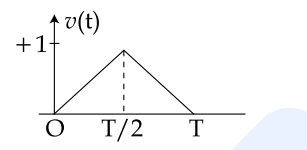
The correct expression of the following triangular wave is :
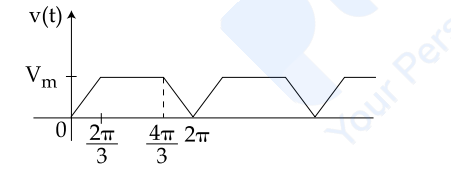
The average value of a periodic trapezoidal waveform is given by :
Important Questions from Standard Signals
Inverse Fourier Transform of δ(ω - ω 0) is ______.
The following statements relate to sampling distributions. Choose the correct code for the statements being correct or incorrect.
Statement I: Sampling distribution of mean is normally distributed irrespective of the type of population distribution and size of samples.
Statement II : The standard deviation of the sampling distribution of mean is less than the standard deviation of the population distribution.
The value of \(\mathop \smallint \limits_{ - \infty }^{ + \infty } {e^{ - t}}\delta \left( {2t - 2} \right)dt\), where \(\delta \left( t \right)\) is the Dirac delta function, is
Which of the following points CANNOT be observed about a unit impulse function if it is assumed in the form of a pulse?
Complete the sentence correctly:
An even signal is _______.



