
The correct expression of the following triangular wave is :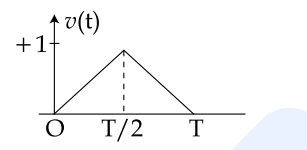
\(v(t)=\dfrac{2}{T}r(t)-\dfrac{4}{T}r\!\left(t-\tfrac{T}{2}\right)+\dfrac{2}{T}r(t-T)\)
The method: build the waveform out of ramps by tracking the slope. A ramp \(r(t-t_0)\) is zero before t0 and rises with unit slope after it. So adding a ramp at t0 with coefficient k changes the slope by k at that instant. Read the picture as a list of slope changes.
Step 1 — the three breakpoints.
| Instant | Slope before | Slope after | Change |
|---|---|---|---|
| t = 0 | 0 | +2/T | +2/T |
| t = T/2 | +2/T | −2/T | −4/T |
| t = T | −2/T | 0 | +2/T |
The rising slope is \(1\div(T/2)=2/T\) because the wave climbs to 1 in half a period; at the peak the slope reverses to \(-2/T\), a change of \(-4/T\); and at t = T the wave flattens, a change of \(+2/T\).
Step 2 — write one ramp per breakpoint, using the slope change as its coefficient.
\(v(t)=\dfrac{2}{T}r(t)-\dfrac{4}{T}r\!\left(t-\dfrac{T}{2}\right)+\dfrac{2}{T}r(t-T)\)
which is option 2.
Verify at the three key instants.
At t = T/2: only the first ramp is active, giving \((2/T)(T/2)=1\) ✓ the peak.
At t = T: the first two act, \((2/T)(T)-(4/T)(T/2)=2-2=0\) ✓ back to zero.
At t = 2T: all three, \((2/T)(2T)-(4/T)(3T/2)+(2/T)(T)=4-6+2=0\) ✓ stays at zero for ever after, which is the real test of the third term.
The check that kills the other options instantly. The coefficients of any such decomposition must sum to zero whenever the waveform ends flat, because the total slope change must return the slope to zero. Here \(2/T-4/T+2/T=0\) ✓. Option 1 gives \(1/T+4/T+2/T=7/T\ne0\), option 3 gives \(1/T\ne0\) and option 4 also fails. One addition settles the question.
Why this representation is worth having. Once written as a sum of shifted ramps, the Laplace transform follows immediately from \(r(t-a)\leftrightarrow e^{-as}/s^{2}\):
\(V(s)=\dfrac{2}{Ts^{2}}\left(1-2e^{-sT/2}+e^{-sT}\right)\)
Hence, the correct expression is \(v(t)=\dfrac{2}{T}r(t)-\dfrac{4}{T}r\!\left(t-\tfrac{T}{2}\right)+\dfrac{2}{T}r(t-T)\).
Similar Questions
From the options given below :
(A) x(t) δ(t) = x(0) δ(t) if x(t) is continuous at t = 0
(B) \(\int_{1}^{2}\left(3t^{2}+1\right)\delta(t)\,dt=4\) where δ(t) is Dirac Delta function
(C) x[n] = (–0.5)nu[n] is not an energy signal, where u[n] is a unit step sequence
(D) tδ'(t) = –δ(t) where δ(t) is Dirac Delta function
(E) x(t) = t u(t) is neither an energy signal nor a power signal, where u(t) is unit step functionChoose the most appropriate answer from the options given below :
The properties of Dirac Delta are
A. δ (t - to)=∞ if t = to
B. δ (t - to)=0 if t = to
C. δ (t - to)=0 if t ≠ to
D. δ (t - to)=∞ if t ≠ to
E. δ (t - to)=1 for all t = to
Choose the correct answer from the options given below:
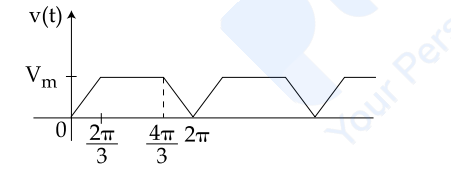
The average value of a periodic trapezoidal waveform is given by :
Important Questions from Standard Signals
Inverse Fourier Transform of δ(ω - ω 0) is ______.
The following statements relate to sampling distributions. Choose the correct code for the statements being correct or incorrect.
Statement I: Sampling distribution of mean is normally distributed irrespective of the type of population distribution and size of samples.
Statement II : The standard deviation of the sampling distribution of mean is less than the standard deviation of the population distribution.
The value of \(\mathop \smallint \limits_{ - \infty }^{ + \infty } {e^{ - t}}\delta \left( {2t - 2} \right)dt\), where \(\delta \left( t \right)\) is the Dirac delta function, is
Which of the following points CANNOT be observed about a unit impulse function if it is assumed in the form of a pulse?
Complete the sentence correctly:
An even signal is _______.



