Similar Triangles Perimeter Calculation
For any two similar triangles, the ratio of their perimeters is equal to the ratio of their corresponding sides.
Given Information
- The two triangles, $\Delta\text{XYZ}$ and $\Delta\text{LMN}$, are similar.
- Perimeter of $\Delta\text{XYZ}$ ($P_{\text{XYZ}}$) = $48\text{ cm}$.
- Perimeter of $\Delta\text{LMN}$ ($P_{\text{LMN}}$) = $32\text{ cm}$.
- Length of side $\text{LM}$ in $\Delta\text{LMN}$ = $12\text{ cm}$.
- We need to find the length of the corresponding side $\text{XY}$ in $\Delta\text{XYZ}$.
Applying Perimeter-Side Ratio Theorem
The theorem states that for similar triangles:
$ \frac{\text{Perimeter of } \Delta\text{XYZ}}{\text{Perimeter of } \Delta\text{LMN}} = \frac{\text{XY}}{\text{LM}} $
Calculating XY Length
Substitute the given values into the formula:
$ \frac{48\text{ cm}}{32\text{ cm}} = \frac{\text{XY}}{12\text{ cm}} $
Simplify the ratio of the perimeters:
$ \frac{48}{32} = \frac{3 \times 16}{2 \times 16} = \frac{3}{2} $
Now, the equation becomes:
$ \frac{3}{2} = \frac{\text{XY}}{12\text{ cm}} $
To find $\text{XY}$, multiply both sides by $12\text{ cm}$:
$ \text{XY} = \frac{3}{2} \times 12\text{ cm} $
$ \text{XY} = 3 \times \frac{12}{2}\text{ cm} $
$ \text{XY} = 3 \times 6\text{ cm} $
$ \text{XY} = 18\text{ cm} $
Final Answer
The length of side $\text{XY}$ is $18\text{ cm}$.
Similar Questions
- In $\Delta ABC$ $\overline{PQ} \parallel \overline{AB}$. P and Q are on BC and CA respectively. If CQ : QA = 1 : 3 and CP = 4, then what is the value of BC?
- The altitudes of two similar triangles are 4 cm and 6 cm. If the area of the larger triangle is $36\text{ cm}^2$, what will be the area of the other one?
- In $\Delta$ABC, DE||BC, intersecting AB at D and AC at E. AD : BD :: 2 : 3 and the area of trapezium BDEC is $63 \text{ cm}^2$. What is the area of $\Delta$ADE?
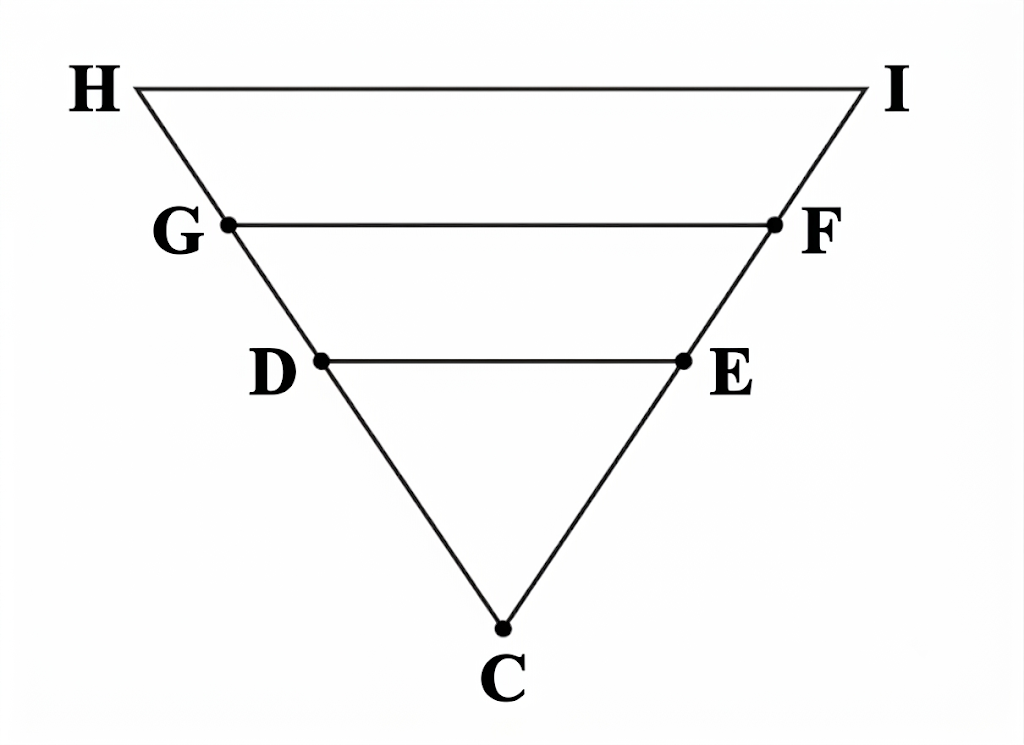
In the given figure, \(HI\), \(GF\), and \(DE\) are parallel lines. If \(DG = 6\), \(GH = 4\), and \(FI = 8\), then \(EF = ?\)
The lengths of the three sides of \(\Delta ABC\) are 6 cm, 4 cm, and 9 cm. Another triangle \(\Delta DEF\) is similar to \(\Delta ABC\), one side of which is 36 cm. What is the largest possible perimeter of \(\Delta DEF\)?
Important Questions from Triangles, Congruence and Similarity
In a $\Delta ABC$, $\angle C = (9/4) \angle B = (3/2) (\angle A+\angle B)$. Find the measure of the angles.
- The areas of two similar triangles $\Delta$XYZ and $\Delta$LMN are 49 cm$^2$ and 9 cm$^2$, respectively. If LM = 9 cm, then the length of XY is:
Triangles \(PQR\) and \(ABC\) are similar triangles. Triangle \(ABC\) have the following sides
\(AB = 12 \text{ cm}\),
\(AC = 15 \text{ cm}\),
\(CB = 21 \text{ cm}\).
Triangle \(PQR\) have the following sides:
\(PQ = 4 \text{ cm}\),
\(RQ = 7 \text{ cm}\).
What is the length of side \(PR\)?
For a pair of similar triangles, the angles made at \(Q\) is same in both the triangles \(PQR\) and \(LQJ\).
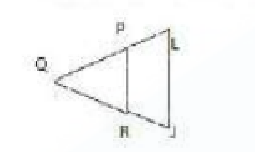
If the length of side \(QJ\) is 10 cm and \(QR\) is 5 cm, what is the ratio of their total areas?- In $\Delta ABC$ $\overline{PQ} \parallel \overline{AB}$. P and Q are on BC and CA respectively. If CQ : QA = 1 : 3 and CP = 4, then what is the value of BC?