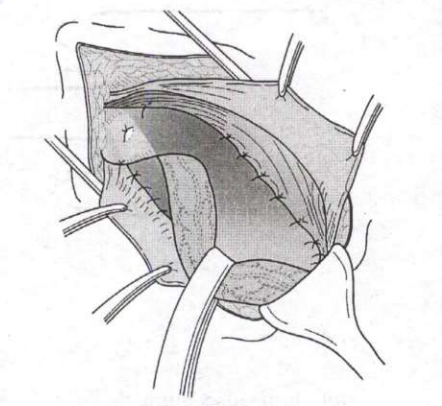
The line diagram shows the cross-section of bowel intussusception. The part marked with an asterisk is called as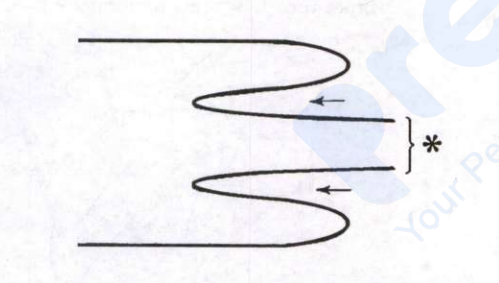
intussusceptum
The correct answer is intussusceptum. In intussusception one segment of bowel telescopes into the lumen of the adjacent distal segment. The proximal, invaginating (inner) segment drawn inwards along with its mesentery and mesenteric vessels is the intussusceptum, seen on cross-section as the inner double-walled tube marked by the asterisk. Because its mesentery is dragged in, venous congestion, oedema, bleeding (red-currant jelly stool) and finally gangrene occur.
Apex is only the leading tip of the intussusceptum, its most distal point of advance, not the whole inner tube. Base or neck is the junction where the intussusceptum bends back on itself, the point of entry into the outer tube. Intussuscipiens is the outer, receiving segment that ensheathes the invaginated portion, so it forms the outermost layer, not the asterisked inner one.
Key point: Intussusceptum goes IN, intussuscipiens RECEIVES. Ileocolic is commonest in children (idiopathic, hypertrophied Peyer patches), while in adults a pathological lead point such as a tumour must be excluded.
Important Questions from Intestines
- A 22-year female has presented with a history of malaise, cough, alternating constipation and diarrhoea with intermittent abdominal pain for last 6 months. She also complains of abdominal distension for last 2 days. On examination her abdomen has a doughy feel along with an ill defined mass over the right lower quadrant. She is most likely suffering from:
- Gentleman of 56 years underwent laparoscopic left hemicolectomy for diagnosed left colonic carcinoma. Histopathology revealed the tumour to be invading submucosa and muscularis propria. Among the 16 regional lymph nodes harvested, 2 were positive for malignant deposits.
His staging as per AJCC will be: - A 40 year old female patient presents with colicky abdominal pain associated with episodes of mild diarrhoea for last 6 months accompanied with intermittent fever and weight loss. There are multiple discharging sinuses on perineal examination. The most likely clinical diagnosis in this patient is:
- An eight month old male child is brought to the emergency with recurrent episodes of screaming and drawing up of legs. The child appears to be listless in between the attacks. Local examination of abdomen reveals feeling of emptiness in the right iliac fossa and blood stained mucus is found on the finger on per rectal examination. The most probable clinical diagnosis in this child is
- Which of the following statements regarding Ogilvie's syndrome are correct?
1. It presents as acute large bowel mechanical obstruction
2. Marked caecal dilatation is a common feature on X-ray abdo- men
3. Caecal perforation is a well recog- nized complication of this condi- tion
4. Intravenous Neostigmine is used for the treatment of this condition
Select the correct answer using the code given below :