
Study the given pattern carefully and select the number that can replace the question mark (?) in it. First row - 12, 7, 32 Second row - 17, 13, 33 Third row - 14, 8, ? (NOTE : Operations should be performed on the whole numbers, without breaking down the numbers into its constituent digits. E.g. 13 - Operations on 13 such as adding/subtracting/multiplying etc. to 13 can be performed. Breaking down 13 into 1 and 3 and then performing mathematical operations on 1 and 3 is NOT allowed)
38
Analyzing the Number Pattern
The question asks us to identify the relationship between the numbers in each row of the given pattern and use it to find the missing number in the third row. The pattern is presented in a grid format:
| First Number (A) | Second Number (B) | Third Number (C) |
|---|---|---|
| 12 | 7 | 32 |
| 17 | 13 | 33 |
| 14 | 8 | ? |
We need to find a mathematical operation or combination of operations performed on the first two numbers (A and B) in each row that results in the third number (C). The constraint is that we must use the whole numbers as given, not their individual digits.
Discovering the Pattern Rule
Let's examine the first two rows to find a consistent relationship between A, B, and C.
- Row 1: A = 12, B = 7, C = 32
- Row 2: A = 17, B = 13, C = 33
We can try different simple operations:
- Addition: $12 + 7 = 19 \neq 32$; $17 + 13 = 30 \neq 33$. (Not simple addition)
- Subtraction: $12 - 7 = 5 \neq 32$; $17 - 13 = 4 \neq 33$. (Not simple subtraction)
- Multiplication: $12 \times 7 = 84 \neq 32$; $17 \times 13 = 221 \neq 33$. (Not simple multiplication)
Let's consider a pattern where the third number C is a linear combination of A and B, in the form $C = xA + yB$. We can use the first two rows to set up a system of equations:
- For Row 1: $12x + 7y = 32$
- For Row 2: $17x + 13y = 33$
We can solve this system for $x$ and $y$. Let's multiply the first equation by 13 and the second by 7 to eliminate $y$:
- $13 \times (12x + 7y) = 13 \times 32 \implies 156x + 91y = 416$
- $7 \times (17x + 13y) = 7 \times 33 \implies 119x + 91y = 231$
Now, subtract the second new equation from the first:
$(156x + 91y) - (119x + 91y) = 416 - 231$
$37x = 185$
$x = \frac{185}{37}$
$x = 5$
Substitute the value of $x = 5$ into the first original equation ($12x + 7y = 32$):
$12(5) + 7y = 32$
$60 + 7y = 32$
$7y = 32 - 60$
$7y = -28$
$y = \frac{-28}{7}$
$y = -4$
So, the pattern appears to be $C = 5A - 4B$. Let's verify this rule with the first two rows:
- Row 1: $5 \times 12 - 4 \times 7 = 60 - 28 = 32$. This matches the given third number.
- Row 2: $5 \times 17 - 4 \times 13 = 85 - 52 = 33$. This matches the given third number.
The pattern $C = 5A - 4B$ is consistent for the first two rows.
Calculating the Missing Number
Now, we apply the discovered pattern to the third row to find the missing number (?).
- Row 3: A = 14, B = 8, C = ?
Using the formula $C = 5A - 4B$:
$C = 5 \times 14 - 4 \times 8$
$C = 70 - 32$
$C = 38$
The missing number in the pattern is 38.
Summary of the Solution
The pattern in the grid follows the rule where the third number (C) is calculated using the formula $C = 5 \times (\text{First Number}) - 4 \times (\text{Second Number})$. Applying this rule to the third row with the first number 14 and the second number 8 gives $5 \times 14 - 4 \times 8 = 70 - 32 = 38$.
Number Pattern Revision Table
| Row | First Number (A) | Second Number (B) | Pattern: $5A - 4B$ | Calculated Third Number | Given Third Number (C) |
|---|---|---|---|---|---|
| 1 | 12 | 7 | $5(12) - 4(7) = 60 - 28$ | 32 | 32 |
| 2 | 17 | 13 | $5(17) - 4(13) = 85 - 52$ | 33 | 33 |
| 3 | 14 | 8 | $5(14) - 4(8) = 70 - 32$ | 38 | ? |
Additional Information on Number Patterns
Number pattern questions are common in logical reasoning and aptitude tests. They assess your ability to identify underlying mathematical or logical relationships between numbers. Patterns can involve:
- Arithmetic progressions (constant difference).
- Geometric progressions (constant ratio).
- Combinations of arithmetic operations (addition, subtraction, multiplication, division).
- Operations on squares, cubes, or other powers.
- Relationships between numbers in rows, columns, or diagonals in a grid.
- Digit-based logic (though explicitly disallowed in this specific question).
- Alternating patterns or multiple interleaved series.
Solving these problems often requires careful observation, hypothesis testing, and systematic checking of potential rules. When dealing with grids, look for relationships within rows, within columns, or even diagonal relationships. Sometimes, the pattern involves a combination of elements from different positions in the grid.
Similar Questions
Find the missing number from the given alternatives.
7 10 5 16 40 8 15 ? 9 Select the missing images from the given responses:
Select the missing numbers from the given alternatives:
Select the missing number from the given responses:
Find the missing term in the following question:
Find the missing number from the alternatives.
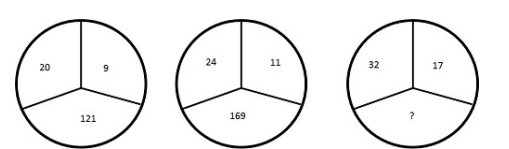
Select the missing number from the given responses:
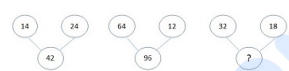
Select the missing number from the given responses.
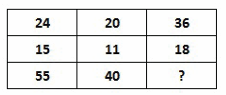
Find the missing number from the given alternatives:
8 7 6 7 6 5 6 5 4 90 65 ? Select the missing numbers from the given alternatives:
7 14 4 4 12 9 6 24 ?
Important Questions from Missing Number
Find the missing number from the below options.
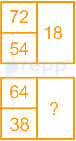
Find the missing number from the below options.
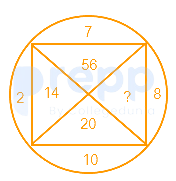
Find the missing number from the below options.
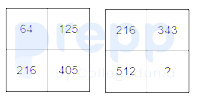
In the following question, select the number which can be placed at the sign of question mark (?) from the given alternatives
12
17
121
21
81
144
36
45
?
In the following question, find the missing number from the given series.
4, 12, 48, 240, 1440, ?



