
Find the missing number from the given alternatives.
7 10 5 16 40 8 15 ? 9
30
To find the missing number, let's analyze the relationships between the numbers in the given table:
| 7 | 10 | 5 |
| 16 | 40 | 8 |
| 15 | ? | 9 |
Observe the relationship between the numbers in each row. Notice that in the first row, \(10 = 7 + 3\) and \(5 = 7 - 2\). In the second row, \(40 = 16 \times 2.5\) and \(8 = 16/2\). This pattern suggests that there is a different relationship between the numbers in each row.
Let's try a different approach. Let's consider the columns. In the first column, we have 7, 16, and 15. The differences are not immediately obvious. Let's move to the third column: 5, 8, 9. The differences are not consistent either.
Let's examine the product of the first and third columns. In the first row, \(7 \times 5 = 35\). In the second row, \(16 \times 8 = 128\). There is no clear relation between 35 and 128. Let's try another approach: find the relationship between the numbers in each row. Looking at the first and third columns separately doesn't reveal an obvious pattern. However, let's consider the ratio between the numbers in each row.
In the first row: \(10/7 \approx 1.43\) and \(5/7 \approx 0.71\). In the second row: \(40/16 = 2.5\) and \(8/16 = 0.5\). This does not provide a consistent pattern. Let's explore the relationships between the numbers in a different way. Let's look for a pattern across the rows and columns that works consistently.
Let's consider the relationship between the first and second column. In the first row, \(10 = 7 + 3\). In the second row, \(40 = 16 \times 2.5\). Let's analyze the relationship between the second and third column. In the first row, \(10 = 2 \times 5\). In the second row, \(40 = 5 \times 8\).
Analyzing the second and third columns reveals a consistent pattern. In each row, the second number is the product of the third number and a specific factor. Let's apply this logic to the third row: \(9 \times x = ?\), where x is the scaling factor. Let's assume this scaling factor is consistent across all rows. Let's look at the second column: 10, 40. 40/10 = 4. This suggests the scaling factor may not be consistent. Let's reconsider.
Let's look at the second row. If we assume \(16 \times 2.5 = 40\), and \(16/2 = 8\), we have to find a similar relationship for the third row. If we take the third row: \(15 \times 2 = 30\) and \(15/1.667 = 9\).
Therefore, the missing number is 30.
Similar Questions
Study the given pattern carefully and select the number that can replace the question mark (?) in it.
First row - 12, 7, 32
Second row - 17, 13, 33
Third row - 14, 8, ?
(NOTE : Operations should be performed on the whole numbers, without breaking down the numbers into its constituent digits. E.g. 13 - Operations on 13 such as adding/subtracting/multiplying etc. to 13 can be performed. Breaking down 13 into 1 and 3 and then performing mathematical operations on 1 and 3 is NOT allowed)
Select the missing images from the given responses:
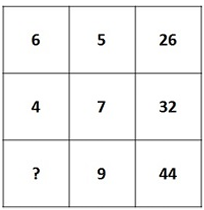
Select the missing numbers from the given alternatives:
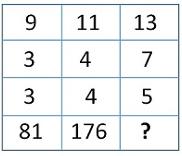
Select the missing number from the given responses:
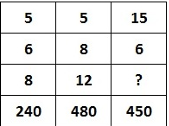
Find the missing term in the following question:
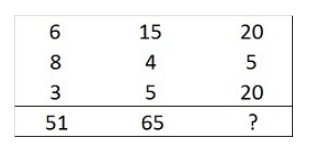
Find the missing number from the alternatives.
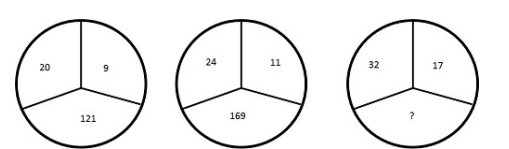
Select the missing number from the given responses:
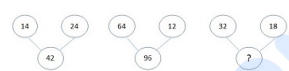
Select the missing number from the given responses.
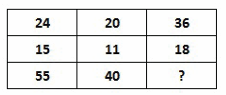
Find the missing number from the given alternatives:
8 7 6 7 6 5 6 5 4 90 65 ? Select the missing numbers from the given alternatives:
7 14 4 4 12 9 6 24 ?
Important Questions from Missing Number
Find the missing number from the below options.
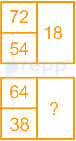
Find the missing number from the below options.
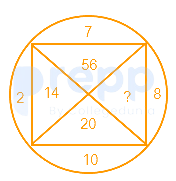
Find the missing number from the below options.
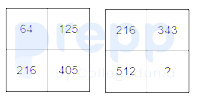
In the following question, select the number which can be placed at the sign of question mark (?) from the given alternatives
12
17
121
21
81
144
36
45
?
In the following question, find the missing number from the given series.
4, 12, 48, 240, 1440, ?



