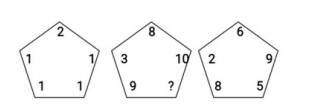
Study the given pattern carefully and select the number that can replace the question mark (?) in it. 7 13 6 4 22 18 15 ? 7
22
Understanding the Number Pattern Question
The question asks us to analyze a given sequence of numbers and find the number that logically replaces the question mark based on the pattern observed in the sequence.
The sequence is: 7, 13, 6, 4, 22, 18, 15, ?, 7.
We need to look for a relationship between the numbers that is consistent throughout the sequence or within segments of the sequence.
Identifying the Structure of the Number Sequence
Let's examine the sequence for possible sub-patterns or groupings. A common approach with sequences that don't follow simple arithmetic or geometric progression is to look for patterns within smaller groups of consecutive numbers.
Let's consider grouping the numbers into sets of three:
- Set 1: 7, 13, 6
- Set 2: 4, 22, 18
- Set 3: 15, ?, 7
The sequence ends after the third set, with 7 being the last number in the third set.
Finding the Pattern Rule in Each Set
Now, let's look for a relationship between the numbers within each identified set. We will analyze the first two sets to see if a consistent rule applies.
Analyzing Set 1: 7, 13, 6
Let's try simple arithmetic operations between the first two numbers (7 and 13) to see if they result in the third number (6).
- Sum: $7 + 13 = 20$ (Not 6)
- Difference: $13 - 7 = 6$ (This matches the third number)
- Difference (reversed): $7 - 13 = -6$ (Not 6)
- Product: $7 \times 13 = 91$ (Not 6)
The pattern observed here is that the third number is the difference between the second number and the first number ($2^{nd} - 1^{st} = 3^{rd}$).
Analyzing Set 2: 4, 22, 18
Let's test the same pattern rule ($2^{nd} - 1^{st} = 3^{rd}$) on the second set (4, 22, 18).
- First number: 4
- Second number: 22
- Third number: 18
Applying the rule: $22 - 4 = 18$.
This calculation matches the third number in Set 2. The pattern rule seems to be consistent across the first two sets.
Applying the Pattern to Find the Missing Number
Now we apply the established pattern rule ($2^{nd} - 1^{st} = 3^{rd}$) to the third set (15, ?, 7) to find the missing number.
- First number: 15
- Second number: ? (the missing number)
- Third number: 7
According to the pattern rule, the third number (7) is the result of subtracting the first number (15) from the second number (?).
So, the equation is: $? - 15 = 7$.
Calculating the Missing Number
To find the value of ?, we need to solve the equation $? - 15 = 7$.
Add 15 to both sides of the equation:
$? - 15 + 15 = 7 + 15$
$? = 22$
The missing number that replaces the question mark is 22.
Let's verify this by placing 22 back into Set 3: (15, 22, 7). Applying the rule: $22 - 15 = 7$. This is correct.
Concluding the Missing Number for the Pattern
Based on the logical pattern observed in the sequence, where the third number in each set of three is the difference between the second and first numbers, the missing number is 22.
Comparing with the given options, the number 22 is present as an option.
Revision Table: Key Steps in Pattern Solving
| Step | Description | Application to this Problem |
|---|---|---|
| 1 | Study the sequence carefully. | Given sequence: 7, 13, 6, 4, 22, 18, 15, ?, 7 |
| 2 | Look for groupings or segments. | Identified groups of three: (7, 13, 6), (4, 22, 18), (15, ?, 7) |
| 3 | Find a pattern rule within segments or the whole sequence. | Rule: $2^{nd}$ number - $1^{st}$ number = $3^{rd}$ number |
| 4 | Verify the pattern rule with known parts of the sequence. | Set 1: $13 - 7 = 6$ (Correct) Set 2: $22 - 4 = 18$ (Correct) |
| 5 | Apply the rule to the segment with the missing number. | Set 3: $? - 15 = 7$ |
| 6 | Calculate the missing value. | $? = 15 + 7 = 22$ |
Additional Information on Sequence Patterns & Logical Reasoning
Sequence and series questions are common in logical reasoning and quantitative aptitude tests. They require you to identify the underlying rule that governs the arrangement of numbers, letters, or figures.
- Types of Patterns: Patterns can be arithmetic progressions (constant difference), geometric progressions (constant ratio), or involve more complex rules based on sums, differences, products, quotients, squares, cubes, alternating operations, or combinations of these.
- Problem-Solving Tips:
- Look at the differences between consecutive terms.
- Look at the ratio between consecutive terms.
- Consider alternating sequences within the main sequence.
- Look for patterns in groups of terms (like in this problem).
- Check for squares, cubes, or other mathematical operations related to the term position or value.
- Sometimes, the pattern involves operations on the digits of the numbers themselves.
- Practice is Key: Solving various types of pattern problems helps develop the intuition needed to quickly spot the potential rules.
This question specifically uses a pattern based on the relationship between elements within fixed-size groups, which is a common variation in number series problems.
Similar Questions
In the following question, select the number which can be placed at the sign of the question mark (?) from the given alternatives.
1
7
6
56
1
4
8
45
2
3
6
?
Select the missing number from the given options.
4 3 1
5 4 2
89 43 ?Select the missing number from the given options.
36
52
86
28
40
12
32
46
?
Select the missing number from the given options.
2
3
5
125
343
216
3
4
?
Study the given pattern carefully and select the number that can replace the question mark (?) in it.
14
17
22
49
61
?
189
237
317
Study the given pattern carefully and select the number that can replace the Question mark (?) in it.
50
48
30
56
32
40
350
192
?
Study the given pattern carefully and select the number that can replace the question mark (?) in it.
10
4
14
35
15
3
5
25
14
7
6
12
18
?
8
16
Study the given pattern carefully and select the number that can replace the question mark (?) in it.
42
37
?
18
24
36
252
296
540
Study the given pattern carefully and select the number that can replace the question mark (?) in it.
21
18
32
19
22
?
299
296
348
Study the given pattern carefully and select the number that can replace the question mark (?) in it.
10
3
14
49
15
68
33
19
?
Important Questions from Missing Number in Matrix
- A clock buzzes 1 time at 1 o'clock, 2 times at 2 o'clock, 3 times at 3 o'clock and so on. How many total number of times will it buzz from 12 noon till 11 p.m. (including both)?
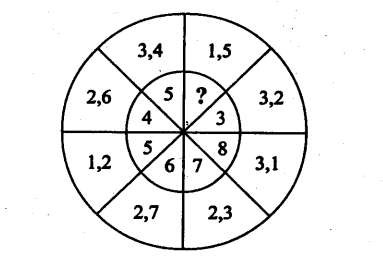
What is the value of the missing number?
Consider the following figure :
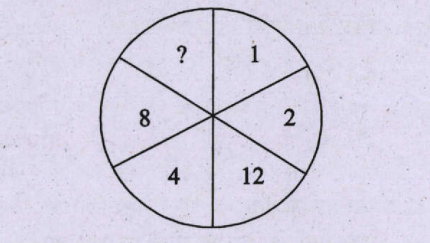
Find out the missing number from among the following:
Consider the following figure matrix
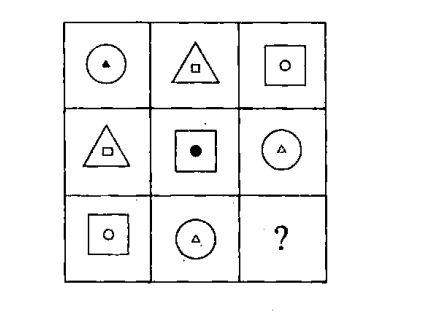
Study the given pattern carefully and select the number from among the given options that can replace the question mark (?) in it.