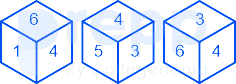
Six numbers 1, 2, 3, 4, 5 and 6 are written on different faces of a dice. Three positions of this dice are shown in the given figure. Find the number on the face opposite to the number 2.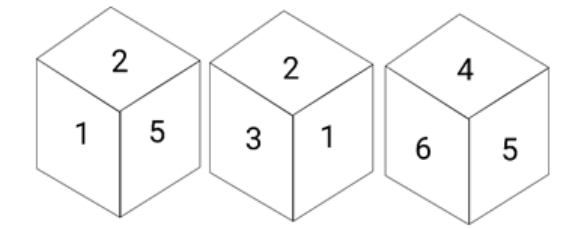
To find the number on the face opposite to the number 2 on the given dice, we need to analyze the three positions of the dice shown in the image.
Let's analyze the positions:
- In the first position, we see the numbers 1, 2, and 5.
- In the second position, we see the numbers 2, 3, and 1.
- In the third position, we see the numbers 4, 5, and 6.
Based on these observations:
- The common number between the first and second positions is 2. This indicates that the faces showing 1 and 5 in the first position are adjacent to the face showing 2, as are the faces showing 3 and 1 in the second position.
- From the first and second positions, we can deduce that 3 and 5 are adjacent to 2.
- In the third position, numbers 4, 5, and 6 are visible, and we already know 5 is adjacent to 2.
Therefore, since 5 and 3 are already adjacent to 2, the opposite face must be 4, which is not adjacent.
Hence, the number on the face opposite to the number 2 is 4.
Similar Questions
Two different position of the same dice are shown, having letters H, I, J, K, L and M written on its faces are shown.

Which letter is on the face opposite to the face having H on it?
Two different positions of the same dice are shown, the six faces of which are numbered 7, 8, 9, 10, 11 and 12.
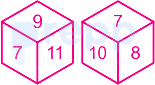
What will be the sum of the number 8 and the number on its opposite face ?
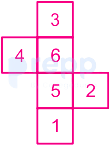
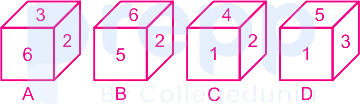
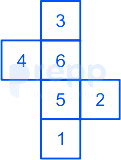
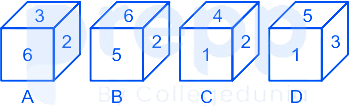
If the given sheet is folded to form a cube, which of the given figures is/are possible?
Two different positions of the same dice are shown, having letters B, C, D, E, F and G written on its faces are shown.

Which letter is on the face opposite to the face having E on it?
Three different positions of the same dice are shown, the six faces of which are indicated by 1, 2, 3, 4, 5 and 6. Select the number that will be on the face opposite to the one showing '5'.
Select the box(es) that can be formed by folding the given sheet along the lines (the numbers are shown to indicate the sides only).
A cube is made by folding the given sheet. In the cube so formed, which of the following pairs of letters will be on opposite sides?
Two positions of a cube are shown. What will come opposite to the face showing '@'?

Three different positions of the same dice are shown, the six faces of which are shown in dots numbered 1 to 6. How many dots will be on the opposite to the face showing ‘3 dots’?

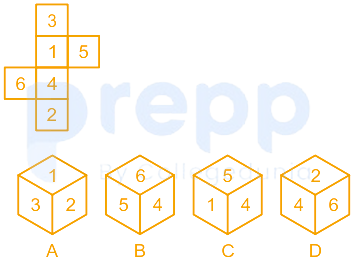
Select the dice(s) that can be formed by folding the given sheet.
Important Questions from Cube and Dice
A cube of side 4 cm is painted green on all its faces and then divided into smaller cubes of side 2 cm each. How many small cubes have been obtained?
Two adjacent faces of a solid cube are painted with black colour. The faces opposite to the black faces is painted with blue colour while the remaining faces are painted with yellow colour. After painting, this cube has been divided into 125 equal cubes. How many cubes have no faces painted?
A cube, whose two adjacent faces are coloured, is cut into 64 identical small cubes. How many of these small cubes are not coloured at all?
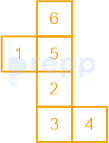
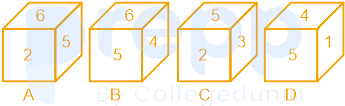
Select the dice that can be formed by folding the given sheet along the lines.
Two different positions of the same dice are shown, the six faces of which are marked with the letters A to F. Select the letter that will be on the face opposite to the one having A.