A cube, whose two adjacent faces are coloured, is cut into 64 identical small cubes. How many of these small cubes are not coloured at all?
36
Understanding the Cube Cutting Problem
This question asks us to find the number of small cubes that have no colour on any of their faces after a larger cube, with two adjacent faces coloured, is cut into 64 smaller, identical cubes.
First, let's determine the size of the larger cube in terms of the small cubes. If a cube is cut into 64 identical small cubes, and these small cubes form a larger cube, then the number of small cubes along each edge of the larger cube is the cube root of the total number of small cubes.
Total number of small cubes = 64
Number of small cubes along each edge, $n = \sqrt[3]{64} = 4$.
So, the larger cube is a $4 \times 4 \times 4$ arrangement of small cubes.
Identifying the Uncoloured Cubes
The larger cube has 6 faces. We are told that two adjacent faces are coloured. Let's imagine these coloured faces are the Top face and the Front face of the cube.
A small cube will have some colour if it touches any part of the coloured faces. Therefore, the small cubes that are not coloured at all are those small cubes that do not touch either the Top face or the Front face of the original large cube.
Calculating the Number of Uncoloured Cubes
Consider the large cube with dimensions $n \times n \times n$. Let the dimensions be length, width, and height, with $n=4$ for each. Let the Top face be the one at maximum height, and the Front face be the one at maximum depth/width (depending on orientation). If we orient the cube such that the faces are defined by ranges of coordinates, say X, Y, Z from 1 to $n$:
- Faces could be at X=1 (Left), X=$n$ (Right), Y=1 (Back), Y=$n$ (Front), Z=1 (Bottom), Z=$n$ (Top).
Let's assume the Top face (Z=$n$) and the Front face (Y=$n$) are coloured.
A small cube is uncoloured if its position does not correspond to a cube on the Top face AND does not correspond to a cube on the Front face.
- Cubes on the Top face have their Z coordinate equal to $n$.
- Cubes on the Front face have their Y coordinate equal to $n$.
For a cube to be not coloured at all, its Z coordinate must NOT be $n$ AND its Y coordinate must NOT be $n$. The X coordinate can be any value from 1 to $n$.
- Possible values for X: $1, 2, ..., n$ (total $n$ values).
- Possible values for Y: $1, 2, ..., n-1$ (total $n-1$ values, excluding $n$).
- Possible values for Z: $1, 2, ..., n-1$ (total $n-1$ values, excluding $n$).
The number of small cubes that satisfy these conditions is the product of the number of possibilities for each coordinate.
Number of uncoloured cubes = (Number of possibilities for X) $\times$ (Number of possibilities for Y) $\times$ (Number of possibilities for Z)
Number of uncoloured cubes = $n \times (n-1) \times (n-1) = n(n-1)^2$
In this problem, $n=4$.
Number of uncoloured cubes = $4 \times (4-1) \times (4-1) = 4 \times 3 \times 3 = 4 \times 9 = 36$
These 36 cubes form an inner block within the large cube with dimensions $4 \times 3 \times 3$, where the dimension corresponding to the two coloured faces (Top and Front) has been reduced by one layer ($4-1=3$).
Let's verify this using a table representing the layers:
| Layer Type | Description | Touches Coloured Face(s)? | Number of Cubes |
|---|---|---|---|
| Top Layer (Z=$n$) | $n \times n$ layer | Yes (Top face) | $n^2 = 16$ |
| Bottom Layers (Z=1 to $n-1$) | Remaining $n-1$ layers | Some might touch Front if $n>1$ | $n^2 \times (n-1) = 16 \times 3 = 48$ |
| Front Slab (Y=$n$) | $n \times n$ slab | Yes (Front face) | $n^2 = 16$ |
| Back Slabs (Y=1 to $n-1$) | Remaining $n-1$ slabs | Some might touch Top if $n>1$ | $n^2 \times (n-1) = 16 \times 3 = 48$ |
We need cubes that are *not* in the Top layer (Z=$n$) AND *not* in the Front slab (Y=$n$). These are the cubes where Z is in $\{1, 2, 3\}$ and Y is in $\{1, 2, 3\}$, and X is in $\{1, 2, 3, 4\}$. As calculated, this gives $4 \times 3 \times 3 = 36$ cubes.
Conclusion
When a cube with two adjacent faces coloured is cut into 64 small cubes (meaning $n=4$), the number of small cubes that are not coloured at all is given by $n(n-1)^2$. For $n=4$, this is $4 \times (4-1)^2 = 4 \times 3^2 = 4 \times 9 = 36$.
Thus, 36 of these small cubes are not coloured at all.
Important Questions from Cube and Dice
A cube of side 4 cm is painted green on all its faces and then divided into smaller cubes of side 2 cm each. How many small cubes have been obtained?
Two adjacent faces of a solid cube are painted with black colour. The faces opposite to the black faces is painted with blue colour while the remaining faces are painted with yellow colour. After painting, this cube has been divided into 125 equal cubes. How many cubes have no faces painted?
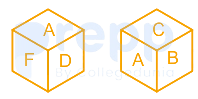
Two different positions of the same dice are shown, the six faces of which are marked with the letters A to F. Select the letter that will be on the face opposite to the one having A.
A Cube is coloured blue on all the faces. It is then cut into 64 smaller cubes. These cubes are now separated. The number of smaller cubes with no surface coloured is:
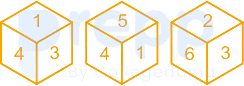
There different positions of the same dice are shown, the six faces of which are numbered 1 to 6. Select the number that will be on the face opposite to the one having '3'.