A Cube is coloured blue on all the faces. It is then cut into 64 smaller cubes. These cubes are now separated. The number of smaller cubes with no surface coloured is:
8
Cube Cutting: Finding Uncolored Smaller Cubes
When a larger cube is painted on all its faces and then cut into a number of smaller, identical cubes, a common task is to determine the count of smaller cubes that have no painted faces. This type of problem is frequently encountered in spatial reasoning sections of various competitive examinations. Let's analyze the given problem step by step.
Total Smaller Cubes
- The question states that the large cube is cut into 64 smaller, identical cubes.
- In cube cutting problems, if a large cube is divided into \(n \times n \times n\) smaller cubes, the total number of smaller cubes formed is represented by \(n^3\).
- Therefore, based on the information provided, we can set up the equation: \(n^3 = 64\).
Determining 'n' for the Cube
To find the value of 'n', which represents the number of smaller cubes along one edge of the larger cube, we need to calculate the cube root of the total number of smaller cubes:
- To find \(n\), we take the cube root of 64: \(\sqrt[3]{64} = 4\).
- So, the value of \(n\) is 4. This means the large cube was divided into 4 sections along its length, 4 sections along its width, and 4 sections along its height.
Cubes with No Surface Coloured
The smaller cubes with no surface coloured are those that are located entirely within the interior of the larger cube. These cubes do not touch any of the original outer faces of the large cube that were painted blue. They essentially form a smaller, unpainted cube within the larger structure. The formula used to calculate the number of such inner, uncolored cubes is \((n-2)^3\).
- The reason for subtracting 2 from 'n' is that we consider the removal of one layer of smaller cubes from each end along every dimension (e.g., one layer from the top and one from the bottom, one from the front and one from the back, one from the left and one from the right).
- For a cube with \(n=4\), the inner part that remains uncolored will effectively be a \((4-2) \times (4-2) \times (4-2)\) cube.
Calculation of Uncolored Cubes
Now, let's apply the value of \(n=4\) into the formula for cubes with no surface coloured, \((n-2)^3\):
| Step | Description | Calculation |
|---|---|---|
| 1 | Identify the value of 'n' | \(n = 4\) |
| 2 | State the formula for cubes with no colored faces | Number of uncolored cubes = \((n-2)^3\) |
| 3 | Substitute the value of 'n' into the formula | Number of uncolored cubes = \((4-2)^3\) |
| 4 | Perform the subtraction inside the parenthesis | Number of uncolored cubes = \((2)^3\) |
| 5 | Calculate the cube of the result | Number of uncolored cubes = \(2 \times 2 \times 2 = 8\) |
Conclusion
Based on our calculations, there are 8 smaller cubes that have no surface colored when a larger cube, painted blue on all faces, is cut into 64 smaller cubes.
Important Questions from Cube and Dice
A cube of side 4 cm is painted green on all its faces and then divided into smaller cubes of side 2 cm each. How many small cubes have been obtained?
Two adjacent faces of a solid cube are painted with black colour. The faces opposite to the black faces is painted with blue colour while the remaining faces are painted with yellow colour. After painting, this cube has been divided into 125 equal cubes. How many cubes have no faces painted?
A cube, whose two adjacent faces are coloured, is cut into 64 identical small cubes. How many of these small cubes are not coloured at all?
Select the dice that can be formed by folding the given sheet along the lines.
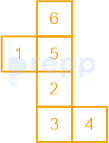
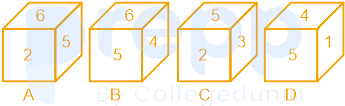
Two different positions of the same dice are shown, the six faces of which are marked with the letters A to F. Select the letter that will be on the face opposite to the one having A.