
Select the set in which the numbers are related in the same way as are the numbers of the given set. (NOTE: Operations should be performed on the whole numbers, without breaking down the number into its constituent digits.E.g. 13 - Operations on 13 such as adding /Subtracting /multiplying etc. to 13 can be performed. Breaking down 13 into 1 and 3 and then performing mathematical operations on 1 and 3 is not allowed.) (25, 150, 3) (18, 180, 5)
(52, 728, 7)
This question asks us to identify a set of numbers from the options that shares the same numerical relationship as the two given sets: (25, 150, 3) and (18, 180, 5). We need to find the rule connecting the three numbers within these sets.
Understanding the Given Sets and Finding the Relation
Let's look at the numbers in the first set: (25, 150, 3). We need to find how 25, 150, and 3 are related. Let's call the numbers A, B, and C, so A=25, B=150, C=3.
Now consider the second set: (18, 180, 5). Here, A=18, B=180, C=5.
We are looking for a rule that applies to both (25, 150, 3) and (18, 180, 5). The rule involves operations on the whole numbers, not breaking them down into digits.
Let's try common mathematical operations to find a pattern between A, B, and C.
- Could B be a multiple of A or C? \(150/25 = 6\), \(150/3 = 50\). \(180/18 = 10\), \(180/5 = 36\). The quotients are different, but maybe there's a connection between the quotients and the third number.
- Let's look at the quotient when dividing B by A. For the first set, \(150 \div 25 = 6\). For the second set, \(180 \div 18 = 10\).
- How is 6 related to 3 (from the first set)? \(6 = 3 \times 2\).
- How is 10 related to 5 (from the second set)? \(10 = 5 \times 2\).
It seems the relationship might be that \(B \div A = C \times 2\). Let's rewrite this rule to isolate B: \(B = A \times (C \times 2)\) or simply \(B = A \times C \times 2\).
Let's verify this rule with the given sets:
- For (25, 150, 3): \(25 \times 3 \times 2 = 25 \times 6 = 150\). This matches B.
- For (18, 180, 5): \(18 \times 5 \times 2 = 18 \times 10 = 180\). This matches B.
The rule \(B = A \times C \times 2\) holds for both the given sets. Now we will check this rule against the given options to find the set related in the same way.
Testing the Options with the Relation \(B = A \times C \times 2\)
We will apply the rule \(B = A \times C \times 2\) to each option:
Option 1: (13, 39, 3)
Here, A=13, B=39, C=3.
Calculate \(A \times C \times 2\): \(13 \times 3 \times 2 = 13 \times 6 = 78\).
Is \(B = A \times C \times 2\)? Is \(39 = 78\)? No. This set does not follow the rule.
Option 2: (101, 408, 2)
Here, A=101, B=408, C=2.
Calculate \(A \times C \times 2\): \(101 \times 2 \times 2 = 101 \times 4 = 404\).
Is \(B = A \times C \times 2\)? Is \(408 = 404\)? No. This set does not follow the rule.
Option 3: (52, 728, 7)
Here, A=52, B=728, C=7.
Calculate \(A \times C \times 2\): \(52 \times 7 \times 2 = 52 \times 14\).
Let's calculate \(52 \times 14\): \(52 \times 10 = 520\), \(52 \times 4 = 208\). \(520 + 208 = 728\).
So, \(52 \times 14 = 728\).
Is \(B = A \times C \times 2\)? Is \(728 = 728\)? Yes. This set follows the rule.
Option 4: (61, 601, 5)
Here, A=61, B=601, C=5.
Calculate \(A \times C \times 2\): \(61 \times 5 \times 2 = 61 \times 10 = 610\).
Is \(B = A \times C \times 2\)? Is \(601 = 610\)? No. This set does not follow the rule.
Only option 3 satisfies the relationship \(B = A \times C \times 2\) found in the given sets.
Summary of Option Testing
| Option Set (A, B, C) | Calculation \(A \times C \times 2\) | Does \(B = A \times C \times 2\)? |
|---|---|---|
| (13, 39, 3) | \(13 \times 3 \times 2 = 78\) | \(39 \neq 78\) (No) |
| (101, 408, 2) | \(101 \times 2 \times 2 = 404\) | \(408 \neq 404\) (No) |
| (52, 728, 7) | \(52 \times 7 \times 2 = 728\) | \(728 = 728\) (Yes) |
| (61, 601, 5) | \(61 \times 5 \times 2 = 610\) | \(601 \neq 610\) (No) |
Based on the analysis, the set (52, 728, 7) is related in the same way as the given sets (25, 150, 3) and (18, 180, 5).
Revision Table: Number Relation Analysis
| Concept | Description | Application in Question |
|---|---|---|
| Number Analogy | Finding a mathematical relationship between numbers in a set and applying it to other sets. | Used to find the rule connecting the three numbers in the given sets. |
| Rule Identification | Analyzing examples to deduce a common mathematical operation or formula. | The rule \(B = A \times C \times 2\) was identified from the given sets. |
| Testing Options | Applying the identified rule to each answer option to see which one fits. | Each option (A, B, C) was checked against the rule \(B = A \times C \times 2\). |
Additional Information: Numerical Reasoning Tips
When tackling number relation or numerical reasoning questions, consider these strategies:
- Look for relationships between the first and second numbers, first and third, second and third, or a combination of operations involving all three.
- Common relationships include addition, subtraction, multiplication, division, squares, cubes, square roots, cube roots, or combinations of these.
- Consider the position of the numbers (first, middle, last) and how they relate.
- If simple operations don't work, look for patterns involving multiples or factors.
- Always test the potential rule with all the given examples before applying it to the options.
- Pay attention to any specific instructions, such as the one in this question about not breaking down numbers into digits.
Similar Questions
Study the given pattern carefully and select the number that can replace the question mark (?) in it.
First row - 12, 7, 32
Second row - 17, 13, 33
Third row - 14, 8, ?
(NOTE : Operations should be performed on the whole numbers, without breaking down the numbers into its constituent digits. E.g. 13 - Operations on 13 such as adding/subtracting/multiplying etc. to 13 can be performed. Breaking down 13 into 1 and 3 and then performing mathematical operations on 1 and 3 is NOT allowed)
Find the missing number from the given alternatives.
7 10 5 16 40 8 15 ? 9 Select the missing images from the given responses:
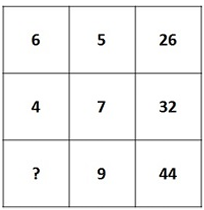
Select the missing numbers from the given alternatives:
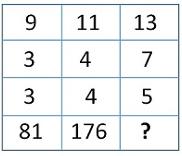
Select the missing number from the given responses:
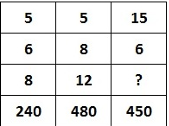
Find the missing term in the following question:
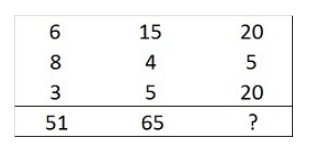
Find the missing number from the alternatives.
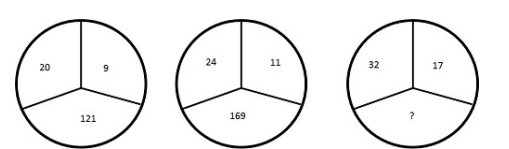
Select the missing number from the given responses:
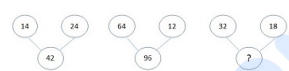
Select the missing number from the given responses.
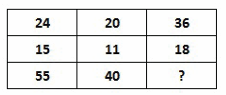
Find the missing number from the given alternatives:
8 7 6 7 6 5 6 5 4 90 65 ?
Important Questions from Missing Number
Find the missing number from the below options.
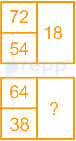
Find the missing number from the below options.
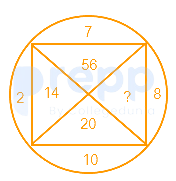
Find the missing number from the below options.
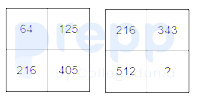
In the following question, select the number which can be placed at the sign of question mark (?) from the given alternatives
12
17
121
21
81
144
36
45
?
In the following question, find the missing number from the given series.
4, 12, 48, 240, 1440, ?



