In the following question, four letter-number pairs are given. The letter-number on the left side of (–) is related to the letter-number on the right side of (–) with some Logic/Rule/Relation. Three pairs are similar on the basis of same Logic/Rule/Relation. Select the odd one out from the given alternatives. (NOTE: Operations should be performed on the whole numbers, without breaking down the number into its constituent digits. E.g.13 – Operations on 13 such as adding /subtracting /multiplying etc. to 13 can be performed. Breaking down 13 into 1 and 3 and then performing mathematical operations on 1 and 3 is not allowed)
BM290 – DP155
In each pair, the first letter shifts forward by 2 places, the second letter shifts forward by 3 places, and the number becomes exactly half of the original.
Check XR432 → ZU216: X(+2)=Z, R(+3)=U, and 432 ÷ 2 = 216. This follows the rule.
Check FN504 → HQ252: F(+2)=H, N(+3)=Q, and 504 ÷ 2 = 252. This follows the rule.
Check TC386 → VF193: T(+2)=V, C(+3)=F, and 386 ÷ 2 = 193. This follows the rule.
Check BM290 → DP155: B(+2)=D, M(+3)=P — the letters follow the rule, but the number check gives 290 ÷ 2 = 145, which is NOT 155.
Since the number relation (half) breaks only for BM290 – DP155, this is the odd pair.
The correct answer is BM290 – DP155.
Similar Questions
In the following question, four letter-number pairs are given. The letter-number on the left side of (−) is related to the letter-number on the right side of (−) with some Logic/Rule/Relation. Three pairs are similar on the basis of same Logic/Rule/Relation. Select the odd one out from the given alternatives.
(NOTE: Operations should be performed on the whole numbers, without breaking down the number into its constituent digits. E.g.13 − Operations on 13 such as adding /subtracting /multiplying etc. to 13 can be performed. Breaking down 13 into 1 and 3 and then performing mathematical operations on 1 and 3 is not allowed)
In the following question, four letter-number pairs are given. The letter-number on the left side of (–) is related to the letter-number on the right side of (–) with some Logic/Rule/Relation. Three pairs are similar on the basis of same Logic/Rule/Relation. Select the odd one out from the given alternatives.
(NOTE: Operations should be performed on the whole numbers, without breaking down the number into its constituent digits. E.g.13 - Operations on 13 such as adding /subtracting /multiplying etc. to 13 can be performed. Breaking down 13 into 1 and 3 and then performing mathematical operations on 1 and 3 is not allowed)
In the following question, four number pairs are given. In each pair the number on left side of (–) is related to the number of the right side of (–) with some Logic/Rule/Relation. Three pairs are similar on the basis of same Logic/Rule/Relation. Select the odd one out from the given alternatives.
(NOTE: Operations should be performed on the whole numbers, without breaking down the number into its constituent digits. E.g.13 - Operations on 13 such as adding /subtracting /multiplying etc. to 13 can be performed. Breaking down 13 into 1 and 3 and then performing mathematical operations on 1 and 3 is not allowed)
In the following question, four number pairs are given. In each pair the number on left side of (−) is related to the number of the right side of (−) with some Logic/Rule/Relation. Three pairs are similar on the basis of same Logic/Rule/Relation. Select the odd one out from the given alternatives.
(NOTE: Operations should be performed on the whole numbers, without breaking down the number into its constituent digits. E.g.13 − Operations on 13 such as adding /subtracting /multiplying etc. to 13 can be performed. Breaking down 13 into 1 and 3 and then performing mathematical operations on 1 and 3 is not allowed)
In the following question, in each alternative a group of numbers is given. The numbers of each group are related to the numbers of the same group by some Logic/Rule/Relation. Select that group of numbers in which numbers are not related by that same Logic/Rule/Relation.
(NOTE: Operations should be performed on the whole numbers, without breaking down the number into its constituent digits. E.g.13 - Operations on 13 such as adding /subtracting /multiplying etc. to 13 can be performed. Breaking down 13 into 1 and 3 and then performing mathematical operations on 1 and 3 is not allowed)
In the following question, in each alternative a group of numbers is given. The numbers of each group are related to the numbers of the same group by some Logic/Rule/Relation. Select that group of numbers in which numbers are not related by that same Logic/Rule/Relation.
(NOTE: Operations should be performed on the whole numbers, without breaking down the number into its constituent digits. E.g.13 - Operations on 13 such as adding /subtracting /multiplying etc. to 13 can be performed. Breaking down 13 into 1 and 3 and then performing mathematical operations on 1 and 3 is not allowed)
In the following question, four letter-number pairs are given. The letter-number on the left side of (–) is related to the letter-number on the right side of (–) with some Logic/Rule/Relation. Three pairs are similar on the basis of same Logic/Rule/Relation. Select the odd one out from the given alternatives.
(NOTE: Operations should be performed on the whole numbers, without breaking down the number into its constituent digits. E.g.13 – Operations on 13 such as adding /subtracting /multiplying etc. to 13 can be performed. Breaking down 13 into 1 and 3 and then performing mathematical operations on 1 and 3 is not allowed)
In the following question, in each option a pair of figures is given. In each pair the figure towards the left of (:) is related by some logic/rule/relation with the figure on the right of (:). Select the odd figure pair from the given alternatives.
Identify the term which does not follow the pattern.
Find the odd one out.
Important Questions from Classification
Directions for the following 3 (three) items : consider the given information and answer the three items that follow.
A, B, C, D, E, F and G are Lecturers from different cities—Hyderabad, Delhi, Shillong, Kanpur, Chennai, Mumbai and Srinagar (not necessarily in the same order) who participated in a conference. Each one of them is specialized in a different subject, viz., Economics, Commerce, History, Sociology, Geography, Mathematics and Statistics (not necessarily in the same order).
Further 1. Lecturer from Kanpur is specialized in Geography
2. Lecturer D is from Shillong
3. Lecturer C from Delhi is specialized in Sociology
4. Lecturer B is specialized in neither History nor Mathematics
5. Lecturer A who is specialized in Economics does not belong to Hyderabad
6. Lecturer F who is specialized in Commerce belongs to Srinagar
7. Lecturer G who is specialized in Statistics belongs to Chennai
Who is specialized in Geography?
A, B, C, D, E, F and G are Lecturers from different cities—Hyderabad, Delhi, Shillong, Kanpur, Chennai, Mumbai and Srinagar (not necessarily in the same order) who participated in a conference. Each one of them is specialized in a different subject, viz., Economics, Commerce, History, Sociology, Geography, Mathematics and Statistics (not necessarily in the same order).
Further 1. Lecturer from Kanpur is specialized in Geography
2. Lecturer D is from Shillong
3. Lecturer C from Delhi is specialized in Sociology
4. Lecturer B is specialized in neither History nor Mathematics
5. Lecturer A who is specialized in Economics does not belong to Hyderabad
6. Lecturer F who is specialized in Commerce belongs to Srinagar
7. Lecturer G who is specialized in Statistics belongs to Chennai
To which city does the Lecturer specialized in Economics belong?
A, B, C, D, E, F and G are Lecturers from different cities—Hyderabad, Delhi, Shillong, Kanpur, Chennai, Mumbai and Srinagar (not necessarily in the same order) who participated in a conference. Each one of them is specialized in a different subject, viz., Economics, Commerce, History, Sociology, Geography, Mathematics and Statistics (not necessarily in the same order).
Further 1. Lecturer from Kanpur is specialized in Geography
2. Lecturer D is from Shillong
3. Lecturer C from Delhi is specialized in Sociology
4. Lecturer B is specialized in neither History nor Mathematics
5. Lecturer A who is specialized in Economics does not belong to Hyderabad
6. Lecturer F who is specialized in Commerce belongs to Srinagar
7. Lecturer G who is specialized in Statistics belongs to Chennai
Who of the following belongs to Hyderabad?
In a school, there are five teachers A, B, C, D and E. A and B teach Hindi and English. C and B teach English and Geography. D and A teach Mathematics and Hindi. E and B teach History and French. Who teaches maximum numb, of subjects?
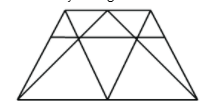
How many triangles are there in the given figure?