
Read the following statements with respect to a Wein bridge : (A) It is an AC bridge to measure frequency Choose the correct answer from the options given below :
(B) It is a DC bridge to measure amplitude
(C) It is used as frequency determining element
(D) It is used as band pass filter
(E) It is used as Notch filter
(A), (C) and (E) Only
Statements (A), (C) and (E) are correct — option 4 — and each names one of the three roles the same network plays.
(A) — an AC bridge that measures frequency. Unlike a Wheatstone bridge, whose balance depends only on resistances, the Wien bridge balances only at one frequency:
\(f=\dfrac{1}{2\pi\sqrt{R_{1}R_{2}C_{1}C_{2}}}=\dfrac{1}{2\pi RC}\ \text{for equal components}\)
With R and C known, the balance point measures the applied frequency. It must be an AC bridge, since capacitors are involved and a DC excitation would settle to nothing — which disposes of (B) at once.
(C) — the frequency-determining element. Turn the bridge round and use its frequency selectivity to set a frequency rather than measure one. In the Wien-bridge oscillator the series-parallel RC arm feeds positive feedback to the non-inverting input, and since it is the only frequency at which that path has zero phase shift, the circuit oscillates there and nowhere else.
(E) — the notch filter, and why it rather than (D). This is the discriminating pair, and the distinction lies in what is taken as the output.
The RC arm alone is indeed a band-pass network: its transfer function peaks at \(f=1/2\pi RC\), where the attenuation is a maximum of \(1/3\).
The complete bridge takes the output as the difference between the two arms. At balance that difference is zero, so the output nulls at the very frequency the arm passes best — a band-reject, that is a notch. Since the question says "Wien bridge" rather than "Wien network", (E) is the correct member of the pair.
Where the notch is used : removing 50 Hz mains hum from an instrumentation signal, and measuring distortion — null the fundamental with the bridge and whatever remains is harmonic content, which is exactly how a distortion analyser works.
The historical footnote ties the three uses together: Hewlett's 1939 Wien-bridge audio oscillator, stabilised by a small lamp in the negative-feedback arm, was Hewlett-Packard's first product.
Hence, the correct statements are (A), (C) and (E).
Similar Questions
Match the following :
List – I List – II a. Miller sweep in CRO i. storage oscilloscope b. Study of transients ii. integrator c. Korotkoff sound iii. phase measurement d. Lissajous pattern iv. blood pressure Codes :
Assertion (A) : Oscilloscope provides graphical representation of time varying signals.
Reason (R) : Bandwidth is the limitation of oscilloscope.
In a normal ECG wave form, which wave has the maximum amplitude ?
Match the following :
List – I List – II a. LED i. Heavily doped b. Avalanche Photodiode ii. Coherent radiation c. Tunnel diode iii. Spontaneous emission d. LASER iv. Current gain Codes :
Match the following :
List – I List – II a. Storage oscilloscope i. Pulse testing b. Sampling oscilloscope ii. Time domain c. High frequency oscilloscope iii. Long term memories d. Low frequency oscilloscope iv. Servo system analyzer Codes :
Assertion (A) : The shift in the position of the bright spot on the CRO screen per unit change of voltage across the deflection plates is called deflection sensitivity.
Reason (R) : The path traveled by the spot on a CRO screen during the retrace time is called retrace path.
A current of 300 µA produces FSD in an instrument whose coil resistance is 75 Ω. What will be the value of shunt resistors if the instrument is to measure current of 5A ?
An ammeter of 1 mA possesses a resistance of 100 ohms. This ammeter is to be converted into 1A ammeter. The value of shunt resistance required will be :
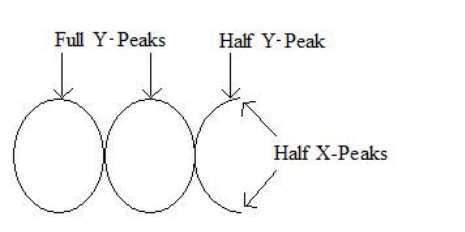
For a Lissajous pattern as shown in Figure below, determine the frequency of vertical signal if the frequency of horizontal signal is 12 kHz.
Write them in descending order of measurement units
A. atto
B. tera
C. Kilo
D. micro
E. pico
Choose the correct answer from the options given below :
Important Questions from Miscellaneous
Which event is marked as an Intangible Cultural Heritage of Humanity by UNESCO?
Who has been conferred with the rank of the Commander of the Order of the British Empire in 2018?
Who directead the film ‘Bhuvan Shome’?
The book “In my mother’s house” is written by _______
In which state is Vishwa Mitra Ka Tila situated?



