
Power absorbed by an element for t = 10 sec, if the current magnitude is 2e-0.1t and the voltage across the element is \(V=6\frac{di}{dt}\), the absorbed power is : A. - 0.325 Watts B. - 2.4 e-0.2(10) Watts C. 0.325 Watts D. 2.4 e-0.2(10) Watts E. 0.625 Watts choose the correct answer from the options given below :
A & B only
To solve this problem, we need to determine the power absorbed by an element at \( t = 10 \) seconds, given the current and voltage expressions for the element. Let's go step-by-step:
Given the current \( i(t) = 2e^{-0.1t} \).
The voltage across the element is given by the expression: \(V = 6\frac{di}{dt}\).
Firstly, we need to find \(\frac{di}{dt}\):
\[\frac{di}{dt} = \frac{d}{dt}(2e^{-0.1t}) = 2 \times (-0.1) \times e^{-0.1t} = -0.2e^{-0.1t}\]Substitute \(\frac{di}{dt}\) into the voltage equation:
\[V = 6 \times (-0.2e^{-0.1t}) = -1.2e^{-0.1t}\]Now, calculate the power using the formula: \(P = V \cdot i\)
\[P = (-1.2e^{-0.1t})(2e^{-0.1t})\]Simplifying this, we get:
\[P = -2.4e^{-0.2t}\]Substitute \( t = 10 \) into the power equation to find the power at that specific time:
\[P = -2.4e^{-0.2 \times 10} = -2.4e^{-2} \]\]Calculate the above expression to find the exact value:
\(-2.4e^{-2} = -2.4 \times 0.1353 \approx -0.325 \text{ Watts}\)
Therefore, the correct options corresponding to these calculations are:
- -0.325 Watts
- -2.4e^{-0.2(10)} Watts
Conclusion: The correct answer choices are A & B only as they represent both forms of the expression calculated for the power absorbed.
Similar Questions
Match List I with List II
LIST I LIST II A. Power I. dBi B. Gain II. Watts C. Resistance III. Henry D. Inductance IV. Ohm Choose the correct answer from the options given below:
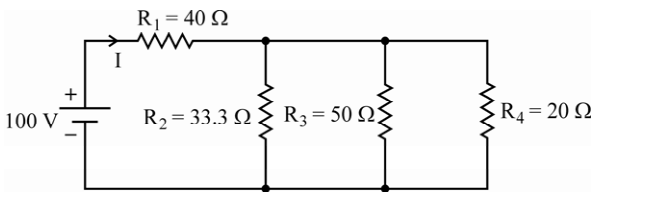
The power dissipation in the resistor R4 of the following circuit will be
Consider a star network as shown in the following figure :
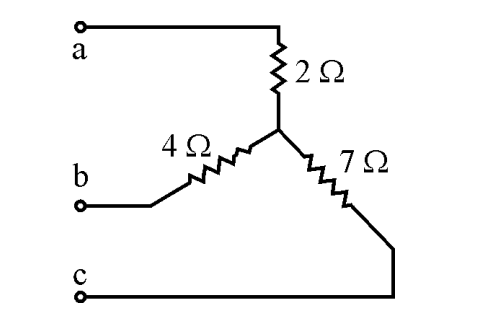
If the resistance between terminals b and c with a open is represented by RA, the resistance between c and a with b open is RB and the resistance between a and b with c open is RC, then arrange RA, RB and RC in descending order.
Important Questions from Network Elements
The maximum safe working voltage for a series combination of two capacitors of rating 2 μF/10V and 4 μF/20V is
Seema has two bulbs, one of them is faulty. She connects both the bulbs in parallel land, not in series. Which of the following is NOT the correct reason to do this?
- The capacitance 'C' is a measure of the capacitor's potential to store energy in:
Capacitor having lowest capacitance has medium of dielectric :
The inductor is a two-terminal energy storage device whose voltage is proportional to the:



