Position vector of four points A, B, C, D are \( -\hat{i} + \hat{j} + \hat{k} \), \( 3\hat{i} - 2\hat{j} + 2\hat{k} \), \( 4\hat{i} - \lambda\hat{j} - \hat{k} \), and \( \hat{i} + \hat{j} + \hat{k} \) respectively. The value of \( \lambda \) for which the points A, B, C, D are coplanar is:
-7
Understanding Coplanarity of Points
Four points A, B, C, and D are said to be coplanar if they all lie in the same plane. In vector algebra, a common way to check for the coplanarity of four points is to consider three vectors formed by connecting these points. If these three vectors are coplanar, then the four points are also coplanar.
Let the position vectors of the four points A, B, C, and D be \( \vec{a} \), \( \vec{b} \), \( \vec{c} \), and \( \vec{d} \) respectively. We are given:
- Position vector of A, \( \vec{a} = -\hat{i} + \hat{j} + \hat{k} \)
- Position vector of B, \( \vec{b} = 3\hat{i} - 2\hat{j} + 2\hat{k} \)
- Position vector of C, \( \vec{c} = 4\hat{i} - \lambda\hat{j} - \hat{k} \)
- Position vector of D, \( \vec{d} = \hat{i} + \hat{j} + \hat{k} \)
Condition for Coplanarity Using Vectors
To determine the value of \( \lambda \) for which points A, B, C, D are coplanar, we can form three vectors using these points, for example, \( \vec{AB} \), \( \vec{AC} \), and \( \vec{AD} \). The points A, B, C, and D are coplanar if and only if the vectors \( \vec{AB} \), \( \vec{AC} \), and \( \vec{AD} \) are coplanar.
The condition for three vectors \( \vec{u}, \vec{v}, \vec{w} \) to be coplanar is that their scalar triple product is zero, i.e., \( [\vec{u}, \vec{v}, \vec{w}] = 0 \).
Calculating the Vectors
First, let's calculate the vectors \( \vec{AB} \), \( \vec{AC} \), and \( \vec{AD} \):
- \( \vec{AB} = \vec{b} - \vec{a} \)
- \( \vec{AB} = (3\hat{i} - 2\hat{j} + 2\hat{k}) - (-\hat{i} + \hat{j} + \hat{k}) \)
- \( \vec{AB} = (3 - (-1))\hat{i} + (-2 - 1)\hat{j} + (2 - 1)\hat{k} \)
- \( \vec{AB} = 4\hat{i} - 3\hat{j} + \hat{k} \)
- \( \vec{AC} = \vec{c} - \vec{a} \)
- \( \vec{AC} = (4\hat{i} - \lambda\hat{j} - \hat{k}) - (-\hat{i} + \hat{j} + \hat{k}) \)
- \( \vec{AC} = (4 - (-1))\hat{i} + (-\lambda - 1)\hat{j} + (-1 - 1)\hat{k} \)
- \( \vec{AC} = 5\hat{i} - (\lambda + 1)\hat{j} - 2\hat{k} \)
- \( \vec{AD} = \vec{d} - \vec{a} \)
- \( \vec{AD} = (\hat{i} + \hat{j} + \hat{k}) - (-\hat{i} + \hat{j} + \hat{k}) \)
- \( \vec{AD} = (1 - (-1))\hat{i} + (1 - 1)\hat{j} + (1 - 1)\hat{k} \)
- \( \vec{AD} = 2\hat{i} + 0\hat{j} + 0\hat{k} \)
Setting up the Scalar Triple Product
For the points A, B, C, D to be coplanar, the scalar triple product of \( \vec{AB} \), \( \vec{AC} \), and \( \vec{AD} \) must be zero:
\( [\vec{AB}, \vec{AC}, \vec{AD}] = \vec{AB} \cdot (\vec{AC} \times \vec{AD}) = 0 \)
This can be calculated using a determinant formed by the components of the vectors:
\( [\vec{AB}, \vec{AC}, \vec{AD}] = \begin{vmatrix} 4 & -3 & 1 \\ 5 & -(\lambda + 1) & -2 \\ 2 & 0 & 0 \end{vmatrix} \)
Solving for \( \lambda \)
To find the value of \( \lambda \), we set the determinant equal to zero and solve. Expanding the determinant along the third row (because it has two zeros) is the easiest method:
\( 2 \times \begin{vmatrix} -3 & 1 \\ -(\lambda + 1) & -2 \end{vmatrix} - 0 \times \begin{vmatrix} 4 & 1 \\ 5 & -2 \end{vmatrix} + 0 \times \begin{vmatrix} 4 & -3 \\ 5 & -(\lambda + 1) \end{vmatrix} = 0 \)
\( 2 \times ((-3) \times (-2) - (1) \times (-(\lambda + 1))) = 0 \)
\( 2 \times (6 - (-\lambda - 1)) = 0 \)
\( 2 \times (6 + \lambda + 1) = 0 \)
\( 2 \times (7 + \lambda) = 0 \)
Since \( 2 \neq 0 \), we must have:
\( 7 + \lambda = 0 \)
\( \lambda = -7 \)
Thus, the value of \( \lambda \) for which the points A, B, C, D are coplanar is -7.
Revision Table: Key Concepts
| Concept | Description |
|---|---|
| Position Vector | A vector from the origin to a point. |
| Vector Connecting Two Points | Vector from point P with position vector \( \vec{p} \) to point Q with position vector \( \vec{q} \) is \( \vec{PQ} = \vec{q} - \vec{p} \). |
| Coplanar Points | Points that lie on the same plane. |
| Coplanar Vectors | Vectors that lie on the same plane or are parallel to the same plane. |
| Scalar Triple Product | For vectors \( \vec{u}, \vec{v}, \vec{w} \), it is \( \vec{u} \cdot (\vec{v} \times \vec{w}) \). Geometrically, its absolute value is the volume of the parallelepiped formed by the vectors. |
| Condition for Coplanarity | Three vectors are coplanar if and only if their scalar triple product is zero. Four points A, B, C, D are coplanar if the vectors \( \vec{AB}, \vec{AC}, \vec{AD} \) (or any other combination forming three vectors from the points) are coplanar. |
Additional Information: Scalar Triple Product Properties
The scalar triple product \( [\vec{u}, \vec{v}, \vec{w}] \) has several useful properties:
- It is cyclic: \( [\vec{u}, \vec{v}, \vec{w}] = [\vec{v}, \vec{w}, \vec{u}] = [\vec{w}, \vec{u}, \vec{v}] \).
- Interchanging any two vectors changes the sign: \( [\vec{u}, \vec{v}, \vec{w}] = -[\vec{v}, \vec{u}, \vec{w}] \).
- If any two vectors are parallel or identical, the scalar triple product is zero.
- If the scalar triple product is zero, the vectors are coplanar. Conversely, if the vectors are coplanar, the scalar triple product is zero.
- It can be computed as the determinant of the matrix formed by the vector components.
Understanding the scalar triple product is crucial for solving problems involving the volume of parallelepipeds and testing for the coplanarity of vectors and points in three-dimensional space.
Similar Questions
If \( \vec{a} \) and \( \vec{b} \) are two vectors such that \( |\vec{a}| = 7 \) and \( |\vec{b}| = 4 \), then the value of the scalar product of vectors \( 2\vec{a} - 3\vec{b} \) and \( 2\vec{a} + 3\vec{b} \) is:
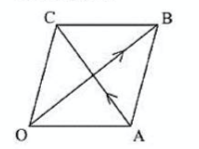
OA BC is a parallelogram. If \( \overrightarrow{OB} = \vec{a} \) and \( \overrightarrow{AC} = \vec{b} \), then \( \overrightarrow{OA} \) is equal to:
Important Questions from Vector Algebra
If a, b and c are three vectors such that a + b + c = 0, where a and b are unit vectors and | c| = 2, then the angle between the vectors b and c is:
If sin y = x sin (a + y), then dy/dx is:
The probability of not getting 53 Tuesdays in a leap year is:
If \( \vec{a} \) and \( \vec{b} \) are two vectors such that \( |\vec{a}| = 7 \) and \( |\vec{b}| = 4 \), then the value of the scalar product of vectors \( 2\vec{a} - 3\vec{b} \) and \( 2\vec{a} + 3\vec{b} \) is:
OA BC is a parallelogram. If \( \overrightarrow{OB} = \vec{a} \) and \( \overrightarrow{AC} = \vec{b} \), then \( \overrightarrow{OA} \) is equal to: