If a, b and c are three vectors such that a + b + c = 0, where a and b are unit vectors and | c| = 2, then the angle between the vectors b and c is:
180o
Understanding the Vector Relationship
We are given three vectors, a, b, and c, with the condition that their sum is the zero vector:
\[ a + b + c = 0 \]
We are also provided with information about the magnitudes of these vectors:
- Vector a is a unit vector, so its magnitude is \( |a| = 1 \).
- Vector b is a unit vector, so its magnitude is \( |b| = 1 \).
- The magnitude of vector c is given as \( |c| = 2 \).
Our goal is to find the angle between vectors b and c.
Manipulating the Vector Equation
From the given vector equation \( a + b + c = 0 \), we can rearrange it to isolate one of the vectors. Let's move vector a to the other side:
\[ a = -b - c \]
This equation can also be written as:
\[ a = -(b + c) \]
Using Magnitudes and Dot Product
Now, let's take the magnitude of both sides of the equation \( a = -(b + c) \). We know that the magnitude of a negative vector is the same as the magnitude of the positive vector, i.e., \( |-v| = |v| \).
\[ |a| = |-(b + c)| = |b + c| \]
We are given that \( |a| = 1 \), so:
\[ 1 = |b + c| \]
To get rid of the magnitude and involve the dot product (which relates to the angle between vectors), we can square both sides of the equation:
\[ 1^2 = |b + c|^2 \] \[ 1 = |b + c|^2 \]
Recall the property that for any vectors x and y, \( |x + y|^2 = |x|^2 + |y|^2 + 2(x \cdot y) \). Applying this to \( |b + c|^2 \):
\[ |b + c|^2 = |b|^2 + |c|^2 + 2(b \cdot c) \]
Substitute the known magnitudes \( |b| = 1 \) and \( |c| = 2 \) into this equation:
\[ |b + c|^2 = (1)^2 + (2)^2 + 2(b \cdot c) \] \[ |b + c|^2 = 1 + 4 + 2(b \cdot c) \] \[ |b + c|^2 = 5 + 2(b \cdot c) \]
Now, substitute the result from squaring the magnitude \( |b + c| \), which was 1:
\[ 1 = 5 + 2(b \cdot c) \]
Calculating the Dot Product
Solve the equation for the dot product \( b \cdot c \):
\[ 1 - 5 = 2(b \cdot c) \] \[ -4 = 2(b \cdot c) \] \[ b \cdot c = \frac{-4}{2} \] \[ b \cdot c = -2 \]
Finding the Angle Between Vectors b and c
The dot product of two vectors b and c is also defined as \( b \cdot c = |b| |c| \cos \theta \), where \(\theta\) is the angle between vectors b and c. We know \( b \cdot c = -2 \), \( |b| = 1 \), and \( |c| = 2 \). Substitute these values into the dot product formula:
\[ -2 = (1)(2) \cos \theta \] \[ -2 = 2 \cos \theta \]
Solve for \( \cos \theta \):
\[ \cos \theta = \frac{-2}{2} \] \[ \cos \theta = -1 \]
We need to find the angle \( \theta \) whose cosine is -1. This angle is \( 180^\circ \).
\[ \theta = 180^\circ \]
Thus, the angle between vectors b and c is \( 180^\circ \).
| Vector Property | Value |
|---|---|
| \(|a|\) | 1 (unit vector) |
| \(|b|\) | 1 (unit vector) |
| \(|c|\) | 2 |
| \(a + b + c\) | \(0\) |
| \(b \cdot c\) | -2 |
| Angle between b and c (\(\theta\)) | \(180^\circ\) |
Revision Table: Vector Sum and Magnitudes
| Given Information | Derived Information | Relevant Formula |
|---|---|---|
| \(a + b + c = 0\) | \(a = -(b + c)\) | Vector rearrangement |
| \(|a| = 1\) | \(|-(b+c)| = |b+c| = 1\) | Magnitude property \(|-v|=|v|\) |
| \(|b| = 1\), \(|c| = 2\) | \(|b+c|^2 = |b|^2 + |c|^2 + 2(b \cdot c)\) | Magnitude of sum squared |
| \(|b+c|^2 = 1^2 = 1\) | \(1 = 1^2 + 2^2 + 2(b \cdot c)\) | Substitution |
| \(1 = 5 + 2(b \cdot c)\) | \(b \cdot c = -2\) | Algebraic solution for dot product |
| \(b \cdot c = -2\) | \(\cos \theta = -1\) | Dot product formula: \(b \cdot c = |b||c| \cos \theta\) |
| \(\cos \theta = -1\) | \(\theta = 180^\circ\) | Inverse cosine function |
Additional Information: Unit Vectors and Vector Algebra
A unit vector is a vector with a magnitude of 1. Unit vectors are often used to indicate direction. For example, in a 3D Cartesian system, the standard unit vectors along the x, y, and z axes are denoted by \(\mathbf{i}\), \(\mathbf{j}\), and \(\mathbf{k}\).
The equation \(a + b + c = 0\) means that the three vectors form a closed triangle when placed head-to-tail, or that they are in equilibrium if representing forces. In this specific case, since \(a = -(b+c)\) and \(|a| = |b+c|\), vectors \(a\) and \((b+c)\) have the same magnitude but opposite directions. The fact that \(b \cdot c = -2\) and \(|b|=1, |c|=2\) led to \(\cos \theta = -1\), which means vectors b and c are in exactly opposite directions. If two vectors are in opposite directions, their sum \(b+c\) would have a magnitude of \(||c| - |b|| = |2-1| = 1\). This aligns with \(|b+c|=1\), which is consistent with the problem statement \(|a|=1\). Since \(a = -(b+c)\) and b and c are opposite, \((b+c)\) points in the direction of the longer vector (c), and \(a\) points in the opposite direction of c. Therefore, a, b, and c are collinear vectors, with a and b opposing c, and a also opposing b.
Important Questions from Vector Algebra
If sin y = x sin (a + y), then dy/dx is:
The probability of not getting 53 Tuesdays in a leap year is:
Position vector of four points A, B, C, D are \( -\hat{i} + \hat{j} + \hat{k} \), \( 3\hat{i} - 2\hat{j} + 2\hat{k} \), \( 4\hat{i} - \lambda\hat{j} - \hat{k} \), and \( \hat{i} + \hat{j} + \hat{k} \) respectively. The value of \( \lambda \) for which the points A, B, C, D are coplanar is:
If \( \vec{a} \) and \( \vec{b} \) are two vectors such that \( |\vec{a}| = 7 \) and \( |\vec{b}| = 4 \), then the value of the scalar product of vectors \( 2\vec{a} - 3\vec{b} \) and \( 2\vec{a} + 3\vec{b} \) is:
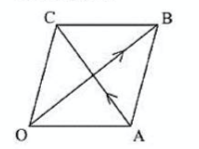
OA BC is a parallelogram. If \( \overrightarrow{OB} = \vec{a} \) and \( \overrightarrow{AC} = \vec{b} \), then \( \overrightarrow{OA} \) is equal to: