The probability of not getting 53 Tuesdays in a leap year is:
\( \frac{5}{7} \)
Understanding Probability in a Leap Year
Let's break down how to calculate the probability of not getting 53 Tuesdays in a leap year. A leap year is special because it has one extra day compared to a regular year.
What is a Leap Year?
A leap year consists of 366 days. This is exactly 52 weeks and 2 extra days. We can see this with a simple calculation:
\( 366 \, \text{days} = 52 \, \text{weeks} \times 7 \, \text{days/week} + 2 \, \text{days} \)
Since there are 52 full weeks, there will always be at least 52 Tuesdays in a leap year. The question is whether there will be a 53rd Tuesday.
Possible Outcomes for the Extra Days
The probability of getting a 53rd Tuesday (or not getting one) depends entirely on the nature of these two extra days. These two consecutive days can be any of the following pairs:
- Sunday, Monday
- Monday, Tuesday
- Tuesday, Wednesday
- Wednesday, Thursday
- Thursday, Friday
- Friday, Saturday
- Saturday, Sunday
There are 7 equally likely possible outcomes for these two extra days.
Outcomes Resulting in 53 Tuesdays
There will be 53 Tuesdays if one of the two extra days is a Tuesday. Looking at the list of possible pairs, this happens in the following cases:
- Monday, Tuesday
- Tuesday, Wednesday
So, there are 2 outcomes where the leap year will have 53 Tuesdays.
Outcomes Not Resulting in 53 Tuesdays
The question asks for the probability of not getting 53 Tuesdays. This means neither of the two extra days should be a Tuesday. Looking at the list of possible pairs, these outcomes are:
- Sunday, Monday
- Wednesday, Thursday
- Thursday, Friday
- Friday, Saturday
- Saturday, Sunday
There are 5 outcomes where the leap year will not have 53 Tuesdays.
Calculating the Probability
Probability is calculated as:
$$ \text{Probability} = \frac{\text{Number of favorable outcomes}}{\text{Total number of possible outcomes}} $$
In this case:
- Total possible outcomes for the two extra days = 7
- Number of outcomes where there are not 53 Tuesdays (favorable outcomes) = 5
Therefore, the probability of not getting 53 Tuesdays in a leap year is:
$$ P(\text{not 53 Tuesdays}) = \frac{5}{7} $$
Summary Table
| Event | Number of Outcomes |
|---|---|
| Leap year (366 days) | 52 weeks + 2 days |
| Possible pairs for 2 extra days | 7 |
| Outcomes with 53 Tuesdays (Monday, Tuesday; Tuesday, Wednesday) | 2 |
| Outcomes without 53 Tuesdays (Sunday, Monday; Wednesday, Thursday; Thursday, Friday; Friday, Saturday; Saturday, Sunday) | 5 |
| Probability of not getting 53 Tuesdays | 5/7 |
Revision Table: Leap Year Probability
| Concept | Description |
|---|---|
| Leap Year Days | 366 |
| Leap Year Structure | 52 weeks and 2 extra days |
| Possible pairs for extra days | 7 (SM, MT, TW, WT, TF, FS, SS) |
| Pairs giving 53rd Tuesday | 2 (MT, TW) |
| Pairs NOT giving 53rd Tuesday | 5 (SM, WT, TF, FS, SS) |
| Probability Formula | Favorable Outcomes / Total Outcomes |
| Probability of not 53 Tuesdays | 5/7 |
Additional Information: Year Probability Concepts
Understanding probability related to calendar days is a common type of question. Here are some related concepts:
- Non-Leap Year: A non-leap year has 365 days, which is 52 weeks and 1 extra day. The single extra day can be any of the 7 days of the week. The probability of having 53 of any specific day (like Tuesday) in a non-leap year is \( \frac{1}{7} \), and the probability of not having 53 of that day is \( \frac{6}{7} \).
- Sample Space: The set of all possible outcomes is called the sample space. In the case of the two extra days in a leap year, the sample space has 7 elements.
- Event: An event is a subset of the sample space. For example, 'getting 53 Tuesdays' is an event consisting of the outcomes {Monday, Tuesday}, {Tuesday, Wednesday}. 'Not getting 53 Tuesdays' is another event.
- Complementary Events: The event 'not getting 53 Tuesdays' is the complement of the event 'getting 53 Tuesdays'. The sum of their probabilities is always 1. \( P(\text{not 53 Tuesdays}) = 1 - P(\text{53 Tuesdays}) \). Since \( P(\text{53 Tuesdays}) = \frac{2}{7} \), \( P(\text{not 53 Tuesdays}) = 1 - \frac{2}{7} = \frac{5}{7} \).
Important Questions from Vector Algebra
If a, b and c are three vectors such that a + b + c = 0, where a and b are unit vectors and | c| = 2, then the angle between the vectors b and c is:
If sin y = x sin (a + y), then dy/dx is:
Position vector of four points A, B, C, D are \( -\hat{i} + \hat{j} + \hat{k} \), \( 3\hat{i} - 2\hat{j} + 2\hat{k} \), \( 4\hat{i} - \lambda\hat{j} - \hat{k} \), and \( \hat{i} + \hat{j} + \hat{k} \) respectively. The value of \( \lambda \) for which the points A, B, C, D are coplanar is:
If \( \vec{a} \) and \( \vec{b} \) are two vectors such that \( |\vec{a}| = 7 \) and \( |\vec{b}| = 4 \), then the value of the scalar product of vectors \( 2\vec{a} - 3\vec{b} \) and \( 2\vec{a} + 3\vec{b} \) is:
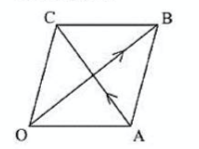
OA BC is a parallelogram. If \( \overrightarrow{OB} = \vec{a} \) and \( \overrightarrow{AC} = \vec{b} \), then \( \overrightarrow{OA} \) is equal to: