OA BC is a parallelogram. If \( \overrightarrow{OB} = \vec{a} \) and \( \overrightarrow{AC} = \vec{b} \), then \( \overrightarrow{OA} \) is equal to: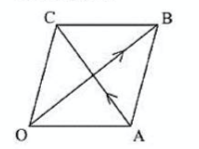
\( \frac{\vec{a} - \vec{b}}{2} \)
In a parallelogram, the midpoint of the diagonals is the same.
From the given vectors, we find that \( O \) and \( A \) are positioned such that:
\( \overrightarrow{OA} = \frac{\overrightarrow{OB} + \overrightarrow{OC}}{2} \).
Since \( \overrightarrow{OC} = \overrightarrow{OB} - \overrightarrow{AC} = \vec{a} - \vec{b} \), we get:
\( \overrightarrow{OA} = \frac{\vec{a} - \vec{b}}{2} \).
Similar Questions
Position vector of four points A, B, C, D are \( -\hat{i} + \hat{j} + \hat{k} \), \( 3\hat{i} - 2\hat{j} + 2\hat{k} \), \( 4\hat{i} - \lambda\hat{j} - \hat{k} \), and \( \hat{i} + \hat{j} + \hat{k} \) respectively. The value of \( \lambda \) for which the points A, B, C, D are coplanar is:
If \( \vec{a} \) and \( \vec{b} \) are two vectors such that \( |\vec{a}| = 7 \) and \( |\vec{b}| = 4 \), then the value of the scalar product of vectors \( 2\vec{a} - 3\vec{b} \) and \( 2\vec{a} + 3\vec{b} \) is:
Important Questions from Vector Algebra
If a, b and c are three vectors such that a + b + c = 0, where a and b are unit vectors and | c| = 2, then the angle between the vectors b and c is:
If sin y = x sin (a + y), then dy/dx is:
The probability of not getting 53 Tuesdays in a leap year is:
Position vector of four points A, B, C, D are \( -\hat{i} + \hat{j} + \hat{k} \), \( 3\hat{i} - 2\hat{j} + 2\hat{k} \), \( 4\hat{i} - \lambda\hat{j} - \hat{k} \), and \( \hat{i} + \hat{j} + \hat{k} \) respectively. The value of \( \lambda \) for which the points A, B, C, D are coplanar is:
If \( \vec{a} \) and \( \vec{b} \) are two vectors such that \( |\vec{a}| = 7 \) and \( |\vec{b}| = 4 \), then the value of the scalar product of vectors \( 2\vec{a} - 3\vec{b} \) and \( 2\vec{a} + 3\vec{b} \) is: