If sin y = x sin (a + y), then dy/dx is:
sin² (a + y) / sin a
Finding the Derivative dy/dx for sin y = x sin (a + y)
The given equation is $\sin y = x \sin (a + y)$. We need to find the derivative $\frac{dy}{dx}$. This involves implicit differentiation.
It is often easier to differentiate with respect to $y$ first if $x$ can be isolated. Let's rearrange the equation to express $x$ in terms of $y$ and the constant $a$:
$\sin y = x \sin (a + y)$
Dividing both sides by $\sin (a + y)$ (assuming $\sin (a + y) \neq 0$), we get:
$x = \frac{\sin y}{\sin (a + y)}$
Now, we can differentiate $x$ with respect to $y$, i.e., find $\frac{dx}{dy}$. We will use the quotient rule for differentiation, which states that if $f(y) = \frac{u(y)}{v(y)}$, then $\frac{df}{dy} = \frac{v(y) \frac{du}{dy} - u(y) \frac{dv}{dy}}{(v(y))^2}$.
In our case, $u(y) = \sin y$ and $v(y) = \sin (a + y)$.
- The derivative of $u(y) = \sin y$ with respect to $y$ is $\frac{du}{dy} = \cos y$.
- The derivative of $v(y) = \sin (a + y)$ with respect to $y$ requires the chain rule. Let $z = a + y$. Then $\frac{dv}{dy} = \frac{d}{dz}(\sin z) \cdot \frac{dz}{dy} = \cos z \cdot \frac{d}{dy}(a + y) = \cos (a + y) \cdot (0 + 1) = \cos (a + y)$.
Applying the quotient rule:
$\frac{dx}{dy} = \frac{\sin (a + y) \cdot \frac{d}{dy}(\sin y) - \sin y \cdot \frac{d}{dy}(\sin (a + y))}{(\sin (a + y))^2}$
$\frac{dx}{dy} = \frac{\sin (a + y) \cos y - \sin y \cos (a + y)}{\sin^2 (a + y)}$
The numerator of this expression is in the form $\sin A \cos B - \cos A \sin B$, which is the expansion for $\sin (A - B)$. Here, $A = a + y$ and $B = y$.
So, the numerator is $\sin ((a + y) - y) = \sin a$.
Therefore, $\frac{dx}{dy} = \frac{\sin a}{\sin^2 (a + y)}$.
We are asked to find $\frac{dy}{dx}$. We know that $\frac{dy}{dx} = \frac{1}{dx/dy}$ (provided $\frac{dx}{dy} \neq 0$).
$\frac{dy}{dx} = \frac{1}{\frac{\sin a}{\sin^2 (a + y)}}$
$\frac{dy}{dx} = \frac{\sin^2 (a + y)}{\sin a}$
This matches one of the given options.
Revision Table: Key Differentiation Rules Used
| Rule | Formula | Application in this problem |
|---|---|---|
| Quotient Rule | $\frac{d}{dx}\left(\frac{u}{v}\right) = \frac{v \frac{du}{dx} - u \frac{dv}{dx}}{v^2}$ | Used to find $\frac{dx}{dy}$ where $x = \frac{\sin y}{\sin (a+y)}$. |
| Chain Rule | $\frac{d}{dx} f(g(x)) = f'(g(x)) \cdot g'(x)$ | Used to differentiate $\sin(a+y)$ with respect to $y$. |
| Reciprocal Rule for Derivatives | $\frac{dy}{dx} = \frac{1}{dx/dy}$ | Used to find $\frac{dy}{dx}$ after finding $\frac{dx}{dy}$. |
| Basic Trigonometric Derivatives | $\frac{d}{dy}(\sin y) = \cos y$, $\frac{d}{dy}(\cos y) = -\sin y$ | Used when differentiating $\sin y$ and $\sin(a+y)$. |
Additional Information: Implicit Differentiation
Implicit differentiation is a technique used when a function $y$ cannot be easily expressed explicitly in terms of $x$, or when the relationship between $x$ and $y$ is given by an equation where $y$ is not isolated.
Steps for implicit differentiation to find $\frac{dy}{dx}$:
- Differentiate both sides of the equation with respect to $x$. Remember that $y$ is a function of $x$, so apply the chain rule whenever differentiating a term involving $y$. For example, $\frac{d}{dx}(y^2) = 2y \frac{dy}{dx}$.
- Collect all terms containing $\frac{dy}{dx}$ on one side of the equation and all other terms on the other side.
- Factor out $\frac{dy}{dx}$ from the terms containing it.
- Solve for $\frac{dy}{dx}$ by dividing by the factor multiplying $\frac{dy}{dx}$.
In this specific problem, rearranging the equation to solve for $x$ and finding $\frac{dx}{dy}$ first was a more direct route due to the structure of the equation, avoiding direct implicit differentiation of the original form with respect to $x$, which would involve product rule on $x \sin(a+y)$. However, both methods should yield the same result.
Important Questions from Vector Algebra
If a, b and c are three vectors such that a + b + c = 0, where a and b are unit vectors and | c| = 2, then the angle between the vectors b and c is:
The probability of not getting 53 Tuesdays in a leap year is:
Position vector of four points A, B, C, D are \( -\hat{i} + \hat{j} + \hat{k} \), \( 3\hat{i} - 2\hat{j} + 2\hat{k} \), \( 4\hat{i} - \lambda\hat{j} - \hat{k} \), and \( \hat{i} + \hat{j} + \hat{k} \) respectively. The value of \( \lambda \) for which the points A, B, C, D are coplanar is:
If \( \vec{a} \) and \( \vec{b} \) are two vectors such that \( |\vec{a}| = 7 \) and \( |\vec{b}| = 4 \), then the value of the scalar product of vectors \( 2\vec{a} - 3\vec{b} \) and \( 2\vec{a} + 3\vec{b} \) is:
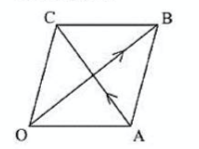
OA BC is a parallelogram. If \( \overrightarrow{OB} = \vec{a} \) and \( \overrightarrow{AC} = \vec{b} \), then \( \overrightarrow{OA} \) is equal to: