If \( \vec{a} \) and \( \vec{b} \) are two vectors such that \( |\vec{a}| = 7 \) and \( |\vec{b}| = 4 \), then the value of the scalar product of vectors \( 2\vec{a} - 3\vec{b} \) and \( 2\vec{a} + 3\vec{b} \) is:
52
Understanding the Vector Scalar Product Problem
The question asks us to find the scalar product (also known as the dot product) of two vector expressions, \( 2\vec{a} - 3\vec{b} \) and \( 2\vec{a} + 3\vec{b} \). We are given the magnitudes of the individual vectors \( \vec{a} \) and \( \vec{b} \).
Given information:
- Magnitude of vector \( \vec{a} \), \( |\vec{a}| = 7 \)
- Magnitude of vector \( \vec{b} \), \( |\vec{b}| = 4 \)
We need to calculate the value of \( (2\vec{a} - 3\vec{b}) \cdot (2\vec{a} + 3\vec{b}) \).
Calculating the Scalar Product
To find the scalar product \( (2\vec{a} - 3\vec{b}) \cdot (2\vec{a} + 3\vec{b}) \), we can use the distributive property of the dot product, similar to how we expand an algebraic expression like \( (x-y)(x+y) \). Recall that \( (x-y)(x+y) = x^2 - y^2 \). The equivalent property for vectors involving the dot product is \( (\vec{u} - \vec{v}) \cdot (\vec{u} + \vec{v}) = \vec{u} \cdot \vec{u} - \vec{v} \cdot \vec{v} \). Since \( \vec{u} \cdot \vec{u} = |\vec{u}|^2 \), this becomes \( |\vec{u}|^2 - |\vec{v}|^2 \).
In our case, let \( \vec{u} = 2\vec{a} \) and \( \vec{v} = 3\vec{b} \). Applying the property:
$$ (2\vec{a} - 3\vec{b}) \cdot (2\vec{a} + 3\vec{b}) = (2\vec{a}) \cdot (2\vec{a}) - (3\vec{b}) \cdot (3\vec{b}) $$
Using the property \( (c\vec{u}) \cdot (d\vec{v}) = cd (\vec{u} \cdot \vec{v}) \):
$$ (2\vec{a}) \cdot (2\vec{a}) = (2)(2) (\vec{a} \cdot \vec{a}) = 4 (\vec{a} \cdot \vec{a}) $$
$$ (3\vec{b}) \cdot (3\vec{b}) = (3)(3) (\vec{b} \cdot \vec{b}) = 9 (\vec{b} \cdot \vec{b}) $$
Also, recall that the dot product of a vector with itself is the square of its magnitude: \( \vec{v} \cdot \vec{v} = |\vec{v}|^2 \).
So, \( \vec{a} \cdot \vec{a} = |\vec{a}|^2 \) and \( \vec{b} \cdot \vec{b} = |\vec{b}|^2 \).
Substituting these back into the expression:
$$ (2\vec{a} - 3\vec{b}) \cdot (2\vec{a} + 3\vec{b}) = 4 |\vec{a}|^2 - 9 |\vec{b}|^2 $$
Now, substitute the given magnitudes \( |\vec{a}| = 7 \) and \( |\vec{b}| = 4 \):
$$ = 4 (7)^2 - 9 (4)^2 $$
Calculate the squares:
$$ = 4 (49) - 9 (16) $$
Perform the multiplication:
$$ = 196 - 144 $$
Finally, perform the subtraction:
$$ = 52 $$
The value of the scalar product of vectors \( 2\vec{a} - 3\vec{b} \) and \( 2\vec{a} + 3\vec{b} \) is 52.
Summary of Scalar Product Calculation
Let's summarize the steps involved in calculating this specific scalar product:
- Recognize the form of the expression \( (2\vec{a} - 3\vec{b}) \cdot (2\vec{a} + 3\vec{b}) \) as similar to an algebraic difference of squares.
- Expand the dot product using distributive properties.
- Simplify using the property \( \vec{u} \cdot \vec{u} = |\vec{u}|^2 \).
- Substitute the given magnitudes of \( \vec{a} \) and \( \vec{b} \).
- Perform the arithmetic calculations.
Revision Table: Key Concepts for Vector Scalar Product
| Concept | Description |
|---|---|
| Scalar Product (Dot Product) | A way to multiply two vectors resulting in a scalar quantity. For \( \vec{a} \) and \( \vec{b} \), \( \vec{a} \cdot \vec{b} = |\vec{a}| |\vec{b}| \cos \theta \), where \( \theta \) is the angle between them. |
| Magnitude of a Vector | The length or size of a vector, denoted by \( |\vec{v}| \). |
| Dot Product with Itself | The dot product of a vector with itself is the square of its magnitude: \( \vec{v} \cdot \vec{v} = |\vec{v}|^2 \). |
| Distributive Property | Similar to algebra, \( \vec{u} \cdot (\vec{v} + \vec{w}) = \vec{u} \cdot \vec{v} + \vec{u} \cdot \vec{w} \) and \( (\vec{u} + \vec{v}) \cdot \vec{w} = \vec{u} \cdot \vec{w} + \vec{v} \cdot \vec{w} \). |
| Scalar Multiplication Property | For scalars \( c \) and \( d \), \( (c\vec{u}) \cdot (d\vec{v}) = cd (\vec{u} \cdot \vec{v}) \). |
Additional Information: Vector Algebra and Dot Product
Vector algebra involves operations like addition, subtraction, and scalar multiplication of vectors, as well as different types of vector multiplication like the scalar product (dot product) and vector product (cross product). The dot product is particularly useful for finding the angle between two vectors and for projections.
The scalar product \( \vec{a} \cdot \vec{b} \) provides information about how much one vector acts in the direction of another. If \( \vec{a} \cdot \vec{b} = 0 \) and neither vector is the zero vector, the vectors are orthogonal (perpendicular). If \( \vec{a} \cdot \vec{b} > 0 \), the angle between them is acute. If \( \vec{a} \cdot \vec{b} < 0 \), the angle between them is obtuse.
In this specific problem, the expansion \( (2\vec{a} - 3\vec{b}) \cdot (2\vec{a} + 3\vec{b}) = 4|\vec{a}|^2 - 9|\vec{b}|^2 \) holds true regardless of the angle between \( \vec{a} \) and \( \vec{b} \), because the terms involving \( \vec{a} \cdot \vec{b} \) cancel out due to the structure of the expression \( (\vec{u} - \vec{v}) \cdot (\vec{u} + \vec{v}) \).
Similar Questions
Position vector of four points A, B, C, D are \( -\hat{i} + \hat{j} + \hat{k} \), \( 3\hat{i} - 2\hat{j} + 2\hat{k} \), \( 4\hat{i} - \lambda\hat{j} - \hat{k} \), and \( \hat{i} + \hat{j} + \hat{k} \) respectively. The value of \( \lambda \) for which the points A, B, C, D are coplanar is:
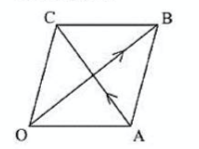
OA BC is a parallelogram. If \( \overrightarrow{OB} = \vec{a} \) and \( \overrightarrow{AC} = \vec{b} \), then \( \overrightarrow{OA} \) is equal to:
Important Questions from Vector Algebra
If a, b and c are three vectors such that a + b + c = 0, where a and b are unit vectors and | c| = 2, then the angle between the vectors b and c is:
If sin y = x sin (a + y), then dy/dx is:
The probability of not getting 53 Tuesdays in a leap year is:
Position vector of four points A, B, C, D are \( -\hat{i} + \hat{j} + \hat{k} \), \( 3\hat{i} - 2\hat{j} + 2\hat{k} \), \( 4\hat{i} - \lambda\hat{j} - \hat{k} \), and \( \hat{i} + \hat{j} + \hat{k} \) respectively. The value of \( \lambda \) for which the points A, B, C, D are coplanar is:
OA BC is a parallelogram. If \( \overrightarrow{OB} = \vec{a} \) and \( \overrightarrow{AC} = \vec{b} \), then \( \overrightarrow{OA} \) is equal to: