
Match the following : Codes :List - I List - II a) $(\dfrac{1}{s-\alpha})$ i) 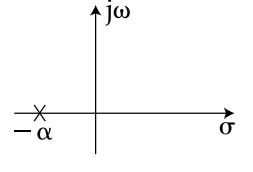
b) $(\dfrac{1}{s+\alpha})$ ii) 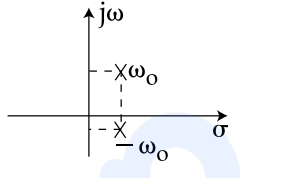
c) $(\dfrac{1}{(s-\alpha)^{2}+\omega_{o}^{2}})$ iii) 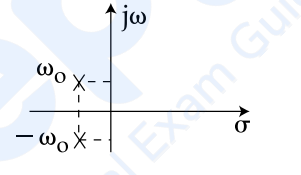
d) $(\dfrac{1}{(s+\alpha)^{2}+\omega_{o}^{2}})$ iv) 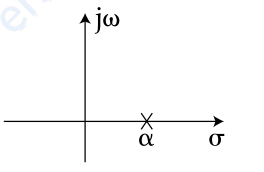
(a)-(iv), (b)-(i), (c)-(ii), (d)-(iii)
A pole sits wherever the denominator vanishes — that is the whole method.
(a) \(\dfrac{1}{s-\alpha}\) vanishes at \(s=+\alpha\): one real pole on the positive axis → (iv). Its time function is \(e^{\alpha t}\), a growing exponential.
(b) \(\dfrac{1}{s+\alpha}\) vanishes at \(s=-\alpha\): one real pole on the negative axis → (i). Its time function is \(e^{-\alpha t}\), a decaying exponential.
(c) \((s-\alpha)^{2}+\omega_{o}^{2}=0\) gives
\(s=\alpha\pm j\omega_{o}\)
a conjugate pair with positive real part — the right-half-plane pair → (ii). The inverse transform is \(\dfrac{1}{\omega_{o}}e^{\alpha t}\sin\omega_{o}t\), a growing oscillation.
(d) \((s+\alpha)^{2}+\omega_{o}^{2}=0\) gives
\(s=-\alpha\pm j\omega_{o}\)
the left-half-plane pair → (iii), whose inverse transform \(\dfrac{1}{\omega_{o}}e^{-\alpha t}\sin\omega_{o}t\) is a damped oscillation.
| Transform | Pole(s) | Time function | Stability |
|---|---|---|---|
| 1/(s−α) | +α | \(e^{\alpha t}\) | Unstable |
| 1/(s+α) | −α | \(e^{-\alpha t}\) | Stable |
| 1/((s−α)²+ω²) | α±jωo | Growing sinusoid | Unstable |
| 1/((s+α)²+ω²) | −α±jωo | Damped sinusoid | Stable |
The two properties encoded in a pole position. Its real part sets the envelope — negative means decay, positive means growth, zero means a sustained oscillation on the jω axis. Its imaginary part sets the frequency of ringing. This is precisely the shifting theorem at work: replacing s by \(s\mp\alpha\) multiplies the time function by \(e^{\pm\alpha t}\) and slides every pole horizontally by α.
The stability rule that follows: a causal LTI system is stable if and only if every pole lies strictly in the left half plane. Sign conventions matter here — \(s+\alpha\) in the denominator means a pole at \(-\alpha\), the opposite sign to the one written, and reversing the two is the most common slip in this type of question.
Reading the codes as (iv), (i), (ii), (iii) identifies option 4.
Hence, the correct match is (a)-(iv), (b)-(i), (c)-(ii), (d)-(iii).
Similar Questions
The Laplace transform converts integro-differential equation in _________ domain.
Laplace transform is equivalent to Fourier transform when, the real term \((\sigma)\) of complex frequency \(S=\sigma+j\omega\) ,should be
If \(x(t)=e^{-ct}-e^{-dt}\,u(-t)\), Laplace transform of x(t) is
For two signals \(x_1(t)\) and \(x_2(t)\). The correct Laplace transform expression for \(x_1(t)\cdot x_2(t)\) is :
Unit parabolic function is represented by its Laplace transform as:
A function f(t) is given by e–αt cos ωt. Its pole location in s-plane will be given by
Following statements are given for Laplace transforms :
(a) \(L[x(t)]=\displaystyle\int_{-\infty}^{\infty}x(t)e^{st}\,dt\)
(b) \(L[x(t)]=\displaystyle\int_{-\infty}^{\infty}x(t)e^{-st}\,dt\)
(c) \(L\left[te^{-at}u(t)\right]=\dfrac{1}{(s+a)^{2}}\)
(d) \(L\left[te^{-at}u(t)\right]=\dfrac{1}{(s-a)^{2}}\)
Out of the above, the following is the correct answer :
Assertion (A) : Laplace and Z transforms can be applied to the analysis of many unstable systems and consequently play an important role in the investigation of the stability or instability of the systems.
Reason (R) : The region of convergence of the Laplace transform of x(t) is given by the expression : \(\displaystyle\int_{-\infty}^{\infty}x(t)e^{-\sigma t}\,dt\ \ge\ \infty\)
Select your answer using the codes given below :
Laplace transform of e–at sin ωt is
Fourier transform and Laplace transform are the significant mathematical tools used for signal and system analysis. The limitation of Fourier transform is that it is not defined for some of the signals. Therefore for such signals analysis Laplace transform is used to overcome the drawback of Fourier transform. Due to availability of convergence factor Laplace transform is completely integrable and hence defined for those signals for which Fourier transform is not absolutely integrable.
The LTI is represented by differential equation. The system response is obtained by solving the given differential equation. Any differential equation is converted into simpler algebraic equation by Laplace transform.
Important Questions from Laplace Transform
Which of the following is the final value of the impulse response of the system whose transfer function is
(2s + 1)/(s 4 + 8s 3 + 16s 2 + s)
Find the Laplace transform for the following time domain.
y(t) = -2te -t + 4e -t - 4e -2t
Match List I with List II
List – I
List – II
f(t)
F(S)
A.
e -at
I.
\(\rm \frac{s}{s^2+ \omega^2}\)
B.
te at
II.
\(\rm \frac{\omega}{s^2+ \omega^2}\)
C.
sinωt
III.
\(\rm \frac{1}{(s- a)^2}\)
D.
cosωt
IV.
\(\rm \frac{1}{(s+ a)}\)
Choose the correct answer from the options given below:
Laplace transform of the function f(t) denoted by F(s) is given by
What will be the Laplace transform for f(t) = e-bt u(t) ?



