
Fourier transform and Laplace transform are the significant mathematical tools used for signal and system analysis. The limitation of Fourier transform is that it is not defined for some of the signals. Therefore for such signals analysis Laplace transform is used to overcome the drawback of Fourier transform. Due to availability of convergence factor Laplace transform is completely integrable and hence defined for those signals for which Fourier transform is not absolutely integrable.
The LTI is represented by differential equation. The system response is obtained by solving the given differential equation. Any differential equation is converted into simpler algebraic equation by Laplace transform.
\(\sigma=0\)
Write both transforms side by side.
Bilateral Laplace transform, with complex frequency \(s=\sigma+j\omega\):
\(X(s)=\int_{-\infty}^{\infty}x(t)e^{-st}\,dt\)
Fourier transform:
\(X(j\omega)=\int_{-\infty}^{\infty}x(t)e^{-j\omega t}\,dt\)
Compare the kernels. Substituting \(s=\sigma+j\omega\) splits the Laplace kernel into two factors:
\(e^{-st}=e^{-\sigma t}\,e^{-j\omega t}\)
The oscillating factor \(e^{-j\omega t}\) is common to both transforms. The only difference is the real exponential \(e^{-\sigma t}\), the convergence (damping) factor that Laplace adds.
Set the two equal. The transforms coincide when that extra factor becomes unity:
\(e^{-\sigma t}=1 \Rightarrow \sigma = 0 \Rightarrow s=j\omega\)
Geometric meaning. σ = 0 is the imaginary (jω) axis of the s-plane. So the Fourier transform is simply the Laplace transform evaluated along that axis — which is why one can read a system's frequency response straight off its transfer function by putting \(s=j\omega\) in H(s).
An important condition. This equivalence is valid only if the jω axis actually lies inside the region of convergence. For a stable system all poles are in the left half plane, the ROC includes the jω axis, and H(jω) exists. For an unstable system — say a pole at s = +2 — the ROC excludes the axis and the Fourier transform does not exist even though the Laplace transform does. This is exactly why Laplace is the more general tool: the damping factor \(e^{-\sigma t}\) can force convergence for signals that grow with time, such as a ramp or a rising exponential, which have no Fourier transform.
Checking the other options. σ = 1 or σ = −1 leaves a residual factor \(e^{\mp t}\) that weights the signal, and σ = ∞ would annihilate the integrand altogether.
Hence, the two transforms are equivalent when σ = 0.
\(X(s)=\frac{2s+c+d}{(s+c)(s+d)}\)
The two standard pairs needed here.
Right-sided (causal) exponential:
\(e^{-ct}u(t)\ \longleftrightarrow\ \dfrac{1}{s+c}, \qquad \text{ROC: } \operatorname{Re}(s) \gt -c\)
Left-sided (anticausal) exponential — note the sign, which is where marks are usually lost:
\(-e^{-dt}u(-t)\ \longleftrightarrow\ \dfrac{1}{s+d}, \qquad \text{ROC: } \operatorname{Re}(s) \lt -d\)
Deriving the second pair. For the left-sided term the integration runs only over negative time:
\(\int_{-\infty}^{0}-e^{-dt}e^{-st}dt=-\int_{-\infty}^{0}e^{-(s+d)t}dt=\dfrac{1}{s+d}\)
The minus sign in front of the signal cancels the minus that comes out of the integration limits, so the transform ends up with a plus sign — the same algebraic form as the causal term, but with the opposite ROC.
Add the two transforms.
\(X(s)=\dfrac{1}{s+c}+\dfrac{1}{s+d}\)
Combine over a common denominator.
\(X(s)=\dfrac{(s+d)+(s+c)}{(s+c)(s+d)}=\dfrac{2s+c+d}{(s+c)(s+d)}\)
Checking the wrong options. Options 2 and 3 place poles at +c or +d, which would require exponentials of the form \(e^{+ct}\); the given signal decays as \(e^{-ct}\), so its pole must be at −c. Option 4's numerator \(2s-c-d\) would result from subtracting the two transforms, i.e. from mishandling the sign of the anticausal term.
The ROC of the result. Being the intersection of \(\operatorname{Re}(s) \gt -c\) and \(\operatorname{Re}(s) \lt -d\), it is the vertical strip \(-c \lt \operatorname{Re}(s) \lt -d\) — the signature of a two-sided signal, and the reason the same X(s) can correspond to different time signals unless the ROC is stated.
Hence, \(X(s)=\dfrac{2s+c+d}{(s+c)(s+d)}\).
\(-a \lt R \lt -b\)
Rule for the ROC of a sum. Each exponential term contributes its own region of convergence, and the ROC of the whole signal is the intersection of them. Two facts fix the shape:
A right-sided term contributes a right half plane bounded by its pole; a left-sided term contributes a left half plane bounded by its pole; and the ROC can never contain a pole.
Apply to the two terms. The first term \(e^{-at}u(t)\) has a pole at \(s=-a\) and converges to its right:
\(\operatorname{Re}(s) \gt -a\)
The second term contributes the pole at \(s=-b\), and taken as the oppositely bounded (left-sided) part of the signal it converges to its left:
\(\operatorname{Re}(s) \lt -b\)
Intersect them. The common region is the vertical strip lying between the two poles:
\(-a \lt R \lt -b\)
which is the keyed answer.
Why the other options cannot be right. The boundaries of an ROC are always the pole locations, and the poles of these exponentials sit at −a and −b, not at +a or +b. So any option written in terms of a and b with positive signs (options 1 and 4, and the mixed option 3) misplaces the boundaries.
The bigger picture. The three possible ROCs for a two-pole X(s) with poles at −a and −b correspond to three different time signals: the right half plane to the right of both poles ⇒ a purely causal signal; the left half plane to the left of both ⇒ a purely anticausal signal; the strip in between ⇒ a two-sided signal. This is why an inverse Laplace transform is unique only when the ROC is specified. A useful corollary: a causal system is stable exactly when its ROC — and therefore the whole right half plane beyond its rightmost pole — includes the jω axis.
Hence, the region of convergence is \(-a \lt R \lt -b\).
\(\int_{-\infty}^{\infty} |x(t)|e^{-\sigma t}\,dt \lt \infty\)
The existence question. The Laplace transform
\(X(s)=\int_{-\infty}^{\infty}x(t)e^{-st}\,dt\)
is meaningful only where the integral converges. The standard sufficient test is absolute convergence: the integral of the magnitude of the integrand must be finite.
Step 1 — take the magnitude of the kernel. With \(s=\sigma+j\omega\),
\(\left|e^{-st}\right|=\left|e^{-\sigma t}\right|\left|e^{-j\omega t}\right|=e^{-\sigma t}\)
because the oscillating factor has unit magnitude, \(\left|e^{-j\omega t}\right|=1\). Only the real part σ affects convergence — the imaginary part merely rotates the phase.
Step 2 — write the condition.
\(\int_{-\infty}^{\infty}\left|x(t)e^{-st}\right|dt=\int_{-\infty}^{\infty}\left|x(t)\right|e^{-\sigma t}\,dt \lt \infty\)
which is option 4.
Why the other options fail.
Option 2, \(\int|x(t)|dt \lt \infty\), is the existence condition for the Fourier transform (a Dirichlet condition). It is far more restrictive — it excludes u(t), the ramp and \(e^{+at}u(t)\), all of which have perfectly good Laplace transforms. It also omits σ entirely, so it cannot describe a region of convergence.
Options 1 and 3 use \(|x(t)|^{2}\), which is an energy condition (square integrability), not the absolute-integrability test that governs the convergence of this integral.
What this condition buys you — the ROC. The set of σ values satisfying the inequality forms the region of convergence, always a vertical strip or half-plane in the s-plane bounded by poles. For a right-sided signal \(e^{-at}u(t)\), for example, \(\int_0^{\infty}e^{-at}e^{-\sigma t}dt\) converges for \(\sigma \gt -a\). The damping factor is precisely what lets Laplace handle signals that grow without bound, provided σ is chosen large enough.
Hence, the Laplace transform is defined when \(\int_{-\infty}^{\infty}|x(t)|e^{-\sigma t}\,dt \lt \infty\).
\(\frac{1}{2\pi j}\left[X_1(s)*X_2(s)\right]\)
Start from the property you already know. Convolution in the time domain becomes ordinary multiplication in the s-domain:
\(x_1(t)*x_2(t)\ \longleftrightarrow\ X_1(s)X_2(s)\)
This is the property behind \(Y(s)=H(s)X(s)\) for LTI systems, and it is the reason transform methods are used at all — a messy convolution integral turns into a product.
Duality gives the reverse. The two operations swap roles when you go the other way, so multiplication in the time domain must become convolution in the complex-frequency domain — with a scaling factor coming from the inverse-transform integral:
\(x_1(t)\cdot x_2(t)\ \longleftrightarrow\ \dfrac{1}{2\pi j}\left[X_1(s)*X_2(s)\right]\)
Where the \(1/2\pi j\) comes from. Writing one signal as its inverse Laplace integral,
\(x_1(t)=\dfrac{1}{2\pi j}\int_{\sigma-j\infty}^{\sigma+j\infty}X_1(p)e^{pt}dp\)
and substituting into the transform of the product, the \(1/2\pi j\) carries through and the remaining integral is a convolution in the complex variable:
\(\dfrac{1}{2\pi j}\int_{\sigma-j\infty}^{\sigma+j\infty}X_1(p)\,X_2(s-p)\,dp\)
evaluated along a vertical line lying in the common region of convergence.
Why the other options are wrong. \(X_1(s)X_2(s)\) is the transform of the convolution, not of the product — the classic mix-up this question tests. \(X_1(s)+X_2(s)\) is the transform of the sum, by linearity. The third option is not a transform property at all.
The Fourier analogue is the familiar modulation theorem, \(x_1(t)x_2(t)\leftrightarrow\frac{1}{2\pi}X_1(\omega)*X_2(\omega)\) — the reason multiplying a signal by a carrier shifts and spreads its spectrum.
Hence, the correct expression is \(\dfrac{1}{2\pi j}\left[X_1(s)*X_2(s)\right]\).
Similar Questions
The Laplace transform converts integro-differential equation in _________ domain.
Unit parabolic function is represented by its Laplace transform as:
A function f(t) is given by e–αt cos ωt. Its pole location in s-plane will be given by
Following statements are given for Laplace transforms :
(a) \(L[x(t)]=\displaystyle\int_{-\infty}^{\infty}x(t)e^{st}\,dt\)
(b) \(L[x(t)]=\displaystyle\int_{-\infty}^{\infty}x(t)e^{-st}\,dt\)
(c) \(L\left[te^{-at}u(t)\right]=\dfrac{1}{(s+a)^{2}}\)
(d) \(L\left[te^{-at}u(t)\right]=\dfrac{1}{(s-a)^{2}}\)
Out of the above, the following is the correct answer :
Match the following :
List - I List - II a) $(\dfrac{1}{s-\alpha})$ i) 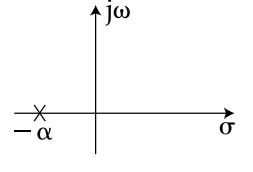
b) $(\dfrac{1}{s+\alpha})$ ii) 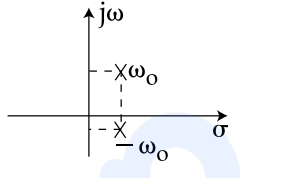
c) $(\dfrac{1}{(s-\alpha)^{2}+\omega_{o}^{2}})$ iii) 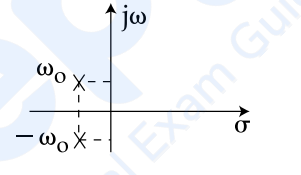
d) $(\dfrac{1}{(s+\alpha)^{2}+\omega_{o}^{2}})$ iv) 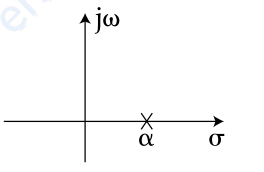
Codes :
Assertion (A) : Laplace and Z transforms can be applied to the analysis of many unstable systems and consequently play an important role in the investigation of the stability or instability of the systems.
Reason (R) : The region of convergence of the Laplace transform of x(t) is given by the expression : \(\displaystyle\int_{-\infty}^{\infty}x(t)e^{-\sigma t}\,dt\ \ge\ \infty\)
Select your answer using the codes given below :
Laplace transform of e–at sin ωt is
Important Questions from Laplace Transform
Which of the following is the final value of the impulse response of the system whose transfer function is
(2s + 1)/(s 4 + 8s 3 + 16s 2 + s)
Find the Laplace transform for the following time domain.
y(t) = -2te -t + 4e -t - 4e -2t
Match List I with List II
List – I
List – II
f(t)
F(S)
A.
e -at
I.
\(\rm \frac{s}{s^2+ \omega^2}\)
B.
te at
II.
\(\rm \frac{\omega}{s^2+ \omega^2}\)
C.
sinωt
III.
\(\rm \frac{1}{(s- a)^2}\)
D.
cosωt
IV.
\(\rm \frac{1}{(s+ a)}\)
Choose the correct answer from the options given below:
Laplace transform of the function f(t) denoted by F(s) is given by
What will be the Laplace transform for f(t) = e-bt u(t) ?



