
Assertion (A) : Laplace and Z transforms can be applied to the analysis of many unstable systems and consequently play an important role in the investigation of the stability or instability of the systems. Reason (R) : The region of convergence of the Laplace transform of x(t) is given by the expression : \(\displaystyle\int_{-\infty}^{\infty}x(t)e^{-\sigma t}\,dt\ \ge\ \infty\) Select your answer using the codes given below :
(A) is true, but (R) is false.
The assertion is true. The Fourier transform exists only for signals that are absolutely integrable, so it simply fails on a growing signal such as \(e^{2t}u(t)\). The Laplace transform repairs this by inserting a convergence factor:
\(X(s)=\int_{-\infty}^{\infty}x(t)e^{-\sigma t}e^{-j\omega t}\,dt\)
The real part \(\sigma\) can be chosen large enough to tame the growth, which is exactly why unstable systems remain analysable. Stability is then read straight off the pole positions — every pole in the left half plane for a causal continuous-time system, every pole inside the unit circle for a discrete-time one — so the transforms are central to stability analysis.
The reason, however, is written incorrectly. The region of convergence is the set of \(\sigma\) for which the integral is finite:
\(\int_{-\infty}^{\infty}\left|x(t)\right|e^{-\sigma t}\,dt\ \lt\ \infty\)
The statement as printed demands that the integral be greater than or equal to infinity, which is the condition for the transform not to exist. It also drops the magnitude bars. So (R) is false while (A) is true — code 3.
Worked illustration. For \(x(t)=e^{at}u(t)\),
\(X(s)=\int_{0}^{\infty}e^{at}e^{-st}dt=\dfrac{1}{s-a}\)
which converges only where \(\mathrm{Re}\{s\} \gt a\). That half plane is the ROC, and the transform is meaningless outside it.
Two rules the ROC obeys, both worth remembering: it never contains a pole, and its shape identifies the signal — a right-sided signal gives a right half plane, a left-sided signal a left half plane, and a two-sided signal a vertical strip. A causal system is stable exactly when its ROC includes the \(j\omega\) axis, which is the same statement as "all poles in the left half plane". The discrete-time counterpart replaces the axis with the unit circle.
Hence, (A) is true but (R) is false.
Similar Questions
The Laplace transform converts integro-differential equation in _________ domain.
Laplace transform is equivalent to Fourier transform when, the real term \((\sigma)\) of complex frequency \(S=\sigma+j\omega\) ,should be
If \(x(t)=e^{-ct}-e^{-dt}\,u(-t)\), Laplace transform of x(t) is
For two signals \(x_1(t)\) and \(x_2(t)\). The correct Laplace transform expression for \(x_1(t)\cdot x_2(t)\) is :
Unit parabolic function is represented by its Laplace transform as:
A function f(t) is given by e–αt cos ωt. Its pole location in s-plane will be given by
Following statements are given for Laplace transforms :
(a) \(L[x(t)]=\displaystyle\int_{-\infty}^{\infty}x(t)e^{st}\,dt\)
(b) \(L[x(t)]=\displaystyle\int_{-\infty}^{\infty}x(t)e^{-st}\,dt\)
(c) \(L\left[te^{-at}u(t)\right]=\dfrac{1}{(s+a)^{2}}\)
(d) \(L\left[te^{-at}u(t)\right]=\dfrac{1}{(s-a)^{2}}\)
Out of the above, the following is the correct answer :
Match the following :
List - I List - II a) $(\dfrac{1}{s-\alpha})$ i) 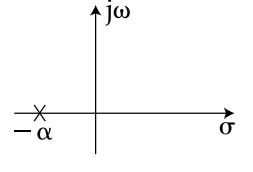
b) $(\dfrac{1}{s+\alpha})$ ii) 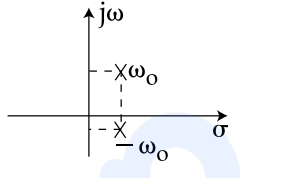
c) $(\dfrac{1}{(s-\alpha)^{2}+\omega_{o}^{2}})$ iii) 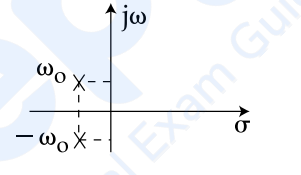
d) $(\dfrac{1}{(s+\alpha)^{2}+\omega_{o}^{2}})$ iv) 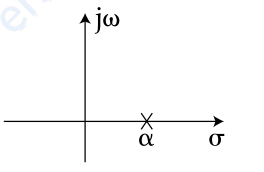
Codes :
Laplace transform of e–at sin ωt is
Fourier transform and Laplace transform are the significant mathematical tools used for signal and system analysis. The limitation of Fourier transform is that it is not defined for some of the signals. Therefore for such signals analysis Laplace transform is used to overcome the drawback of Fourier transform. Due to availability of convergence factor Laplace transform is completely integrable and hence defined for those signals for which Fourier transform is not absolutely integrable.
The LTI is represented by differential equation. The system response is obtained by solving the given differential equation. Any differential equation is converted into simpler algebraic equation by Laplace transform.
Important Questions from Laplace Transform
Which of the following is the final value of the impulse response of the system whose transfer function is
(2s + 1)/(s 4 + 8s 3 + 16s 2 + s)
Find the Laplace transform for the following time domain.
y(t) = -2te -t + 4e -t - 4e -2t
Match List I with List II
List – I
List – II
f(t)
F(S)
A.
e -at
I.
\(\rm \frac{s}{s^2+ \omega^2}\)
B.
te at
II.
\(\rm \frac{\omega}{s^2+ \omega^2}\)
C.
sinωt
III.
\(\rm \frac{1}{(s- a)^2}\)
D.
cosωt
IV.
\(\rm \frac{1}{(s+ a)}\)
Choose the correct answer from the options given below:
Laplace transform of the function f(t) denoted by F(s) is given by
What will be the Laplace transform for f(t) = e-bt u(t) ?



