In a closed electrical loop supplied by 10 V, two resistors produce voltage drops of 6 V and 4 V, respectively. Which statement correctly expresses Kirchhoff’s Voltage Law for this loop?
The algebraic sum of all voltages around the loop is zero
In this problem, we are asked to correctly express Kirchhoff's Voltage Law (KVL) for a given electrical loop. Kirchhoff's Voltage Law states that the sum of the electromotive forces (EMFs) and voltage drops around any closed loop in a circuit must equal zero. This principle is fundamental to electrical engineering and is used to solve circuit problems.
Let's examine the given parameters in the problem:
- The loop is supplied by a voltage source of 10 V.
- There are two resistors in the loop, with voltage drops of 6 V and 4 V respectively.
Given these parameters, we can apply Kirchhoff's Voltage Law:
- According to KVL, the algebraic sum of all voltages in the loop should equal zero:
V_{source} - V_{drop1} - V_{drop2} = 0
Substituting the given values:
10\,V - 6\,V - 4\,V = 0
Calculating the above expression, we find:
0 = 0
This calculation confirms that the option stating "The algebraic sum of all voltages around the loop is zero" is correct. Let's briefly analyze why the other options are incorrect:
- The current through the two resistors is different: KVL does not address current; it only involves voltages. Furthermore, in a series circuit, the current through each component is the same.
- The source voltage is greater than the total voltage drop: As we calculated, the total voltage drop equals the source voltage, complying with KVL.
- The source voltage is less than the total voltage drop: This statement contradicts our calculation where the source voltage matches the sum of the voltage drops, not less.
Hence, the statement "The algebraic sum of all voltages around the loop is zero" accurately reflects Kirchhoff's Voltage Law.
Similar Questions
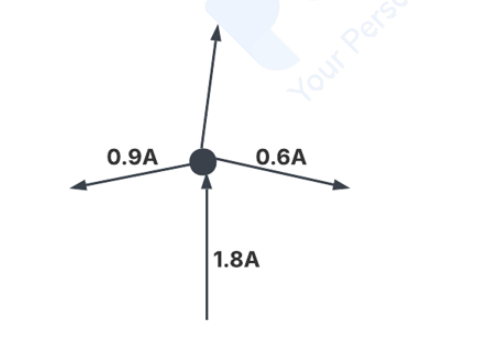
A DC node has 1.8 A entering it. Two branches carry 0.6 A and 0.9 A away from the node. Assuming the remaining branch current is also leaving the node, what is its value?
Important Questions from Kirchhoff's Laws
______ finds the voltage potentials at different nodes that provide a common connection for two or more circuit components in a circuit.
How many equations are necessary to solve a circuit with two principal nodes?
A 40 Ω resistor is in parallel with an 80 Ω resistor. Current in the 40 Ω resistor is 6 A. How will you add a third resistor and what will be its value if the line-current is to be 10 A?
Kirchoff's first law states that at a junction in an electric circuit -
Kirchhoff's current law is based on the conservation of