A DC node has 1.8 A entering it. Two branches carry 0.6 A and 0.9 A away from the node. Assuming the remaining branch current is also leaving the node, what is its value?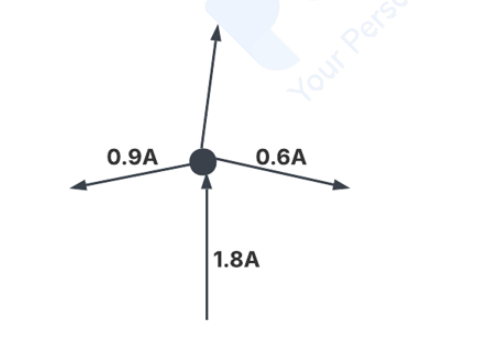
0.3 A
To solve this problem, we need to apply Kirchhoff's Current Law (KCL) which states that the total current entering a node is equal to the total current leaving the node.
In this case, we have:
- Current entering the node: 1.8 \, \text{A}
- Currents leaving the node through two branches: 0.6 \, \text{A} and 0.9 \, \text{A}
- Let the current in the remaining branch leaving the node be I_{\text{remaining}}.
According to KCL,
1.8 \, \text{A} = 0.6 \, \text{A} + 0.9 \, \text{A} + I_{\text{remaining}}
Solving for I_{\text{remaining}}:
I_{\text{remaining}} = 1.8 \, \text{A} - (0.6 \, \text{A} + 0.9 \, \text{A})
I_{\text{remaining}} = 1.8 \, \text{A} - 1.5 \, \text{A}
I_{\text{remaining}} = 0.3 \, \text{A}
Thus, the current in the remaining branch is 0.3 A.
The correct answer is option 2: 0.3 A.
Similar Questions
In a closed electrical loop supplied by 10 V, two resistors produce voltage drops of 6 V and 4 V, respectively. Which statement correctly expresses Kirchhoff’s Voltage Law for this loop?
Important Questions from Kirchhoff's Laws
______ finds the voltage potentials at different nodes that provide a common connection for two or more circuit components in a circuit.
How many equations are necessary to solve a circuit with two principal nodes?
A 40 Ω resistor is in parallel with an 80 Ω resistor. Current in the 40 Ω resistor is 6 A. How will you add a third resistor and what will be its value if the line-current is to be 10 A?
Kirchoff's first law states that at a junction in an electric circuit -
Kirchhoff's current law is based on the conservation of