
Kedar starts form his house and travel s 25 km towards the south by bicycle and reaches the bus stand. Then he takes a left turn and travels 15 km., take takes a left turn again and travels 25 km more. How far is he form his original position?
15 km
Understanding Kedar's Journey and Distance Calculation
The problem asks us to find the final distance of Kedar from his starting point after a series of movements in different directions. This is a typical directional distance problem where we need to track the displacement from the origin.
Step-by-Step Analysis of Kedar's Movement
- Kedar starts from his house and travels 25 km towards the south. Let's assume his starting point is the origin (0,0) on a coordinate plane. Traveling south takes him to the point (0, -25).
- He then takes a left turn. If he is facing south, a left turn means turning towards the east. He travels 15 km towards the east. From (0, -25), traveling 15 km east takes him to the point (0 + 15, -25) = (15, -25).
- He takes a left turn again. If he is facing east, a left turn means turning towards the north. He travels 25 km towards the north. From (15, -25), traveling 25 km north takes him to the point (15, -25 + 25) = (15, 0).
His final position is (15, 0) assuming his starting point (house) was (0, 0).
Calculating Distance from Original Position
The original position was the starting point (0, 0). The final position is (15, 0).
To find the distance between the starting point and the final position, we can use the distance formula between two points \( (x_1, y_1) \) and \( (x_2, y_2) \), which is \( \sqrt{(x_2 - x_1)^2 + (y_2 - y_1)^2} \).
Here, \( (x_1, y_1) = (0, 0) \) and \( (x_2, y_2) = (15, 0) \).
Distance = \( \sqrt{(15 - 0)^2 + (0 - 0)^2} \)
Distance = \( \sqrt{(15)^2 + (0)^2} \)
Distance = \( \sqrt{225 + 0} \)
Distance = \( \sqrt{225} \)
Distance = 15 km.
Alternatively, we can visualize the movements:
- He went 25 km south and then 25 km north. These two movements cancel each other out in the north-south direction. His net displacement in the north-south direction is 0.
- He only had a movement of 15 km towards the east.
So, his final position is directly east of his starting point, at a distance equal to his eastward travel.
The distance from his original position is 15 km.
This matches one of the given options.
| Step | Direction | Distance (km) | Change in Position (relative to start) | Current Position (relative to start) |
|---|---|---|---|---|
| Start | - | - | - | (0, 0) |
| 1 | South | 25 | (0, -25) | (0, -25) |
| 2 | Left (East) | 15 | (15, 0) | (15, -25) |
| 3 | Left (North) | 25 | (0, 25) | (15, 0) |
The final position is (15, 0). The distance from the origin (0, 0) is 15 km.
Revision Table: Key Concepts
| Concept | Explanation | Relevance Here |
|---|---|---|
| Directional Sense | Understanding North, South, East, West, and turns (Left/Right) from facing a specific direction. | Crucial for mapping movements correctly. |
| Displacement vs. Distance | Displacement is the straight-line distance from start to end. Distance is the total path length traveled. This problem asks for displacement. | We need the final position relative to the start, not the total km traveled. |
| Coordinate Geometry | Representing positions and movements on a 2D plane using coordinates (x, y). | Helps visualize and calculate the final position easily. |
| Distance Formula | Calculating the straight-line distance between two points in a coordinate system. | Used to find the final distance from the origin. |
Additional Information: Directional Problems
Directional sense problems often involve a series of movements in different directions. To solve them effectively, you can:
- Draw a diagram: Sketching the path helps visualize the movements and the final position relative to the start.
- Use coordinate geometry: Assigning the starting point as (0,0) and tracking the changes in x and y coordinates for each movement makes calculating the final position straightforward. Moving East increases the x coordinate, West decreases x, North increases y, and South decreases y.
- Understand turns: A left turn from North is West, from East is North, from South is East, and from West is South. Similarly for right turns.
- Differentiate between total distance traveled and displacement: Total distance is the sum of the lengths of all segments of the journey. Displacement is the shortest distance (a straight line) from the starting point to the ending point. This problem specifically asks "How far is he form his original position?", which implies displacement.
These methods help in accurately determining the final location and the distance from the origin for various directional travel scenarios.
Similar Questions
One morning, Riti walks towards the east and sees her friend Sanju coming from a direction. She sees Sanju's shadow towards his right. From which direction Sanju is coming?
In a morning after sunrise, a boy rode his bicycle 4 km towards west. Then the took right turn and rode 6 km then he right turn and rode 6 km to reach is school. In which direction the school is from then starting point?
- Ramesh wants to visit his childhood friend’s house. Ramesh’s friend explained his house directions over a text message. See the below text sent to Ramesh about the direction of his friend’s house and answer the following question accordingly.“When you step out of your house, you are facing north. Take a right and walk 3 km, you will see a T-point/junction. Take a right and walk 2 km. There will be a roundabout with four roads. Take the second left from the roundabout and walk 1 km. Take a right and walk 3 km. Take a right and walk 1 km. You will find my house at the front.”How many kilometres did Ramesh walk till the roundabout?
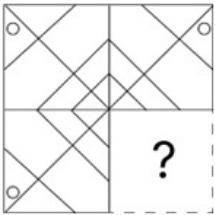
Select the figure from the options that can replace the question mark (?) and complete the given pattern.
- Aditi walks 18 m South from her home to reach a grocery store. From there, she turns right and walks 12 m to reach a bakery. She then takes a left turn and walks 6 m to reach a bookstore. From the bookstore, she walks 24 m North to reach a clinic, then turns left and walks 12 m. In which direction and how far is her home from her final position?
- A car travels 50 km West, then turns around and travels 30 km East. What is the car's final position relative to its starting point?
- A man goes 12 km North, turns East and walks 5 km, turns South and walks 3 km, then turns West and walks 5 km. How far is he from the starting point?
In morning after sunrise, a boy rode his bicycle 4 km towards North then he took right turn and rode 6 km then he took left turn and rode 5 km to reach his school. In which direction the starting point is with respect to location of School?
Town P is to the East of town Q. Town R is to the South of town P. Town T is to the West of town R. Town P is towards which direction of town T?
In a certain coded language.
@ means East
# means West
means North
! means South
For example,
*@means North-East
Mr. Rajan started from his house and moves towards East. After walking for a distance of 20 m, he took aright turn, and walks for 20 m. Then he took a left turn and walk for 15 m. After that he took a right turn and walked 15 m more towards his office. In which direction Mr. Rajan facing now?
Important Questions from Direction and Distance
What is the direction of U with respect to P?
What is the shortest distance between R and T?
If a person walks 3m towards the North from point V, takes a right turn and walks for another 15m, which of the following points would he reach?
In which direction is Amit facing at point F?
What is the distance between the starting point and the end point?



