
In the given figure, A, B and C are three points on a circle. If AB = 3 cm and BC = 4 cm, then the measure of the radius of the circle is: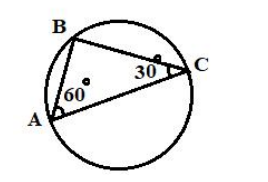
$\frac{5}{2}cm$
To find the radius of the circle given the points \(A\), \(B\), and \(C\) on the circle with \(AB = 3 \text{ cm}\) and \(BC = 4 \text{ cm}\), we must consider the properties of a circle and the triangle formed by these points.
Assuming \(A\), \(B\), and \(C\) are points on the circle, the triangle \(ABC\) forms a right-angled triangle inscribed in the circle, with the hypotenuse as the diameter of the circle. This is based on Thales' theorem.
Since \( \angle ACB = 90^\circ \), we can treat \(AC\) as the hypotenuse of the triangle \(ABC\). Using the Pythagorean theorem:
\(AC^2 = AB^2 + BC^2\)
Substitute the given values:
\(AC^2 = 3^2 + 4^2 = 9 + 16 = 25\)
Therefore, \(AC = \sqrt{25} = 5 \text{ cm}\).
Since \(AC\) is the diameter of the circle (from \(A\) to \(C\)), the radius \(r\) is half of the diameter.
\(r = \frac{AC}{2} = \frac{5}{2} \text{ cm}\)
Thus, the measure of the radius of the circle is \(\frac{5}{2} \text{ cm}\).
The correct answer is \(\frac{5}{2} \text{ cm}\).
Similar Questions
- Find the ratio of the measure of an angle of a regular pentagon to that of a regular octagon.
- The area of an isosceles right angle triangle is $81 \text{ cm}^2$ . Find the length of its hypotenuse.
- In a polygon, the sum of the interior angles is triple the sum of the exterior angles. The number of sides is:
- What is the measure of each exterior angle of a regular octagon?
- The difference between the interior and exterior angles at a vertex of a regular polygon is $140^\circ$. The number of sides of the polygon is:
- The ratio of an interior angle to the exterior angle of a regular polygon is $4:1$. The number of sides of the polygon is:
- If the interior angles of a pentagon are in the ratio 1 : 3 : 5 : 7 : 11, then the measure of the smallest interior angle is:
- If the side of an equilateral triangle is 2 cm, then find the area and the altitude of the triangle.
- Two sides of a triangle are of lengths 4 cm and 10 cm. If the length of the third side is $a$ cm, then:
- If the difference between the interior and exterior angles of a polygon is $36^\circ$, then find the number of sides in the polygon.
Important Questions from Geometry
If the angles of a triangle are in the ratio of 2:3:4, then the difference of the measure of greatest angle and smallest angle is
In ΔABC, ∠A = 90°, AD ┴ BC and AD = BD = 2 cm. The length of CD is
How many lines of symmetry does a rectangle have?
The number of diagonals in each face a cube is
Which of the following is/are the geometric figures with the line of symmetry?
I. Rectangle
II. Isosceles triangle



