
INDIA Word Permutation Analysis
We need to find the number of ways to arrange the letters of the word INDIA so that the vowels appear only in the odd positions. Let's first understand the components of the word INDIA:
- The word INDIA has 5 letters. We will assume these 5 letters are distinct for the purpose of this permutation calculation (e.g., I, N, D, R, A).
- Vowels in the word are: I, A. There are 2 vowels.
- Consonants in the word are: N, D, R. There are 3 consonants.
Identifying Available Positions
A 5-letter arrangement requires 5 positions. We need to identify which ones are odd and which are even:
- The positions are numbered 1, 2, 3, 4, 5.
- The odd positions are 1, 3, and 5. There are 3 odd positions available.
- The even positions are 2 and 4. There are 2 even positions available.
Vowel Placement Calculation
The main condition is that the vowels must be placed in the odd positions. We have 2 vowels (I, A) and 3 available odd positions (1, 3, 5).
- We need to find the number of ways to arrange these 2 vowels within the 3 odd positions. Since the order of vowels matters (e.g., IA is different from AI), this is a permutation problem.
- The formula for permutations is \( P(n, k) = \frac{n!}{(n-k)!} \), where \( n \) is the total number of available positions, and \( k \) is the number of items to arrange.
- In this scenario, \( n = 3 \) (number of odd positions) and \( k = 2 \) (number of vowels).
- Let's calculate the number of ways: \( P(3, 2) = \frac{3!}{(3-2)!} \)
- \( P(3, 2) = \frac{3!}{1!} \)
- Since \( 3! = 3 \times 2 \times 1 = 6 \) and \( 1! = 1 \), the calculation becomes: \( P(3, 2) = \frac{6}{1} = 6 \)
Therefore, there are 6 distinct ways to arrange the vowels I and A within the available odd positions (1st, 3rd, 5th).
Consonant Placement Context
To complete the arrangement, the 3 consonants (N, D, R) need to be placed in the remaining \( 5 - 2 = 3 \) positions. These remaining positions consist of the two even slots (2nd, 4th) and the one odd slot that was not occupied by a vowel. The number of ways to arrange these 3 consonants in the 3 remaining spots is \( P(3, 3) = 3! = 6 \). The total number of permutations for the word INDIA with vowels in odd positions would be the product of the ways to arrange vowels and the ways to arrange consonants (\( 6 \times 6 = 36 \)). However, the calculation specifically for placing vowels in odd positions yields 6.
Similar Questions
- Three perfect dice \(D_1, D_2\) and \(D_3\) are rolled. Let \(x, y\) and \(z\) represent the numbers on \(D_1, D_2\) and \(D_3\) respectively. What is the number of possible outcomes such that \(x < y < z\)?
- A man has \(7\) relatives (\(4\) women and \(3\) men). His wife also has \(7\) relatives (\(3\) women and \(4\) men). In how many ways can they invite \(3\) women and \(3\) men so that \(3\) of them are man's relatives and \(3\) of them are his wife's relatives?
- A triangle \(PQR\) is such that \(3\) points lie on the side \(PQ\), \(4\) points on \(QR\) and \(5\) points on \(RP\) respectively. Triangles are constructed using these points as vertices. What is the number of triangles so formed ?
- How many four-digit natural numbers are there such that all of the digits are even?
- How many 4-digit numbers are there having all digits as odd?
- The letters of the word EQUATION are arranged in such a way that all vowels as well as consonants are together. How many such arrangements are there?
- What is the maximum number of possible points of intersection of four straight lines and a circle (intersection is between lines as well as circle and lines)?
- What is the sum of all four digit numbers formed by using all digits \(0, 1, 4, 5\) without repetition of digits?
- In how many ways can a student choose \((n-2)\) courses out of \(n\) courses if 2 courses are compulsory \((n > 4)\)?
If the number of selections of r as well as (n + r) things from 5n different things are equal, then what is the value of r?
Important Questions from Permutation and Combination
The following figure is made with nine squares of length 1 cm each.
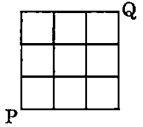
A student is standing at point P. The total number of shortest paths to reach point Q from point P, if the student walks along the boundaries of the squares only, is:
Consider the following statements (all the angles are measured in degrees) :
1. If two supplementary angles are $4x + 40$ and $10x$, then $x$ is;
2. The complementary angle of $\frac{4}{5} \times 45$ is :
3. If two complementary angles are in the ratio of $4 : 5$, then the smallest angle is :
Which of the following is correct?
Codes:
1 2 3- There are 40 persons in a palace. If every person shakes hands with every other person, what will be the total number of handshakes?
- How many words can be formed with or without meaning by using all letters of the word DELHI?
A rectangular wall is divided into four squares of equal size where there are two rows each having two squares. The top left square is coloured with green. If, including green, there are three colours available and each square is coloured using any one of these three colours such that no two adjacent squares get painted with the same colour; then how many colour combinations are possible ?



