
In angular measurement, one radian is equivalent to ________ degree (approximately).
57.27
Understanding Angular Measurement: Radians and Degrees
Angular measurement is fundamental in many fields, including mathematics, physics, engineering, and navigation. There are primarily two common units used to measure angles: degrees and radians. This question asks about the relationship between these two units, specifically how many degrees are equivalent to one radian.
Connecting Radians and Degrees
The relationship between radians and degrees is defined by the circle. A full circle represents 360 degrees, and the circumference of a circle is given by the formula \(2\pi r\), where \(r\) is the radius. One radian is defined as the angle subtended at the center of a circle by an arc whose length is equal to the radius of the circle. A full circle, with a circumference of \(2\pi r\), contains \(2\pi\) radians.
Therefore, the relationship is:
- 360 degrees = \(2\pi\) radians
We can simplify this by dividing both sides by 2:
- 180 degrees = \(\pi\) radians
This is the key conversion formula between degrees and radians.
Calculating 1 Radian in Degrees
To find out how many degrees are in one radian, we can rearrange the conversion formula (180 degrees = \(\pi\) radians). We need to isolate 'radian' on one side. Let's divide both sides of the equation by \(\pi\):
\(\frac{180 \text{ degrees}}{\pi} = \frac{\pi \text{ radians}}{\pi}\)
This gives us:
\(1 \text{ radian} = \frac{180}{\pi} \text{ degrees}\)
Now, we need to use an approximate value for \(\pi\). A common approximation for \(\pi\) is 3.14159. Let's perform the division:
\(1 \text{ radian} \approx \frac{180}{3.14159} \text{ degrees}\)
\(1 \text{ radian} \approx 57.2958 \text{ degrees}\)
Looking at the options provided, 57.27 degrees is the closest value to our calculation of approximately 57.2958 degrees. The slight difference comes from the approximation used for \(\pi\).
Comparing Options for 1 Radian Equivalent
Let's look at the given options:
- 65.27 degrees
- 57.27 degrees
- 90 degrees
- 180 degrees
Based on our calculation, 1 radian is approximately 57.2958 degrees. The option that is closest to this value is 57.27 degrees.
| Radians | Degrees |
|---|---|
| \(2\pi\) | 360 |
| \(\pi\) | 180 |
| \(\frac{\pi}{2}\) | 90 |
| \(\frac{\pi}{3}\) | 60 |
| \(\frac{\pi}{4}\) | 45 |
| 1 | \(\approx 57.296\) |
The option 57.27 degrees is the widely accepted approximate value for one radian when expressed in degrees.
Revision Table: Angular Measurement Units
| Concept | Description |
|---|---|
| Degree | A unit of angular measure, where a full rotation is 360 degrees (\(360^\circ\)). |
| Radian | A unit of angular measure, where a full rotation is \(2\pi\) radians. One radian is the angle subtended by an arc equal in length to the radius. |
| Conversion | The primary relationship is 180 degrees = \(\pi\) radians. |
| 1 Radian to Degree | \(1 \text{ radian} = \frac{180}{\pi} \text{ degrees} \approx 57.2958 \text{ degrees}\). Often approximated as 57.3 degrees or 57.27 degrees depending on required precision. |
| 1 Degree to Radian | \(1 \text{ degree} = \frac{\pi}{180} \text{ radians} \approx 0.01745 \text{ radians}\). |
Additional Information: Why Use Radians?
While degrees are intuitive because a full circle is a 'nice' number like 360, radians have significant advantages in higher mathematics and physics, particularly in calculus. Many formulas involving trigonometric functions are simpler and more elegant when angles are expressed in radians. For example, the derivative of \(\sin(x)\) is \(\cos(x)\) when \(x\) is in radians, but it would involve a conversion factor if \(x\) were in degrees.
The definition of a radian being related to the radius and arc length makes it a more natural unit in contexts involving circular motion, arc length (\(s = r\theta\), where \(\theta\) is in radians), and sector area (\(A = \frac{1}{2}r^2\theta\), where \(\theta\) is in radians).
Similar Questions
How many triangles are present in the below figure?
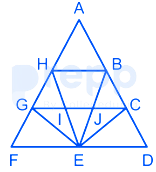
- In Δ ABC, AB = 10 cm. ∠ A is bisected internally to intersect BC at D. BD = 6 cm and DC = 7.5 cm. What is the length of CA?
The length of a minor arc is 2/9 of the circumference of the circle. Write the measure of the angle (in degrees) subtended by the centre of the circle.
Important Questions from Lines and Angles
Two parallel lines are intersected by a transversal, the corresponding angles are:
If l, m, n are lines such that, l is parallel to n and m is parallel to n, then, ______
There are three points P, Q and R on a straight line such that PQ : QR = 3 : 5. If n is the number of possible values of PQ : PR, then what is n equal to ?
Two cars start from a point at the same time and travel on two different roads at right angles to each other. Their speed is 18 km/h and 72 km/h respectively. What will be the distance between them after 6 seconds?
Express 65° in radian :



