
The length of a minor arc is 2/9 of the circumference of the circle. Write the measure of the angle (in degrees) subtended by the centre of the circle.
80
Understanding Arc Length and Central Angle
This question asks us to find the measure of the angle subtended at the center of a circle by a minor arc, given that the length of this minor arc is a specific fraction of the circle's circumference. The key relationship we need to use connects the ratio of the arc length to the circumference with the ratio of the central angle to the total angle in a circle (360 degrees).
Relating Arc Length, Circumference, and Central Angle
The length of an arc is directly proportional to the measure of the angle it subtends at the center of the circle. The full circumference corresponds to a central angle of 360 degrees. Therefore, the ratio of the arc length to the circumference is equal to the ratio of the central angle (in degrees) to 360 degrees.
Mathematically, this can be written as:
$$ \frac{\text{Arc Length}}{\text{Circumference}} = \frac{\text{Central Angle (in degrees)}}{360^\circ} $$
Solving the Problem
We are given that the length of the minor arc is $\frac{2}{9}$ of the circumference of the circle.
So, we have:
$$ \frac{\text{Arc Length}}{\text{Circumference}} = \frac{2}{9} $$
Now, we can substitute this ratio into our relationship formula:
$$ \frac{2}{9} = \frac{\text{Central Angle (in degrees)}}{360^\circ} $$
To find the measure of the central angle, we need to isolate it. We can do this by multiplying both sides of the equation by $360^\circ$:
$$ \text{Central Angle (in degrees)} = \frac{2}{9} \times 360^\circ $$
Now, let's calculate the value:
$$ \text{Central Angle (in degrees)} = 2 \times \frac{360^\circ}{9} $$
$$ \text{Central Angle (in degrees)} = 2 \times 40^\circ $$
$$ \text{Central Angle (in degrees)} = 80^\circ $$
Thus, the measure of the angle subtended by the minor arc at the center of the circle is 80 degrees.
Understanding the Terms
- Minor Arc: A minor arc is an arc of a circle that is less than a semicircle (less than 180 degrees).
- Circumference: The circumference is the total distance around the circle. It is equal to $2\pi r$, where $r$ is the radius.
- Central Angle: A central angle is an angle whose vertex is the center of the circle and whose sides are radii intersecting the circle at two distinct points. The measure of the central angle is equal to the measure of the intercepted arc.
| Relationship | Formula |
|---|---|
| Arc Length to Circumference Ratio | $$ \frac{\text{Arc Length}}{\text{Circumference}} $$ |
| Central Angle to Full Circle Angle Ratio | $$ \frac{\text{Central Angle}}{360^\circ} $$ |
| Equating the Ratios | $$ \frac{\text{Arc Length}}{\text{Circumference}} = \frac{\text{Central Angle}}{360^\circ} $$ |
Final Calculation Steps
- Identify the given information: Arc Length / Circumference = 2/9.
- Recall the relationship: (Arc Length / Circumference) = (Central Angle / 360°).
- Substitute the given ratio: 2/9 = Central Angle / 360°.
- Solve for the Central Angle: Central Angle = (2/9) * 360°.
- Calculate the value: Central Angle = 80°.
Revision Table: Arc Length and Central Angle
| Concept | Description | Relationship to Central Angle ($\theta$) |
|---|---|---|
| Arc Length (L) | Distance along the curved edge of an arc. | $$ L = \frac{\theta}{360^\circ} \times C = \frac{\theta}{360^\circ} \times 2\pi r $$ (where C is circumference, r is radius, $\theta$ in degrees) |
| Circumference (C) | Total distance around the circle. | Corresponds to $360^\circ$ central angle. $$ C = 2\pi r $$ |
| Central Angle ($\theta$) | Angle at the circle's center subtending the arc. | Determines the fraction of the circle represented by the arc and sector. |
Additional Information: Sector Area
Similar to how arc length relates to circumference and the central angle, the area of the sector formed by an arc and the center relates to the total area of the circle and the central angle.
The relationship is:
$$ \frac{\text{Area of Sector}}{\text{Area of Circle}} = \frac{\text{Central Angle (in degrees)}}{360^\circ} $$
Since the Area of Circle is $\pi r^2$, we can write the Area of Sector as:
$$ \text{Area of Sector} = \frac{\text{Central Angle (in degrees)}}{360^\circ} \times \pi r^2 $$
This shows that the central angle plays a crucial role in determining both the length of the arc and the area of the sector it defines.
Similar Questions
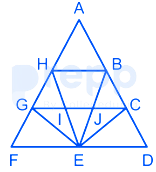
How many triangles are present in the below figure?
In angular measurement, one radian is equivalent to ________ degree (approximately).
- In Δ ABC, AB = 10 cm. ∠ A is bisected internally to intersect BC at D. BD = 6 cm and DC = 7.5 cm. What is the length of CA?
Important Questions from Lines and Angles
Two parallel lines are intersected by a transversal, the corresponding angles are:
If l, m, n are lines such that, l is parallel to n and m is parallel to n, then, ______
There are three points P, Q and R on a straight line such that PQ : QR = 3 : 5. If n is the number of possible values of PQ : PR, then what is n equal to ?
Two cars start from a point at the same time and travel on two different roads at right angles to each other. Their speed is 18 km/h and 72 km/h respectively. What will be the distance between them after 6 seconds?
Express 65° in radian :



