
Ratio Problem: Solving for (x - y) : (x + y)
This problem involves working with ratios and algebraic expressions. We are given the ratio between two variables, \(x\) and \(y\), and asked to find a new ratio involving expressions of \(x\) and \(y\). Let's break down the steps to find the solution.
Understanding the Given Ratio
We are given that the ratio \(x : y\) is equal to \(8:3\). This can be written mathematically as:
\( \frac{x}{y} = \frac{8}{3} \)
This means that for some non-zero constant \(k\), we can express \(x\) and \(y\) as:
- \(x = 8k\)
- \(y = 3k\)
Using this representation helps us work with the variables in the subsequent steps.
Calculating the New Expressions
The question asks for the ratio \((x - y) : (x + y)\). We need to find the values of the expressions \((x - y)\) and \((x + y)\) using our representations of \(x\) and \(y\).
- Calculating \((x - y)\): Substitute \(x = 8k\) and \(y = 3k\) into the expression \((x - y)\): \((x - y) = 8k - 3k = 5k\)
- Calculating \((x + y)\): Substitute \(x = 8k\) and \(y = 3k\) into the expression \((x + y)\): \((x + y) = 8k + 3k = 11k\)
Finding the Final Ratio
Now we have the values for both parts of the required ratio:
- \((x - y) = 5k\)
- \((x + y) = 11k\)
The ratio \((x - y) : (x + y)\) can be written as:
\( (x - y) : (x + y) = 5k : 11k \)
To simplify this ratio, we can divide both terms by the common factor \(k\) (assuming \(k \neq 0\)):
\( \frac{5k}{11k} = \frac{5}{11} \)
Therefore, the ratio \((x - y) : (x + y)\) simplifies to \(5:11\).
Conclusion
Based on the calculations, when \(x : y = 8:3\), the ratio \((x - y) : (x + y)\) is found to be \(5:11\).
Similar Questions
- An amount is divided between two friends in the ratio 4: 7. If the second part is ₹6 more than the first, then the difference in amount between two friends is:
- If (4x + 5) : (3x + 11) = 13:17, then (5x + 4) : (4x - 1) =?
- If \(4/9 : x = 2/3 : 16/81\), then \(x = ?\)
- If (4x + 5) : (3x + 11) = 13:17, then (5x + 4) : (4x - 1) = ?
If 11.6: x :: x: 2.9, and x > 0, then find the value of x.
Two plumbers, X and Y, are paid a total of ₹770 per day by their employer. If X is paid 140% of the sum paid to Y, then how much is Y paid (in ₹, rounded off to two decimal places) per day?
A workshop mixes coolant concentrate and water in a 3:2 ratio for a machine cooling system. If the total mixture required is 25 liters, how many liters of coolant concentrate are required?
Given the ratio 3:4::6:8, which operation verifies the proportion?
If a : b = 3 : 2 and b : c = 4 : 5, then a : b : c = ?
Study the following graph and answer the given question.
The graph shows the height of five students in a class.
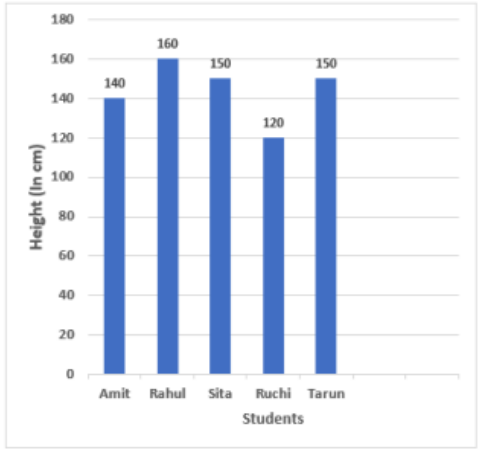
What is the respective ratio between the height of Amit and the height of Rahul?
Important Questions from Ratio and proportion
- An amount is divided between two friends in the ratio 4: 7. If the second part is ₹6 more than the first, then the difference in amount between two friends is:
- If the third proportional of 9 and 60 be x, then what is the value of x?
- If 36% of first number is equal to four-sevenths of second number, what is the ratio of first number to the second number?
- A, B and C invest a sum in the ratio of 61 : 43 : 90, respectively. If they earned a total profit of ₹2,910 at the end of the year, then what is the difference between share of B and C?
- The average price of three items of furniture is ₹16,050. If their prices are in the ratio 3 : 5 : 7, the price of the cheapest item (in ₹) is:



