
If the sum of lengths of two adjacent sides of a parallelogram is 12 cm, then the perimeter of the parallelogram is:
24 cm
To determine the perimeter of a parallelogram, we use the property that opposite sides are equal in length. If the sum of the lengths of two adjacent sides of the parallelogram is 12 cm, we can let these sides be \( a \) and \( b \). Thus, \( a + b = 12 \) cm.
The perimeter of a parallelogram is given by the formula:
\[ P = 2(a + b) \]
Substituting the given sum of adjacent sides into the formula, we have:
\[ P = 2(12) = 24 \text{ cm} \]
Therefore, the perimeter of the parallelogram is 24 cm.
Similar Questions
- The volume of a wall that is 5 times as high as it is broad and 8 times as long as it is high is 12.8 cubic meters. Find the breadth of the wall.
- If the radius of a sphere is increased by 2 cm, then its surface area increases by 704 cm\(^2\). Using \(\pi = \frac{22}{7}\), find the radius of the sphere after the increase.
- The volume of a solid cylinder is 5,236 cm$^3$ and its height is 34 cm. What is the total surface area of the solid cylinder? $\left(\text{Use } \pi = \frac{22}{7}\right)$
- Find the area of a regular hexagon whose side measures \(18\sqrt{2}\) cm. (Use \(\sqrt{3} = 1.73\))
The sides of the rectangle are in the ratio 8 : 10 and its perimeter is 90 cm. The area of this rectangle is:
Find the number of bricks, each measuring 24 cm × 12 cm × 8 cm, required to construct a wall 24 m long, 8 m high, and 60 cm thick if 10% of the wall is filled with mortar?
From a rectangular cardboard sheet of length 46 m and breadth 8 m, three circular plates of radii 3 m, 2 m and 1 m are cut out. If the area of the remaining part of the cardboard sheet is equal to the area of a square, then find the length of each side of the square (use π = 22/7).
In a workshop calculation, you need to find the side of a square base with an area of 64 cm2. What is the correct length?
Calculate the area of an irregular plot using the Trapezoidal Rule, given the offsets are 2 m, 4 m, 3 m, and 5 m at an equal spacing of 1 m.
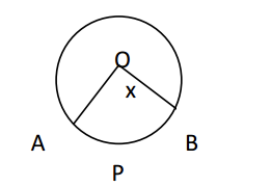
In figure 'o' is the centre of a circle. The area of sector OAPB is $\frac{5}{18}$ of the area of the circle find $x$.
Important Questions from Mensuration
- The volume of a wall that is 5 times as high as it is broad and 8 times as long as it is high is 12.8 cubic meters. Find the breadth of the wall.
- If the radius of a sphere is increased by 2 cm, then its surface area increases by 704 cm\(^2\). Using \(\pi = \frac{22}{7}\), find the radius of the sphere after the increase.
- What is the perimeter of an equilateral triangle with side 13 cm?
- The perimeter of a square is 76 m. Its area (in $m^2$) is:
- A cylindrical rod has an outer curved surface area of 1800 cm$^2$. If the length of the rod is 52 cm, then the outer radius (in cm) of the rod, correct to two places of decimal, is:
Take $\pi = \frac{22}{7}$



