
$1804 cm^2$
Cylinder Information
We are given the following details for a solid cylinder:
- Volume ($V$): $5,236 \text{ cm}^3$
- Height ($h$): $34 \text{ cm}
- Value of $\pi$: $\frac{22}{7}
Cylinder Radius Calculation
The formula for the volume ($V$) of a cylinder is $V = \pi r^2 h$. We use the given volume and height to find the radius ($r$).
Substitute the known values into the formula:
$ 5,236 = \frac{22}{7} \times r^2 \times 34 $Rearrange the equation to solve for $r^2$:
$ r^2 = \frac{5,236 \times 7}{22 \times 34} $ $ r^2 = \frac{36,652}{748} $ $ r^2 = 49 $Calculate the radius by taking the square root:
$ r = \sqrt{49} = 7 \text{ cm} $Total Surface Area Calculation
The formula for the total surface area (TSA) of a solid cylinder is $TSA = 2\pi r (r+h)$.
Substitute the calculated radius ($r = 7$ cm) and the given height ($h = 34$ cm) into the TSA formula:
$ TSA = 2 \times \frac{22}{7} \times 7 \times (7 + 34) $Simplify the expression:
$ TSA = 2 \times 22 \times (41) $ $ TSA = 44 \times 41 $ $ TSA = 1,804 \text{ cm}^2 $Final Answer
The total surface area of the solid cylinder is $1,804 \text{ cm}^2$.
Similar Questions
- The volume of a wall that is 5 times as high as it is broad and 8 times as long as it is high is 12.8 cubic meters. Find the breadth of the wall.
- If the radius of a sphere is increased by 2 cm, then its surface area increases by 704 cm\(^2\). Using \(\pi = \frac{22}{7}\), find the radius of the sphere after the increase.
- Find the area of a regular hexagon whose side measures \(18\sqrt{2}\) cm. (Use \(\sqrt{3} = 1.73\))
The sides of the rectangle are in the ratio 8 : 10 and its perimeter is 90 cm. The area of this rectangle is:
Find the number of bricks, each measuring 24 cm × 12 cm × 8 cm, required to construct a wall 24 m long, 8 m high, and 60 cm thick if 10% of the wall is filled with mortar?
If the sum of lengths of two adjacent sides of a parallelogram is 12 cm, then the perimeter of the parallelogram is:
From a rectangular cardboard sheet of length 46 m and breadth 8 m, three circular plates of radii 3 m, 2 m and 1 m are cut out. If the area of the remaining part of the cardboard sheet is equal to the area of a square, then find the length of each side of the square (use π = 22/7).
In a workshop calculation, you need to find the side of a square base with an area of 64 cm2. What is the correct length?
Calculate the area of an irregular plot using the Trapezoidal Rule, given the offsets are 2 m, 4 m, 3 m, and 5 m at an equal spacing of 1 m.
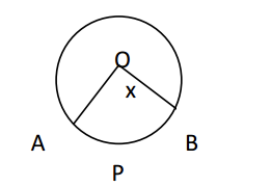
In figure 'o' is the centre of a circle. The area of sector OAPB is $\frac{5}{18}$ of the area of the circle find $x$.
Important Questions from Mensuration
- The volume of a wall that is 5 times as high as it is broad and 8 times as long as it is high is 12.8 cubic meters. Find the breadth of the wall.
- If the radius of a sphere is increased by 2 cm, then its surface area increases by 704 cm\(^2\). Using \(\pi = \frac{22}{7}\), find the radius of the sphere after the increase.
- What is the perimeter of an equilateral triangle with side 13 cm?
- The perimeter of a square is 76 m. Its area (in $m^2$) is:
- A cylindrical rod has an outer curved surface area of 1800 cm$^2$. If the length of the rod is 52 cm, then the outer radius (in cm) of the rod, correct to two places of decimal, is:
Take $\pi = \frac{22}{7}$



