
If the ratio of cost price and selling price be 10:11, then the profit percentage is
10%
To determine the profit percentage, we start with the ratio of the cost price (CP) to the selling price (SP), which is given as 10:11. Let's assume the cost price is 10x and the selling price is 11x. The profit (P) is the difference between the selling price and the cost price: P = SP - CP = 11x - 10x = x. The profit percentage is calculated using the formula: Profit Percentage = (Profit / Cost Price) × 100%. Therefore, substituting the values, we get: Profit Percentage = (x / 10x) × 100% = (1/10) × 100% = 10%. Thus, the profit percentage is 10%.
Similar Questions
By selling a bag at Rs. 230, profit of 15% is made. The selling price of the bag, when it is sold at 20% profit would be
- A furniture establishment initially disposes of a particular dining table for ₹X, thereby realizing a 25% profit margin. Subsequently, as a promotional strategy for a festive period, the marked price of this identical table is elevated to ₹Y. Following this adjustment, a special concession of 20% is applied to the newly established marked price. The inquiry then seeks to ascertain the resulting percentage profit generated by the store during this specific celebratory sales period. What is the percentage profit earned by the store during the festive sale?
A trader had 630 kgs of rice. He sold a part of it at 15% profit and the rest at 8% profit, so that he made a total profit of 12%. How much rice (in kgs) did he sell at 8% profit?
The value of (sin A + cosec A)² + (cos A + sec A)² is:
The following pie chart below shows the expenditure in book publishing by a publisher under various heads.
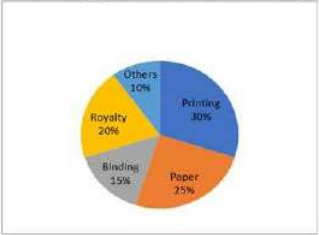
Given that marked price of a book is ₹270, what is the cost of paper to publish a single copy of the book if the marked price of a book is 20% more than its cost price?
Loss of 20% on selling price is equal to x% loss in cost price. What is x?
A shopkeeper marks his goods 50% more than the cost price and allows a discount of 25%. His profit or loss percentage is:
The selling price of 6 bananas is equal to the cost price of 8 bananas. Then the percentage of profit is
A merchant buys 25 litres of milk daily at the rate of ₹ 12 per litre. He mixes 5 litres of water in it and sells at the rate ₹ 10.40 per litre. His gain/loss is:
If 10% loss is made on selling price, then the rate of loss on the cost price will be:
Important Questions from Profit and Loss
- Veer bought some sharpeners at the rate of ₹180/dozen. He sold them for ₹23 each. His profit percentage is ____ % (rounded off to two decimal places).
- A shopkeeper lists the price of a fan at 60% above its cost price and offers a 15% discount on its list price. If he earns a profit of ₹117, then what is the list price (in ₹) of the fan?
- The marked price of an article is ₹800. It is sold at two successive discounts of 24% and 15%, respectively. Find the selling price of the article.
- A discount of 13% on the marked price of an article is allowed and then the article is sold for ₹348. The marked price of the article is:
- A trader claims to sell grains at a profit of 29%, but also dishonestly uses a weight which is 13% less than what is mentioned on it. Find the total percentage of profit earned by the trader. (Round off the answer to the nearest whole number.)



